Why AR teams look for HighRadius alternatives
HighRadius is a rule-based accounts receivable and treasury platform, first built in 2006, and most teams that look for alternatives are reacting to one of three things: long implementations, inbound billing queries it wasn't built to handle, or a preference for AI-native architecture over AI features added to older code. HighRadius itself does not publish implementation timelines, but our dedicated look at HighRadius implementation timelines and independent reviews on G2 both describe multi-module rollouts as demanding: one enterprise reviewer wrote that "multi product implementation is not for the faint of heart," while G2 reviews also show wide variance, with some smaller deployments going live quickly and others taking considerably longer as ERP count and workflow complexity increase.
The second driver is inbound handling. HighRadius, like every platform built before generative AI existed, was designed around outbound workflows: statements, dunning sequences, and payment reminders. None of the vendors in this comparison built before 2023 were designed to read and reply to an inbound billing query in natural language; that capability has had to be retrofitted, module by module, onto architecture that predates it.
The third driver is architecture itself. A platform "adding AI" to a rules engine built a decade or two ago is a different thing from a platform built after large language models existed, where agents read a conversation, decide what evidence is needed, and act, rather than routing a ticket down a pre-set decision tree. That distinction, not vendor age alone, is what separates the AI-native row in the table below from the rest.
How we compared HighRadius alternatives
We evaluated each HighRadius alternative on five criteria: whether it handles inbound billing queries end to end, whether its AI is agent-native or bolted onto a rules engine, stated or observed implementation speed, whether pricing is public, and which AR sub-problem (billing support, collections, cash application, disputes, or full order-to-cash) it is actually built to solve. We did not score vendors on features they don't claim to offer; a focused collections tool like Chaser is not weaker than a full suite like Esker, it is solving a narrower problem, and the table below is organised so you can match the tool to the problem rather than rank tools in the abstract.
Every pricing and product claim in the table and vendor sections below was checked directly against the vendor's own site on 19 August 2026, except where noted otherwise. Where a vendor's public pages didn't disclose pricing, we say so rather than guessing.
HighRadius alternatives compared
Platform | Category | Best for | Inbound query handling | Implementation | Pricing |
|---|
Paraglide | AI-native, agent-built | Teams whose bottleneck is the inbound billing conversation | Yes, full 2-way conversation across languages | Go live in 3 days, start collecting in 7 | Not publicly listed, quote-based |
Esker | Order-to-cash suite (Gen 1) | Broad, document-heavy O2C across credit, invoicing, cash application, deductions, collections | Limited, workflow-routed | Not publicly stated; multi-module | Not publicly listed, quote-based |
Sidetrade | AI-augmented collections (Gen 1) | Predictive collections prioritisation and credit risk scoring | Limited | Not publicly stated | Not publicly listed, quote-based |
Quadient AR (formerly YayPay) | Mid-market collections (Gen 2) | Mid-sized AR teams wanting collections automation without enterprise scope | No | Not publicly stated | Not publicly listed at the URL checked |
Billtrust | Billing-led AR (Gen 1) | Invoicing and payment facilitation bundled with collections | Limited | Not publicly stated | Not publicly listed, quote-based |
Versapay | Collaborative AR (Gen 1) | Buyer-seller dispute resolution via a shared portal | Limited | Not publicly stated | Not publicly listed, quote-based |
Emagia | AI-augmented O2C suite (Gen 1) | Broad AR and credit automation with AI-assisted cash application | Limited | Not publicly stated | Not publicly listed, quote-based |
Gaviti | Mid-market collections (Gen 2) | Configurable dunning workflows, priced on usage not seats | No | Not publicly stated | Custom, usage-based (not per-seat) |
Tesorio | Cash forecasting and collections (Gen 2) | Treasury-adjacent teams wanting forecasting tied to collections | No | Not publicly stated | Not publicly listed, quote-based |
Chaser | Collections and dunning (Gen 2) | Smaller finance teams wanting transparent, low-commitment pricing | No | Not publicly stated | Public tiers from $259/month |
HighRadius itself is the baseline this table alternatives against: quote-based pricing, no published implementation timeline, and, per its own product pages, built around configurable modules rather than inbound conversation handling.
1. Paraglide — the AI-native alternative built for the inbound billing conversation
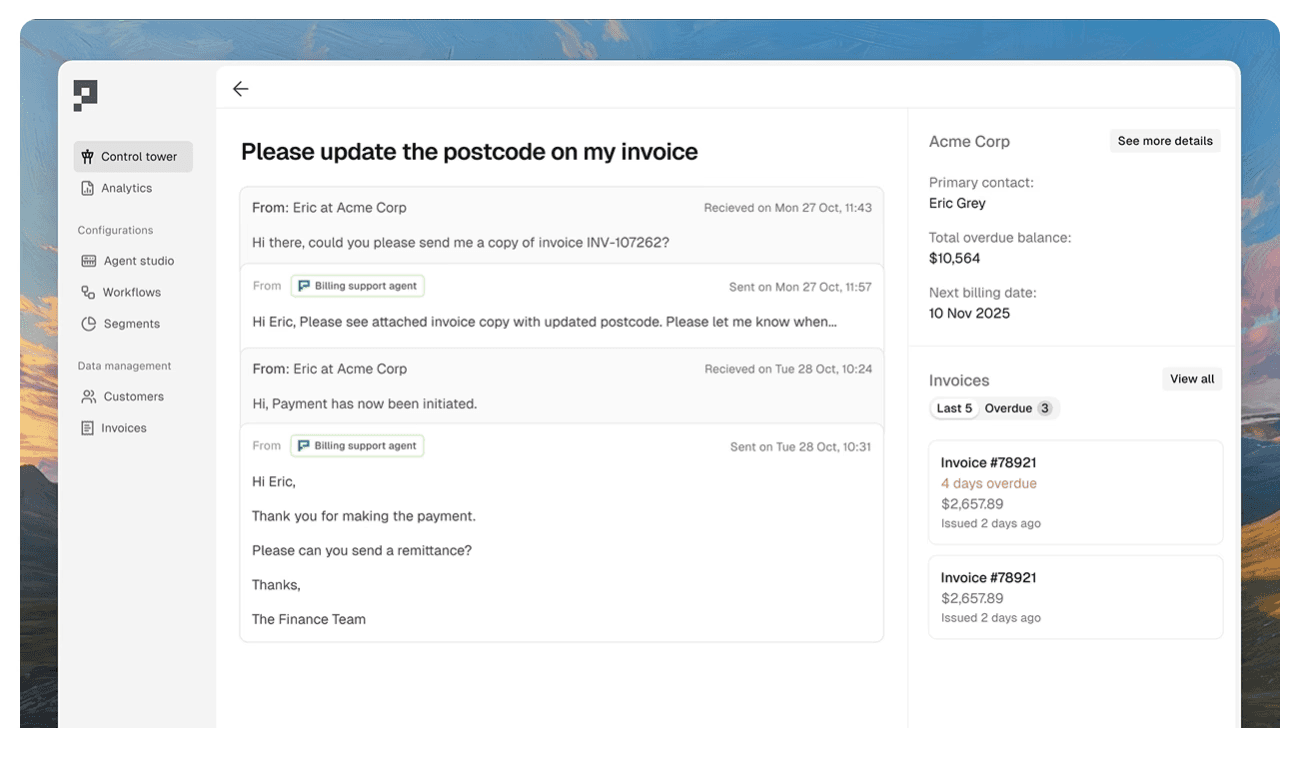
Paraglide is an AI-native accounts receivable platform built entirely on AI agents, not a legacy AR tool with AI features added, and it is the only platform in this comparison designed around handling the full two-way billing conversation rather than only sending outbound reminders. Where the Gen 1 and Gen 2 vendors above route an inbound reply back into someone's inbox for a human to answer, Paraglide's billing support agent reads the reply, in whichever language it arrived in, and responds directly, 24 hours a day.
Paraglide covers four other AR jobs beyond inbound queries, which matters because most teams switching off HighRadius are trying to consolidate tools, not add another point solution:
Billing support agent: resolves inbound invoice queries and disputes across email and ticketing systems, captures promise-to-pay dates and remittance details, and escalates only what genuinely needs a human.
Collection agent: manages the full two-way collections conversation (not just outbound reminders), including personalised outreach, reply handling, broken-promise follow-up, and multi-channel escalation across email, SMS and letters.
Reconciliation agent: reads remittances in any format (PDF, Excel, CSV, email, lockbox, even scanned documents) and matches the payments rule-based cash application tools reject, including wrong references, missing digits, short payments, and bulk transfers.
Disputes agent: detects disputes from tone and subject line, gathers context across systems, routes to the right approver, and chases until resolved.
Supplier portal agent: logs into supplier portals (Ariba, Coupa, Tungsten and others) to upload invoices, match PO numbers, resolve rejections, and download remittances, without breaking when a portal's interface changes.
Implementation is the other structural difference: Paraglide customers go live in three days and start collecting inside seven, against implementations HighRadius reviewers themselves describe as demanding across multiple modules and ERPs. See the full HighRadius vs Paraglide implementation comparison →
Book a demo of Paraglide's AR agents →
2. Esker — best for a broad, document-heavy order-to-cash suite
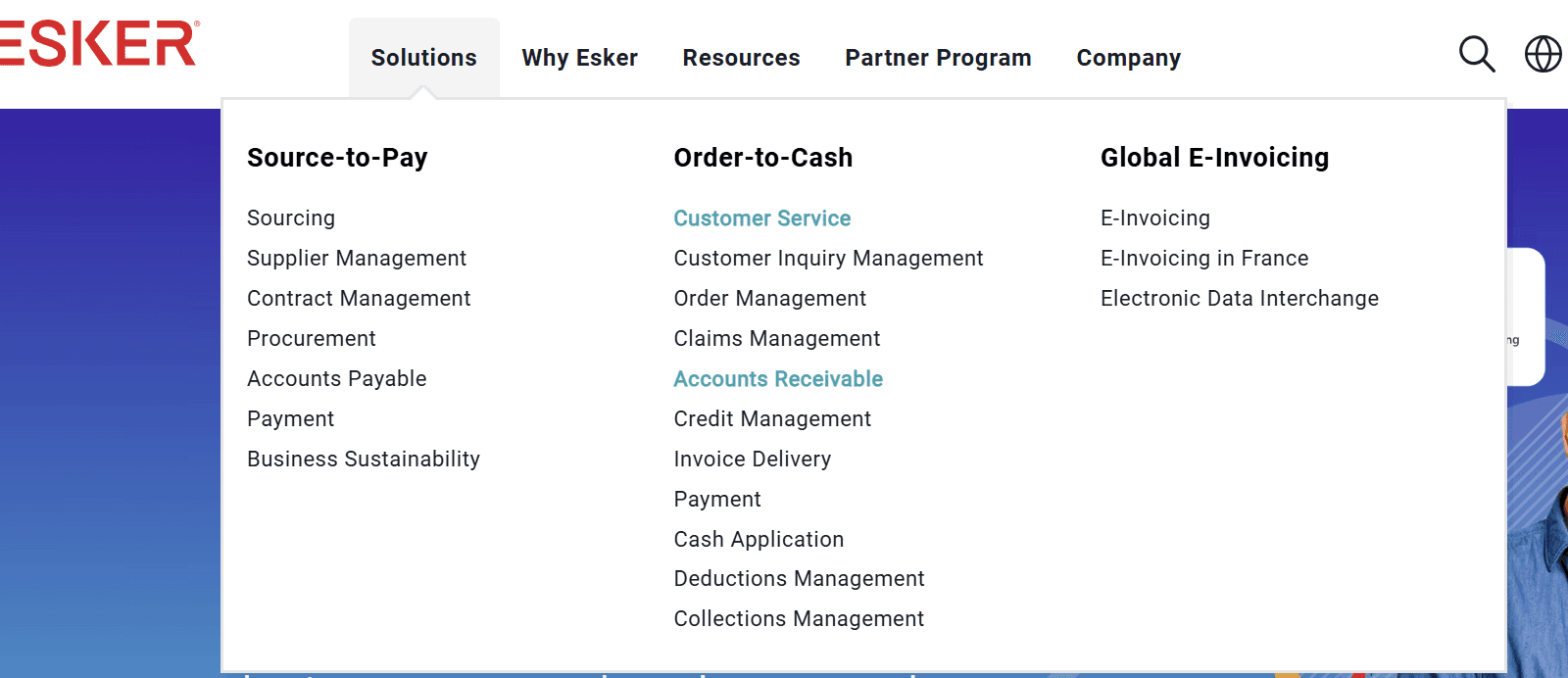
Esker is a Gen 1 order-to-cash suite covering credit management, invoice delivery, payment processing, cash application, deductions management and collections management under one platform, and it suits teams that want one broad enterprise vendor rather than a point solution. Esker's own site does not publish pricing; every path leads to "get in touch" or a demo request, consistent with the rest of the Gen 1 cohort.
Where Esker differs from Paraglide is architecture and scope of inbound handling: Esker's modules route and manage workflows, but the platform was not built around an agent reading and replying to a billing conversation in natural language. Teams whose main pain is document volume across the full order-to-cash cycle, not specifically the inbound query backlog, are the better fit for Esker. Read the full Esker alternatives comparison →
3. Sidetrade — best for predictive collections prioritisation

Sidetrade is a Gen 1 platform built around AI-augmented collections prioritisation and credit risk scoring, and it suits teams whose main need is deciding who to chase first, not automating the billing conversation itself. Pricing is not publicly listed; Sidetrade's site directs every path to a demo request.
Sidetrade's AI is applied to scoring and sequencing decisions within a workflow that a human or a rules engine still executes, rather than an agent handling the conversation end to end. Read the full Sidetrade alternatives comparison →
4. Quadient AR (formerly YayPay) — best for mid-market collections without enterprise scope
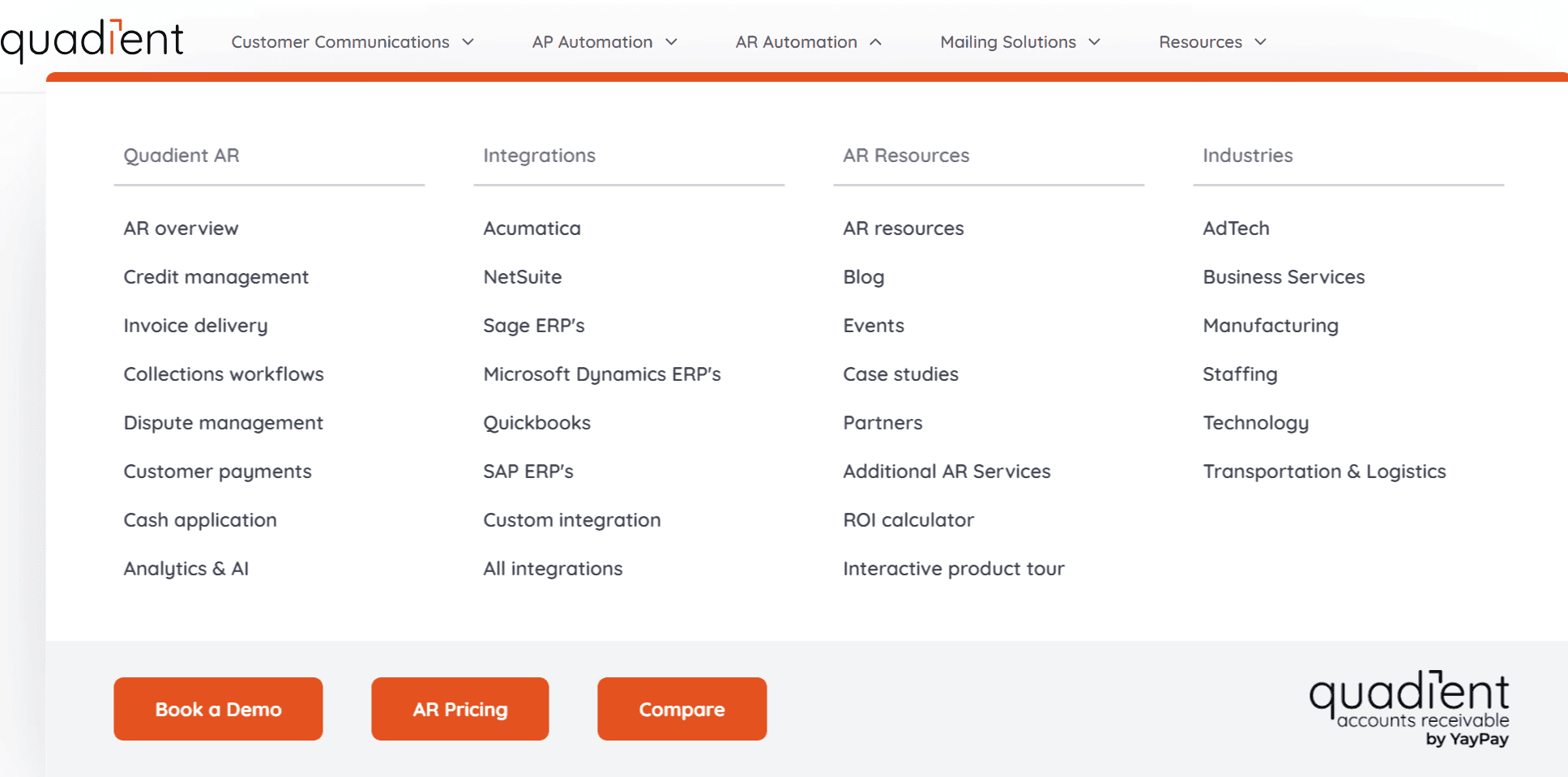
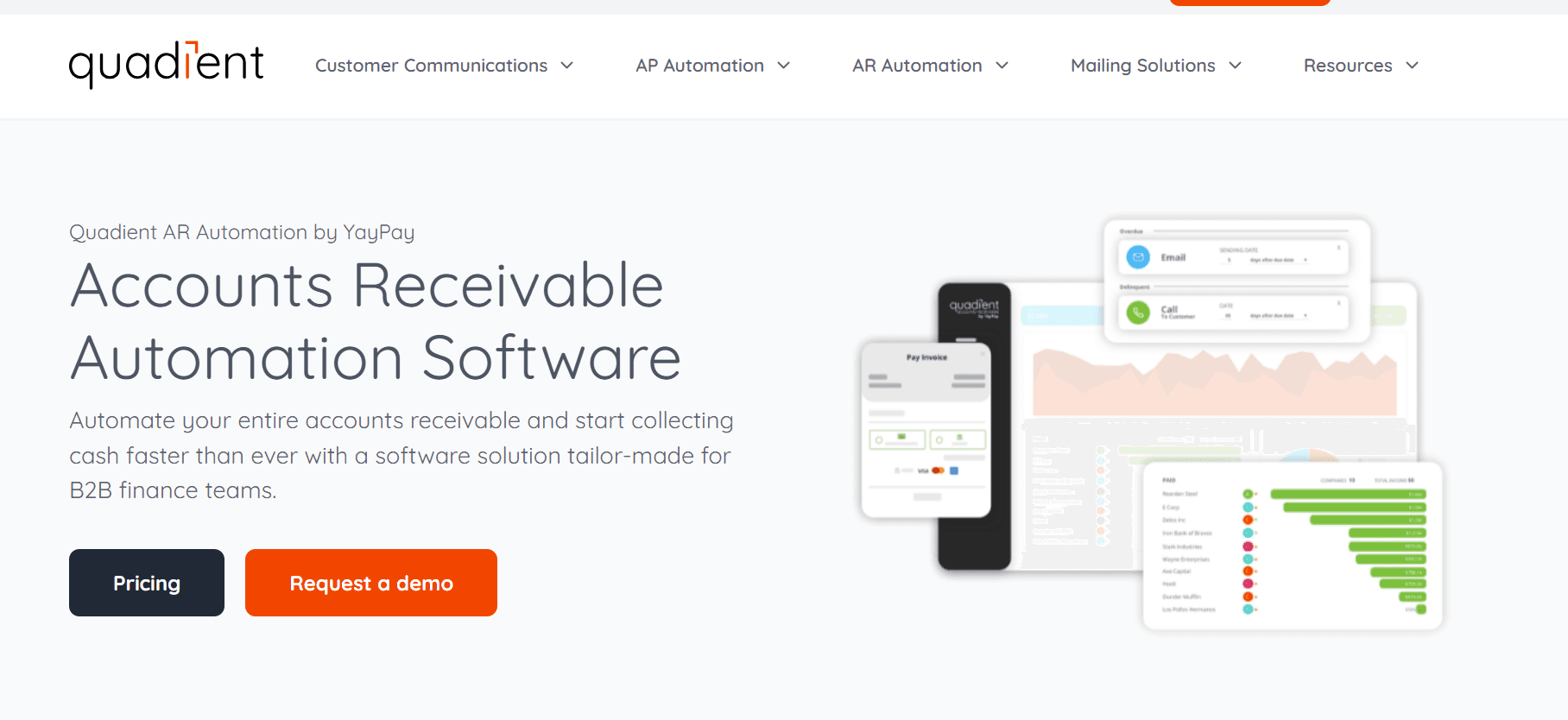
Quadient AR, formerly YayPay, is a Gen 2 collections and cash application platform aimed at mid-market finance teams who find enterprise suites like HighRadius oversized for their needs. We could not confirm current public pricing at the URL checked on this pass; treat pricing as quote-based until confirmed directly with Quadient.
Quadient AR automates collections workflows and reporting but, like the rest of Gen 2, does not handle inbound billing conversations as a two-way exchange. Read the full Quadient (YayPay) alternatives comparison →
5. Billtrust — best for billing-led AR with payment facilitation
Billtrust is a Gen 1 platform built around invoicing and payment facilitation, bundling billing, payment acceptance and collections into one product, and it suits teams whose priority is getting invoices out and paid rather than managing an inbound query queue. Pricing is not publicly listed; Billtrust's site consistently routes to "talk to an expert" rather than a rate card.
Billtrust's differentiator versus a broader O2C suite is its billing-and-payments core; collections and dispute handling sit alongside that core rather than being the platform's starting point, and inbound conversation handling is not a stated capability. Read the full Billtrust alternatives comparison →
6. Versapay — best for collaborative, portal-based dispute resolution
Versapay is a Gen 1 platform built around a collaborative AR portal where buyers and sellers resolve disputes and share remittance information directly, and it suits teams whose collections friction is mostly disputes rather than volume. Pricing is not publicly listed; the site directs every path to a demo or expert call.
The portal model is Versapay's real differentiator: instead of an agent handling the conversation, it gives both sides a shared workspace. That suits relationship-heavy B2B accounts but depends on customers actually adopting the portal, which is a different adoption curve to a billing agent that works inside a customer's existing inbox. Read the full Versapay alternatives comparison →
7. Emagia — best for AI-assisted cash application inside a broad AR suite
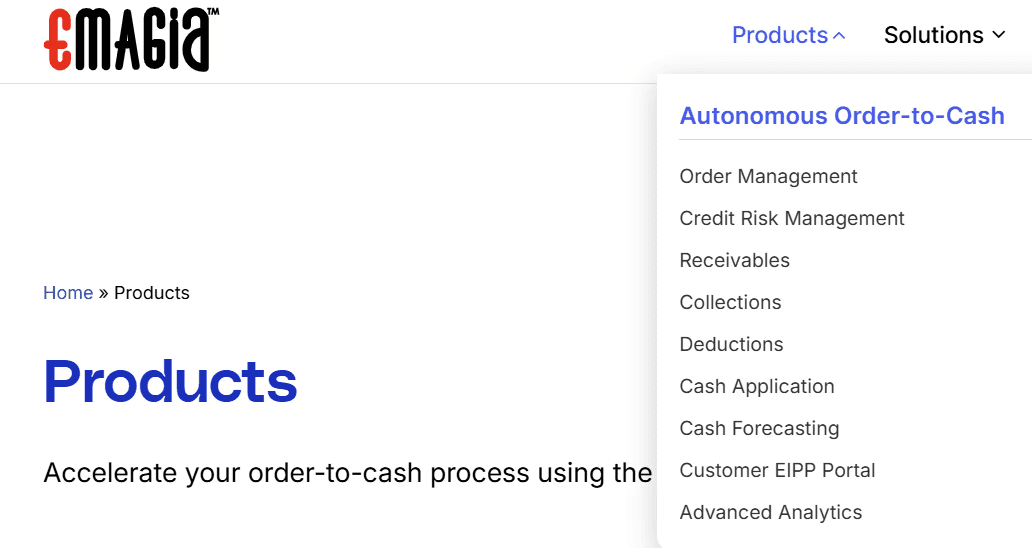
Emagia is a Gen 1 AR and credit automation suite that has added AI-powered cash application and collections features to a broader order-to-cash platform, and it suits teams that want one enterprise vendor with some machine-assisted matching already built in. Pricing is not publicly listed on Emagia's site.
The distinction worth understanding here is architectural, not a judgement of quality: Emagia's AI features sit on top of a platform designed before agentic AI existed, which is a different starting point to a platform built from day one on AI agents. Read the full Emagia alternatives comparison →
8. Gaviti — best for usage-based, configurable dunning workflows
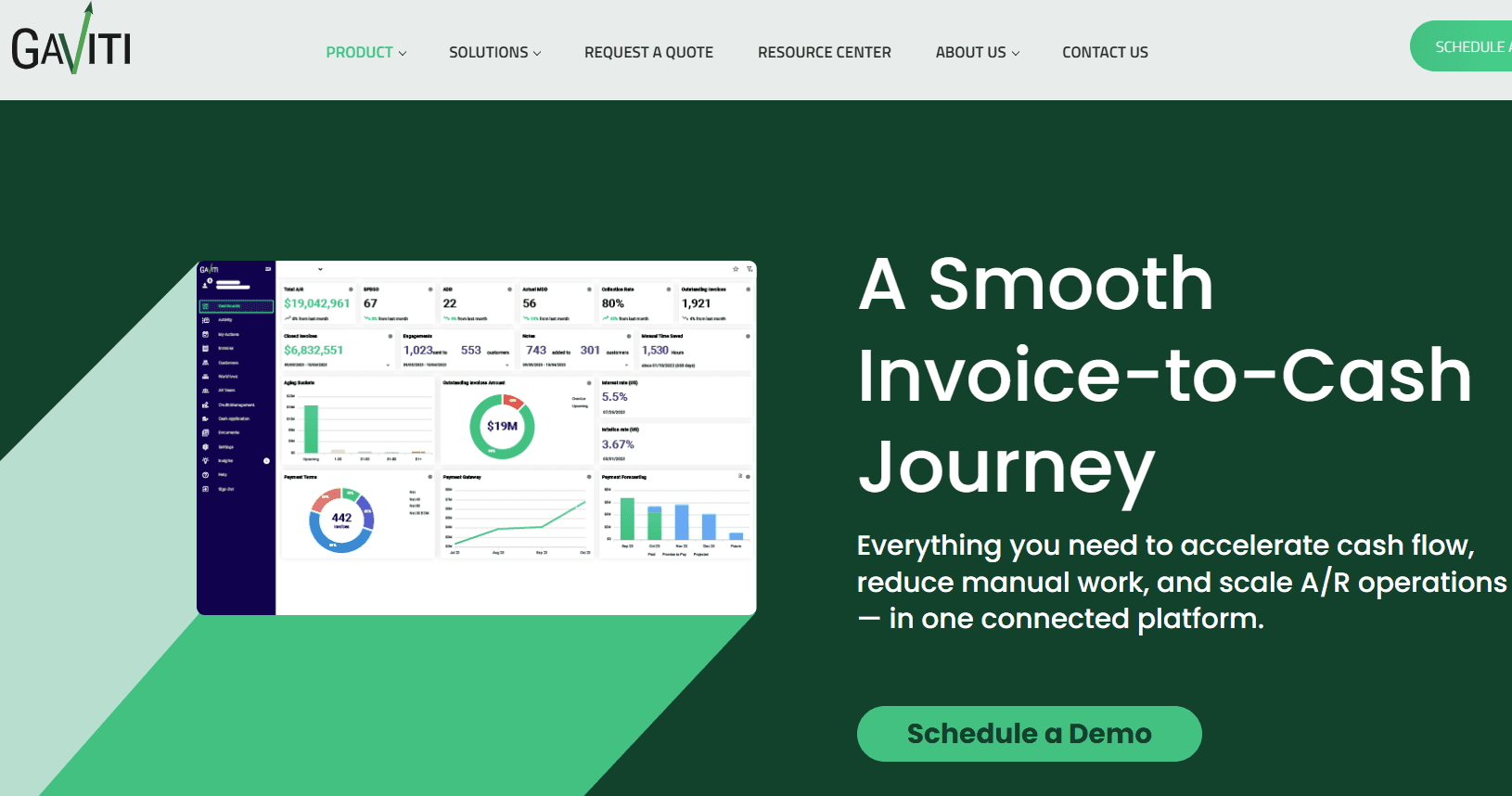
Gaviti is a Gen 2 mid-market collections platform priced on invoice usage rather than per seat, and it suits teams that want unlimited users and configurable workflows without a per-user cost creeping up as the team grows. Gaviti's own pricing page is explicit about the model: "Because every company's invoice volume, workflows and requirements are unique, Gaviti offers tailored pricing based on your usage, not per user," with no published dollar figures.
Gaviti automates dunning sequences and reporting, but, like the rest of Gen 2, does not handle an inbound reply as a natural-language conversation; a reply still needs a human to read and act on it. Read the full Gaviti alternatives comparison →
9. Tesorio — best for teams that want collections tied to cash forecasting
Tesorio is a Gen 2 platform that pairs collections automation with cash flow forecasting, and it suits treasury-adjacent teams who want visibility into future cash position alongside dunning. Pricing is not publicly listed; the site's primary call to action is "speak with a human" rather than a quote form or rate card.
Tesorio's forecasting angle is its main point of difference from the other Gen 2 tools here, but the collections layer itself works the same way as its peers: rule-based sequencing rather than an agent handling replies. Read the full Tesorio alternatives comparison →
10. Chaser — best for smaller finance teams that want transparent pricing

Chaser is a Gen 2 collections and dunning tool aimed at smaller finance teams, and it is the only vendor in this comparison with fully public pricing, published as four tiers from $259 a month. As of 19 August 2026, Chaser's own pricing page lists Compact from $259/month (4 users, 30 templates, 4 workflows) for businesses under $5m revenue, Core from $779/month (unlimited users and workflows) for businesses under $13m, Complete from $1,169/month (adds a dedicated account manager and forecasting) for businesses under $120m, and Custom pricing above that, with a 10% discount for annual billing.
That transparency is genuinely useful if your evaluation criteria include knowing the cost before a sales call, but Chaser's scope is narrower than the Gen 1 suites above: it automates outbound reminders and reply routing rather than reading and responding to an inbound conversation itself. Read the full Chaser alternatives comparison →
Other HighRadius alternatives worth knowing
Beyond the ten platforms compared in detail above, AR teams researching HighRadius alternatives also encounter Kolleno, Upflow, and a longer tail of smaller collections tools including Cevinio, EzyCollect, Creditpoint, Credithound, Satago and Debtor Daddy. Kolleno and Upflow are both Gen 2 rule-based collections platforms in the same broad category as Gaviti, Tesorio and Chaser; Peec AI's own citation data for this exact query shows both being surfaced by AI models alongside the ten reviewed above, which is why they're named here rather than omitted. The remaining names (Cevinio, EzyCollect, Creditpoint, Credithound, Satago, Debtor Daddy) are smaller, regionally focused, or dunning-only tools that tend to come up for specific segments, such as SMB-focused teams or particular geographies, rather than as broad HighRadius replacements.
None of the vendors named in this section change the core distinction this article makes: they are Gen 2 rule-based tools, not AI-native platforms, and none is built around handling an inbound billing conversation end to end.
Results AR teams report after switching
Paraglide customers who have switched report DSO reductions as high as 34% within weeks, not the months typically associated with legacy AR platform rollouts. These are individual customer outcomes, not guarantees, and are presented here exactly as published:
Customer | Result | Source |
|---|
Choco (Finance Director Tobias Pfleger) | 34% DSO reduction within 14 days | Paraglide collections agent page |
GetAccept (Finance Operations Manager Stephanie Cronqvist) | Reached inbox zero in the first week, from hundreds of open billing cases | Paraglide billing support agent page |
Spiideo (CFO Linda Canive) | 43% reduction in invoices aged over 30 days | Paraglide disputes page |
Gorilla Gasket (Owner Jerret Turner) | 38% reduction in overall ageing | Paraglide collections agent page |
For context on why AR specifically is where the money sits: The Hackett Group's U.S. Working Capital Survey, reported by PYMNTS Intelligence on 16 April 2026, found that $1.7 trillion remains trapped in excess working capital across large US companies, with accounts receivable accounting for the largest share, an estimated $600 billion opportunity. The same reporting cites Billtrust data showing a 23% average DSO reduction at companies using a purpose-built AR platform that combines invoicing, payments and collections, and notes that 83% of firms have not yet fully automated their AR operations. That 23% figure is a different claim from Paraglide's own 34% Choco result above (a different vendor's data, a different measurement window), but both point the same direction: AR automation done properly moves DSO by double digits, and most companies haven't done it yet.
How to evaluate and switch from a legacy AR platform
Switching AR platforms, whether away from HighRadius or any Gen 1 or Gen 2 tool above, comes down to six practical steps most teams underweight until mid-project.
Map your inbound volume first, not just outbound. Count how many billing replies, disputes and remittance emails land in the AR inbox weekly; this is the number that determines whether an inbound-handling agent or a collections-only tool is the right category of fit.
Confirm ERP and data source compatibility. Check whether the platform integrates via API with your ERP (SAP, Oracle, Microsoft Dynamics, NetSuite, Sage, Infor, IFS, Odoo, QuickBooks, Xero and others) without custom middleware.
Get a real implementation timeline in writing. Ask each vendor for a timeline tied to your specific ERP and module count, not a generic range; G2 reviews for multi-module enterprise platforms show wide variance in practice.
Ask what happens to a reply the system can't resolve. Every platform escalates something; ask what the escalation path looks like and who it lands with.
Pilot on a live but bounded segment. Run the new platform against one entity, region, or customer segment before a full cutover, so exceptions surface before they're expensive.
Set a 30/60/90-day review. Track DSO, aged debt over 30/60/90 days, and inbox response time at each checkpoint against your pre-switch baseline.
What AR teams and reviewers say
Paraglide holds a 5.0 out of 5 rating across 9 reviews on G2 as of 19 August 2026 (g2.com/products/paraglide/reviews), a small but currently perfect review base worth weighing alongside the customer outcomes above rather than in isolation. At Teamtailor, the finance team described the billing agent's reply quality as impressive enough that handing over routine queries became a comfortable decision rather than a leap of faith, an adoption signal that matters as much as the DSO numbers for teams worried about losing the customer relationship to automation.