Sidetrade: What It Does and Why Teams Look for Alternatives
Sidetrade is a European order-to-cash platform founded in 2000. Over its 25 years in the market, it has built a strong presence among mid-to-large enterprises and multi-entity operations. The platform automates dunning letters, provides credit risk scoring, credit management capabilities, and cash flow forecasting. Reviews from AR teams that have evaluated or used Sidetrade commonly cite strong credit management capabilities but long implementation timelines.
AR teams evaluating Sidetrade alternatives typically have one of several reasons. Some are looking for a platform that handles more of the AR workflow automatically, including inbound billing queries and replies to payment reminders, which Sidetrade's rule-based workflows cannot handle. Others are looking for a more AI-native solution, as Sidetrade is over 25 years old. AI-native solutions, such as Paraglide, with agentic collections workflows go beyond rule-based automation, where AI agents handle the full conversation rather than requiring the AR team to pre-configure every scenario manually. Handling inbound queries automatically requires agentic capabilities that rule-based platforms were not built to deliver. Other AR teams are looking for faster and less expensive implementations, as Sidetrade often takes 6+ months to implement. Others are mid-market or SMB teams that find Sidetrade's enterprise-oriented pricing and implementation model heavier than what their operation requires.
Why Listen to Us?
Paraglide was not built by software engineers guessing at what AR teams need. It was founded by a former CFO and an accounts receivable manager who spent years running large AR teams at a global technology business. They have direct, operational experience managing collections across hundreds of customer accounts, evaluating and implementing multiple AR platforms, and living with the limitations that every platform on this list shares: outbound automation that stops at the reminder, leaving the conversation to the team.
That experience is why Paraglide was built differently. The founders did not set out to build a better reminder tool. They built the platform they wished they had when they were managing AR themselves — one that handles the full conversation, not just the first message.
Paraglide is backed by Bessemer Venture Partners and DN Capital, two of the most established enterprise software investors in the world. Bessemer's portfolio includes Anthropic, Shopify, Twilio, and LinkedIn. These investors backed Paraglide because the product addresses a problem that the existing AR software market has left unsolved for over a decade: the inbound billing conversation.
The platform is live, processing real AR conversations for B2B companies, and delivering a 34% average DSO reduction — not through better predictions or more reminders, but through faster resolution of the issues that actually block payment.
Read more about how Paraglide's AI agents are transforming accounts receivable operations at paraglide.ai.
Platform | Best For |
Paraglide | High-volume B2B AR teams that want an AI-native solution where AI agents automate invoice queries, disputes, and end-to-end collections |
Sidetrade | Enterprise AR teams with deep credit management and credit risk requirements |
Chaser | Cheapest alternative for micro-SMBs that need basic payment reminders |
1. Paraglide — AI Agents for Accounts Receivable and Collections
Sidetrade vs Paraglide: Rule-Based Reminders vs AI-Native Collections
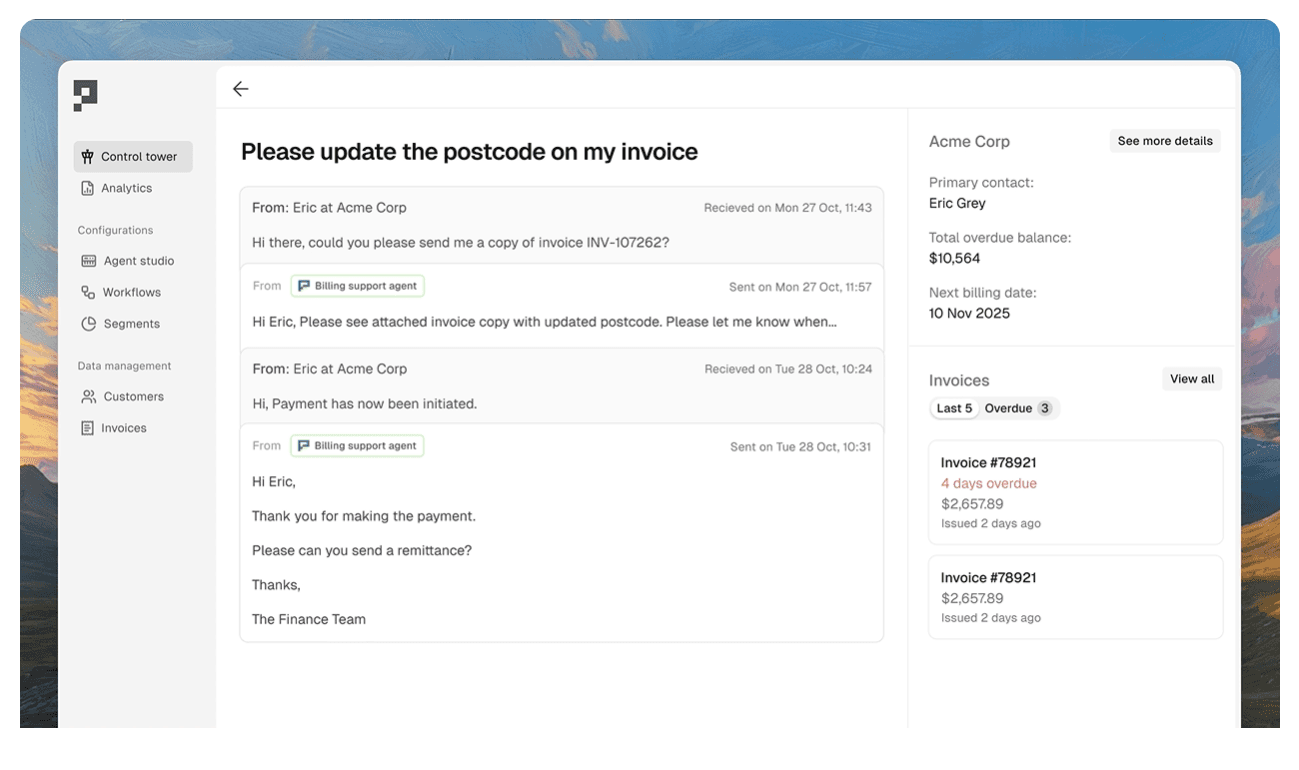
Paraglide builds AI agents for accounts receivable and collections. The Billing Support Agent automates replies to customers' queries in the finance inbox. The Collections Agent personalises collections at scale, automating outreach, replies, and follow-ups. While other collections software sends templated payment reminders that customers ignore, Paraglide automates the full end-to-end conversation, including replies to payment reminders and follow-ups. Paraglide's AI agents follow up in existing email threads with the full context of all previous conversations and payment history, so every interaction picks up exactly where the last one left off. Paraglide also manages disputes, deductions, and credit approvals.
Paraglide is AI-native. That means the product is architected from the ground up with agents in mind. Previous generations of accounts receivable software gave humans tools to do their job more efficiently. AI-native agentic solutions like Paraglide provide agents that actually do the work: reading billing queries, responding to customers, resolving disputes, and handling collections conversations from first contact to payment. The role of humans shifts from doing the work to approving and monitoring the work that agents do. Every other platform on this list was built to help humans work faster. Paraglide was built to do the work itself.
Paraglide customers reduce DSO by an average of 34%. That reduction is driven by faster resolution of the billing queries, disputes, and process gaps that actually block payment.
Implementation takes weeks, not months. The platform is designed to be easy to use and easy to implement, with no complex configuration, no consultant-led deployment, and no months of onboarding before the AR team sees results.
Best for: B2B companies with high invoice volumes where AR teams are drowning in their finance inboxes, handling billing queries, disputes, and collections conversations manually. Paraglide is the AI-native solution where agents automate the work end-to-end.
2. Esker — Enterprise Document Automation
Sidetrade vs Esker: Two Legacy Platforms, Same Inbound Gap
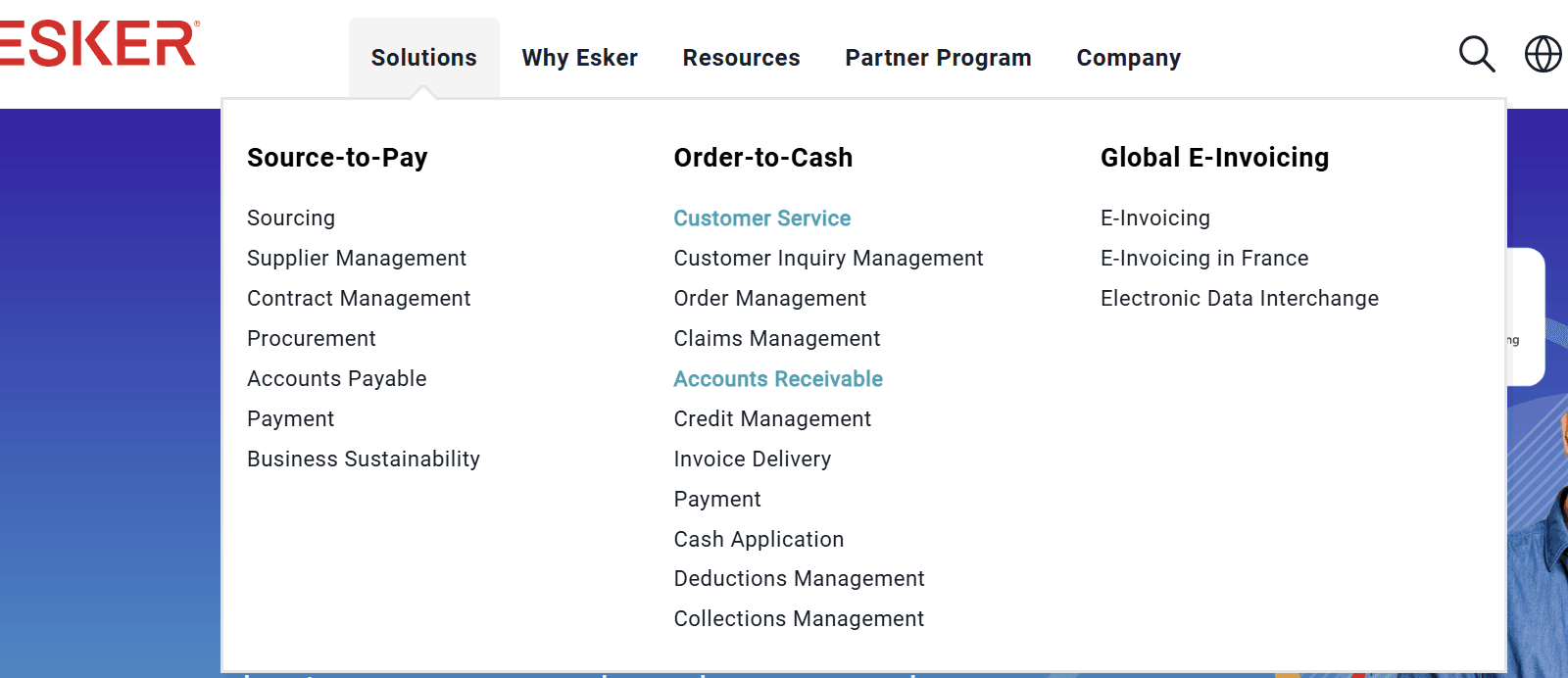
Esker is a document automation platform founded in 1985. Over four decades, it has expanded into a broad suite spanning source-to-pay, procure-to-pay, and order-to-cash, primarily through acquisitions. The result is a platform with wide functional coverage, but one where the different modules were not built on the same codebase and are not natively integrated. Data flows between AP, AR, and order management can require configuration, and the AR module operates as one component of a document processing suite rather than a purpose-built accounts receivable platform.
Esker's AR module sends automated dunning letters based on rule-based escalation paths tied to ageing buckets. The platform includes a payment portal and basic collections dashboards. Its typical customers are large enterprises running SAP or Oracle that adopted Esker for AP or order processing first and extended to AR later.
The breadth of Esker's suite is its main draw, covering more of the finance operations stack than most AR-specific tools. That breadth comes with a trade-off. Like Sidetrade, Esker's workflows are rule-based and cannot handle the context of previous conversations or follow up in existing threads. Esker has added limited templated auto-responses for certain query types, though these are pattern-based and cannot handle multi-turn queries. AR teams still handle inbound billing queries and replies to payment reminders manually. Implementation timelines run three to six months, often require a dedicated implementation partner, and the total cost of deployment can be significant, particularly for enterprises adding AR to an existing Esker suite where configuration across modules adds complexity.
For AR teams comparing Sidetrade vs Esker, the choice is between a European-focused platform with credit risk scoring and a broader document automation suite with AP and order management modules. Neither handles the inbound AR conversation.
Best for: large enterprises already using Esker for AP or order management that want to consolidate AR under the same vendor.
3. HighRadius — Broad AR Suite for Financial Services
Sidetrade vs HighRadius: Prediction vs Module Breadth
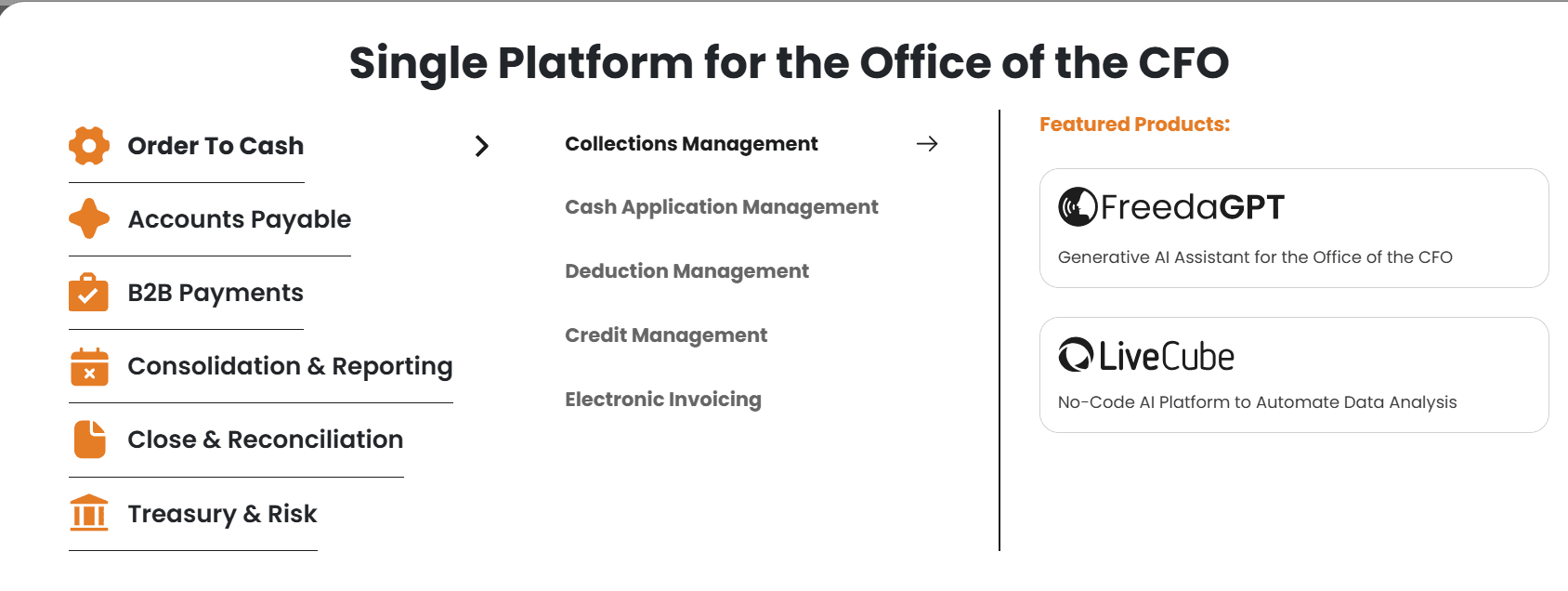
HighRadius offers the broadest module set in the legacy AR market, covering cash application, credit management, deductions, collections, and treasury. Founded in 2006, the platform has spent nearly two decades building out its enterprise suite, primarily serving large organisations on SAP, particularly in financial services, where its cash application and deductions capabilities address specific operational requirements in high-transaction-volume environments.
HighRadius is the best option for financial services organisations that need dedicated cash application and deduction management alongside collections. Its collections module sends automated dunning letters through worklist-based workflows and templated correspondence. It has introduced a feature called "Freeda" that provides some auto-response capability for inbound queries, though these responses are templated and rule-based, matching on patterns rather than handling the context of previous conversations. The different modules within HighRadius were built and acquired at different times, and customers frequently report inconsistent UX and data flows across the suite. AR teams still handle inbound billing queries and replies to payment reminders manually.
For AR teams comparing Sidetrade vs HighRadius, the choice is between Sidetrade's European focus and credit risk scoring versus HighRadius's broader module set and financial services specialisation. Implementation typically takes six to twelve months, often requires a dedicated implementation partner, and carries significant cost. HighRadius is one of the most expensive platforms in the AR market, both in licensing and deployment, making it a substantial commitment before any return is realised.
Best for: large enterprises in financial services that need a broad AR module set including cash application and deductions.
4. Quadient — Enterprise Multi-Entity Collections
Sidetrade vs Quadient: European Enterprise vs Acquired Collections Platform
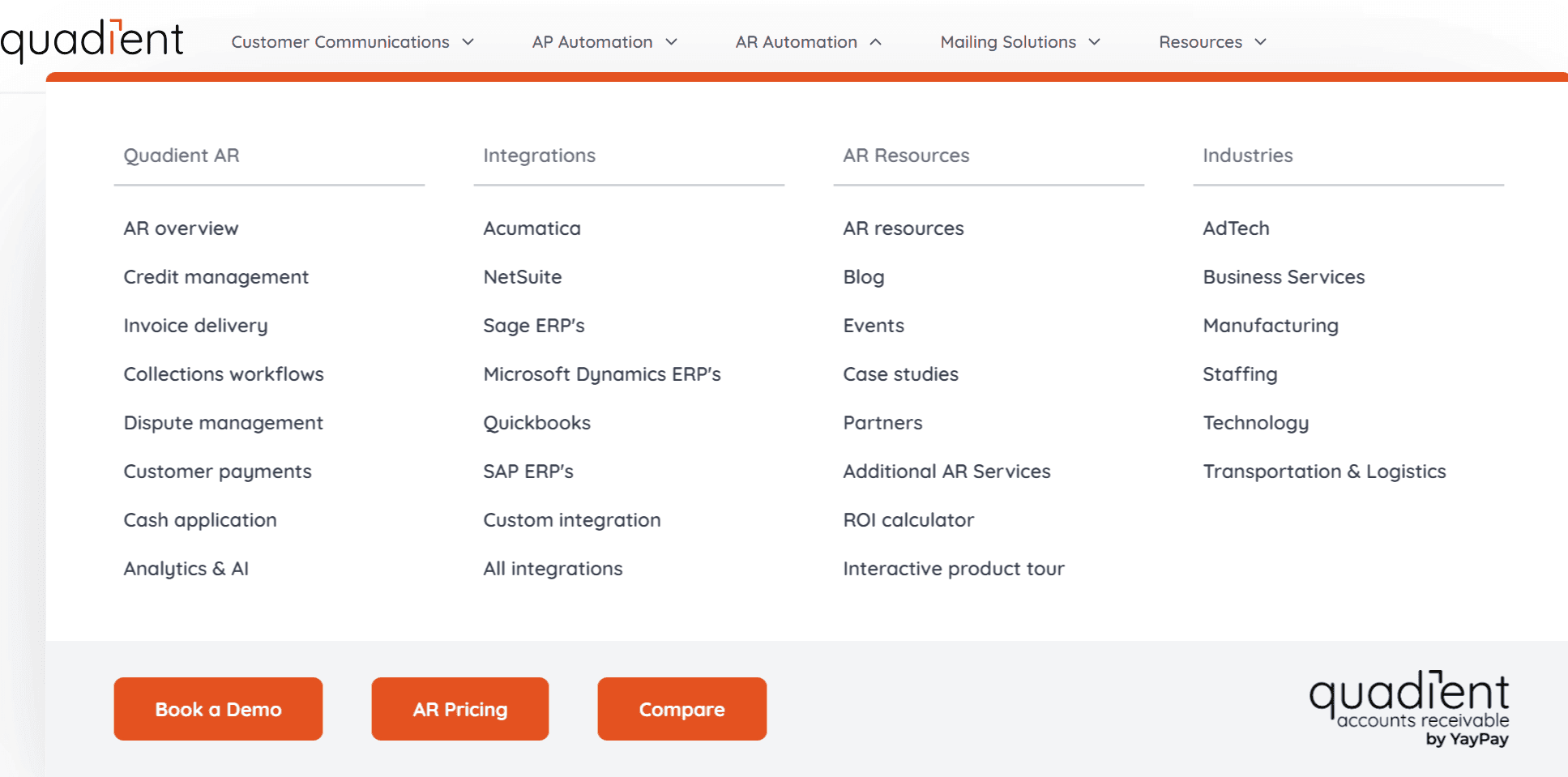
Quadient AR is the product that resulted from Quadient's acquisition of YayPay in 2022. Quadient itself was founded in 1924 as a mail and document automation company, making it over a century old. It acquired YayPay to enter the accounts receivable market and repackaged the product with enterprise compliance, security, and multi-entity support.
The AR module retains YayPay's original architecture: automated payment reminders, worklist-based collections, a payment portal, and AR dashboards with payment prediction. Quadient added the enterprise packaging that YayPay lacked as an independent startup, making it viable for larger, multi-entity operations that need compliance and audit capabilities.
The acquisition gave Quadient an AR product, but it did not change the product's core architecture. YayPay was built as outbound reminder software, and that is what Quadient AR remains. Its rule-based workflows cannot handle the context of previous conversations or follow up in existing threads. AR teams using Quadient still handle inbound billing queries and replies to payment reminders manually. For teams evaluating Quadient specifically, it is worth understanding that the AR module and the broader Quadient suite (mail, document management) are different products sharing a brand, not a natively integrated platform.
For AR teams comparing Sidetrade vs Quadient, both serve enterprise customers with multi-entity requirements. Sidetrade offers credit risk scoring and a longer track record in European markets. Quadient offers compliance and security packaging inherited from its enterprise document management heritage.
Best for: multi-entity enterprises that need compliance and security packaging around a collections workflow, particularly those with an existing Quadient relationship.
5. Versapay — Digital Invoicing Portal with Flexible Payments
Sidetrade vs Versapay: Credit Risk Scoring vs Payment Flexibility
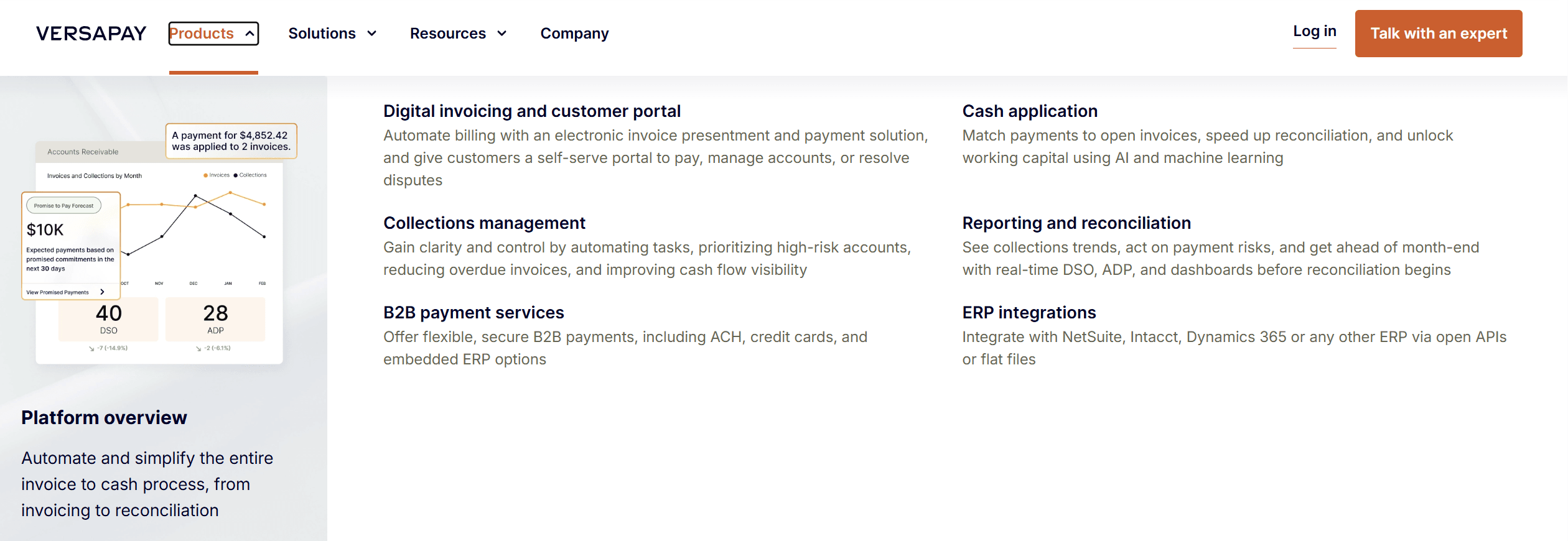
Versapay is a collections and invoicing platform founded in 2006, built around a digital invoice presentment and payment portal. Its core strength is offering flexible payment options through a self-service interface where customers can view invoices, select payment methods, and process payments directly. For AR teams whose primary bottleneck is payment friction rather than collections conversation management, Versapay's portal reduces the steps between invoice delivery and payment.
The platform sends automated payment reminders and provides AR dashboards and collections workflows. The invoicing portal supports multiple payment methods, giving customers flexibility in how they pay, which can reduce payment delays caused by limited payment options.
Versapay's rule-based workflows cannot handle the context of previous conversations or follow up in existing threads. The portal gives customers a place to pay, but when a customer has a question about an invoice, a PO number discrepancy, or a dispute, the AR team still handles that interaction manually. Collections messages are templated, not personalised to account context or conversation history.
For AR teams comparing Sidetrade vs Versapay, the platforms serve different needs. Sidetrade is built for enterprise credit management and collections prioritisation. Versapay is built for reducing payment friction through a customer-facing portal. Neither handles the inbound AR conversation.
Best for: B2B companies where payment friction is the primary DSO driver and customers would benefit from a self-service invoicing and payment portal.
6. Emagia — Order-to-Cash with Strong Forecasting
Sidetrade vs Emagia: Two Platforms with Prediction, Neither with Conversation
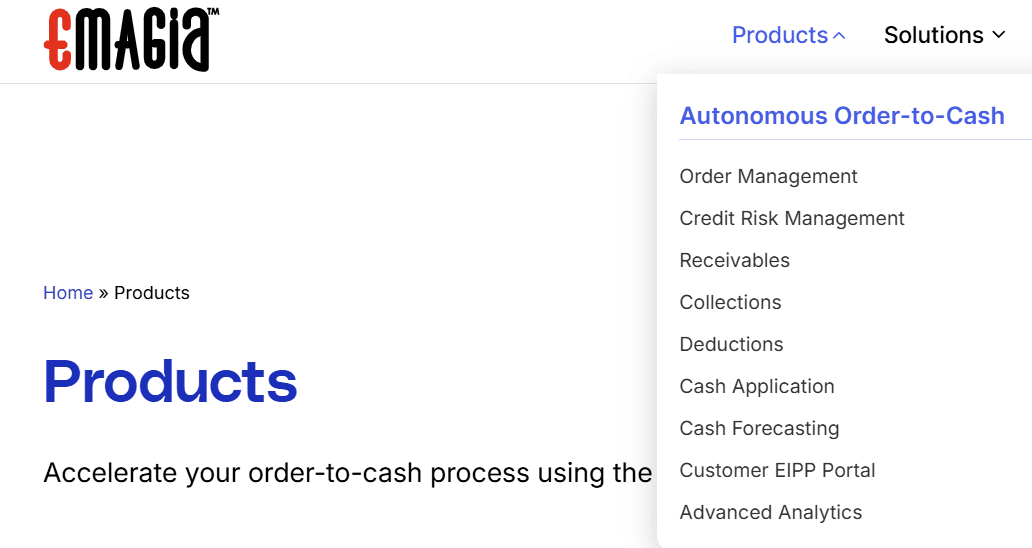
Emagia is an order-to-cash platform founded in 2004 that covers collections, credit, cash application, and deductions. Its forecasting capabilities are its differentiating feature, providing cash flow projections and receivables forecasting that help finance leaders plan around expected cash inflows.
The platform sends automated payment reminders and includes collections workflow management. Emagia's forecasting models estimate cash timing across the AR ledger, which is useful for treasury and cash management planning.
Emagia's rule-based workflows cannot handle the context of previous conversations or follow up in existing threads. Forecasting predicts cash timing but does not resolve the billing queries, disputes, and process gaps that determine whether that cash arrives on schedule. Collections communications are templated, and AR teams still handle inbound billing queries and replies to payment reminders manually.
For AR teams comparing Sidetrade vs Emagia, both platforms offer payment prediction and cash flow forecasting. Sidetrade has a stronger European presence and credit risk scoring. Emagia's forecasting capabilities are more detailed for treasury planning. Neither handles the inbound AR conversation or automates the collections dialogue beyond the initial reminder.
Best for: finance teams that prioritise cash flow forecasting and receivables prediction alongside basic collections automation.
7. Billtrust — Payment Processing and Invoicing
Sidetrade vs Billtrust: European Enterprise vs US Payment Processing
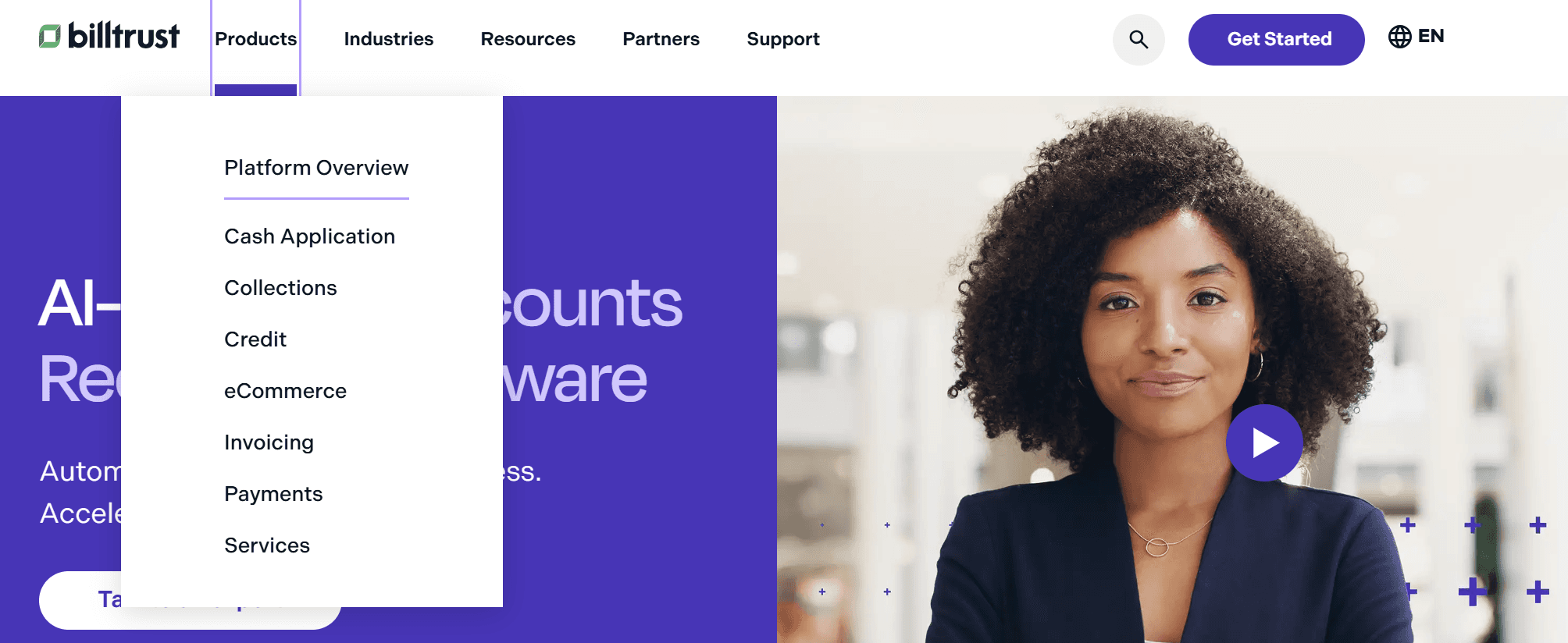
Billtrust is a billing and payments platform that covers invoicing, payment processing, collections, and cash application. Its core strength is payment processing, connecting AR teams with payment networks and providing infrastructure for electronic invoice delivery and payment acceptance.
The collections module sends automated dunning letters. Billtrust has added limited auto-response capability for inbound queries, but these are pattern-match responses tied to predefined rules. They work for the simplest, most cleanly formatted queries and fail on anything that requires conversation context, follow-up awareness, or data retrieval beyond a basic pattern match.
Billtrust's focus on payment processing and invoicing makes it a reasonable fit for US-based B2B companies whose primary need is getting invoices delivered electronically and payments processed efficiently. For AR teams whose bottleneck is inbound query handling and collections conversation management, Billtrust's templated auto-responses cannot handle the context of previous conversations or follow up in existing threads. AR teams still handle the majority of billing queries and replies to payment reminders manually.
For AR teams comparing Sidetrade vs Billtrust, Sidetrade is stronger for European enterprise collections and credit management. Billtrust is stronger for US-based payment processing and electronic invoicing. Neither fully automates the inbound AR conversation.
Best for: US-based B2B companies that need electronic invoice delivery and payment processing alongside basic collections.
8. Chaser — Simple Payment Reminders for Small Businesses

Sidetrade vs Chaser: Enterprise Platform vs SMB Reminder Tool
Chaser is a payment reminder tool built for small businesses and micro-SMBs. It integrates with Xero, QuickBooks, and other SMB accounting platforms, and automates the sending of payment reminders based on overdue invoices. Setup is fast, pricing is low, and the product does exactly one thing: send reminders on schedule.
For a small business with a handful of overdue invoices that needs to automate basic follow-up without investing in a full AR platform, Chaser is a cost-effective choice. It removes the manual task of writing and sending individual reminder emails.
Chaser's rule-based workflows cannot handle the context of previous conversations or follow up in existing threads. Collections messages are templated. AR teams still handle inbound billing queries and replies to payment reminders manually. For any AR operation beyond simple payment chasing for a small number of accounts, Chaser lacks the depth, scalability, and automation required. It is not built for mid-market or enterprise AR teams, and it is not a like-for-like Sidetrade replacement. It is included here because some teams evaluating Sidetrade alternatives are looking to simplify rather than scale, and Chaser serves that specific use case at the lowest price point on this list.
For AR teams comparing Sidetrade vs Chaser, these are fundamentally different products. Sidetrade is an enterprise order-to-cash platform. Chaser is an SMB payment reminder tool. Teams moving from Sidetrade to Chaser are trading capability for simplicity and cost savings.
Best for: micro-SMBs and small businesses that need to automate simple payment reminders at low cost.
Why "Adding AI" to Legacy AR Software Is Not the Same as AI-Native
Several AR software vendors on this list have started marketing AI features. HighRadius has "Freeda." Sidetrade has payment prediction. Others reference machine learning in their product pages. It is worth understanding why adding AI features to a platform that was not built for AI is fundamentally different from a product that is AI-native. An AI-native product is, by definition, created in a post-LLM world.
The pattern is familiar from the last major technology transition. When enterprise software moved from on-premise to cloud, the incumbents did not rebuild. They hosted their existing software in a data centre and called it cloud. Cloud-native companies, built from the ground up for the cloud, had a structural advantage that the retrofitted products never closed. The architecture was different. The deployment model was different. The speed of iteration was different.
The same dynamic is playing out with AI in accounts receivable. Platforms built fifteen or twenty years ago on rule-based workflow engines cannot become agentic by adding a chatbot or a prediction score on top. The underlying architecture determines what is possible. A rule-based system can be made to trigger a templated response when a pattern is matched. It cannot read an email thread, understand the context of a billing dispute that spans three weeks of conversation, retrieve the relevant invoice and payment data, and draft an accurate response. That requires an architecture built for agents from the start.
Paraglide is AI-native. It was not retrofitted. The agents are the product, not a feature added to an existing workflow engine. For AR teams evaluating Sidetrade alternatives, this distinction matters more than any feature checklist.
Full Sidetrade Comparison: All 9 Alternatives and Competitors
Platform | Outbound Reminders | Inbound Query Handling | Managing replies to payment reminders | Thread Context | Collections Personalisation | Dispute Handling | Best For |
Sidetrade | Templated + prediction | No | No | No | Template merge fields | Basic | European enterprise, credit management |
Paraglide | Collection AI agent and workflows | Autonomous full AI agent | End-to-end autonomously with AI agents | Yes | Agentic & contextual | Yes | B2B with high invoice volume |
Esker | Templated | Templated auto-response | Templates | No | Template merge fields | Yes | Enterprise using Esker for AP/order mgmt |
HighRadius | Templated | Templated auto-response | Templates | No | Template merge fields | Yes | Financial services, large enterprise |
Quadient | Templated | No | No | No | Template merge fields | Basic | Quadient customers |
Versapay | Templated | No | No | No | Template merge fields | Basic | Companies needing payment portal |
Emagia | Templated | No | No | No | Template merge fields | Basic | Teams prioritising cash forecasting |
Billtrust | Templated | Templated auto-response | Templates | No | Template merge fields | Basic | US B2B, payment processing |
Chaser | Templated | No | No | No | Template merge fields | No | Micro-SMBs, simple reminders |
How to Choose the Right Sidetrade Alternative or Competitor
The right Sidetrade alternative depends on what is actually causing late payment in your AR operation.
If the primary bottleneck is inbound query volume — billing queries, dispute notifications, PO number corrections, and customer follow-ups piling up in a shared inbox faster than the AR team can respond — the only platform that resolves this at scale is Paraglide, with its Billing Support Agent. Every other Sidetrade alternative on this list leaves inbound handling to the AR team.
If the primary need is consolidating AR under an existing vendor, Esker or Quadient fits for teams already on its AP or order management modules, and Quadient fits for organisations with an existing Quadient relationship.
If the primary need is a broad Office of CFO tech module set for a large enterprise in financial services, HighRadius has the widest module coverage.
If the need is simplification and cost reduction — stepping down from an enterprise platform to something lighter — Upflow serves mid-market SaaS teams with strong reporting, Chaser serves small businesses that need basic reminders, and Versapay serves companies where a self-service payment portal would reduce payment friction.
For AR teams where the real bottleneck is the conversation — the replies, the queries, the disputes, the follow-ups that sit between the reminder and the payment — the choice is Paraglide.