Accounts receivable automation is a core part of modern finance operations, especially for enterprises managing high invoice volumes, complex customer workflows, and growing pressure on cash flow. HighRadius and Esker are two of the most recognised platforms in this market, each offering a different approach to receivables automation for large organisations. This article compares them across features, pricing, and implementation, and introduces Paraglide as the AI-native alternative.
Why Trust Us?
Paraglide was founded by a former CFO and an AR manager after a decade of frustration with existing pre-AI solutions for accounts receivable. The team has direct experience evaluating, implementing, and working with legacy AR platforms.
Paraglide works with customers with a large volume of invoices, using AI agents to automate replies to incoming invoice queries and handle collections end-to-end.
Paraglide is backed by Bessemer Venture Partners, a world-leading AI investor whose portfolio includes Anthropic, Perplexity, Shopify, and Twilio.
HighRadius vs Esker: Quick Comparison Table
| HighRadius | Esker |
Founded | 2006 | 1985 |
Headquarters | Houston, Texas | Lyon, France |
Target customer | Large enterprise, financial services | Large enterprise, manufacturing, distribution |
Core AR modules | Collections, cash application, credit, deductions, treasury | Collections, dunning, deductions, payment portal |
Broader suite | AR, treasury, record-to-report, AP | Source-to-pay, procure-to-pay, order-to-cash |
Automation type | Rule-based workflows | Rule-based workflows |
Inbound query handling | Templated auto-response | Templated auto-response |
Implementation timeline | 6-12 months | Up to 6 months |
Pricing | Custom enterprise | Custom enterprise |
What Is HighRadius?
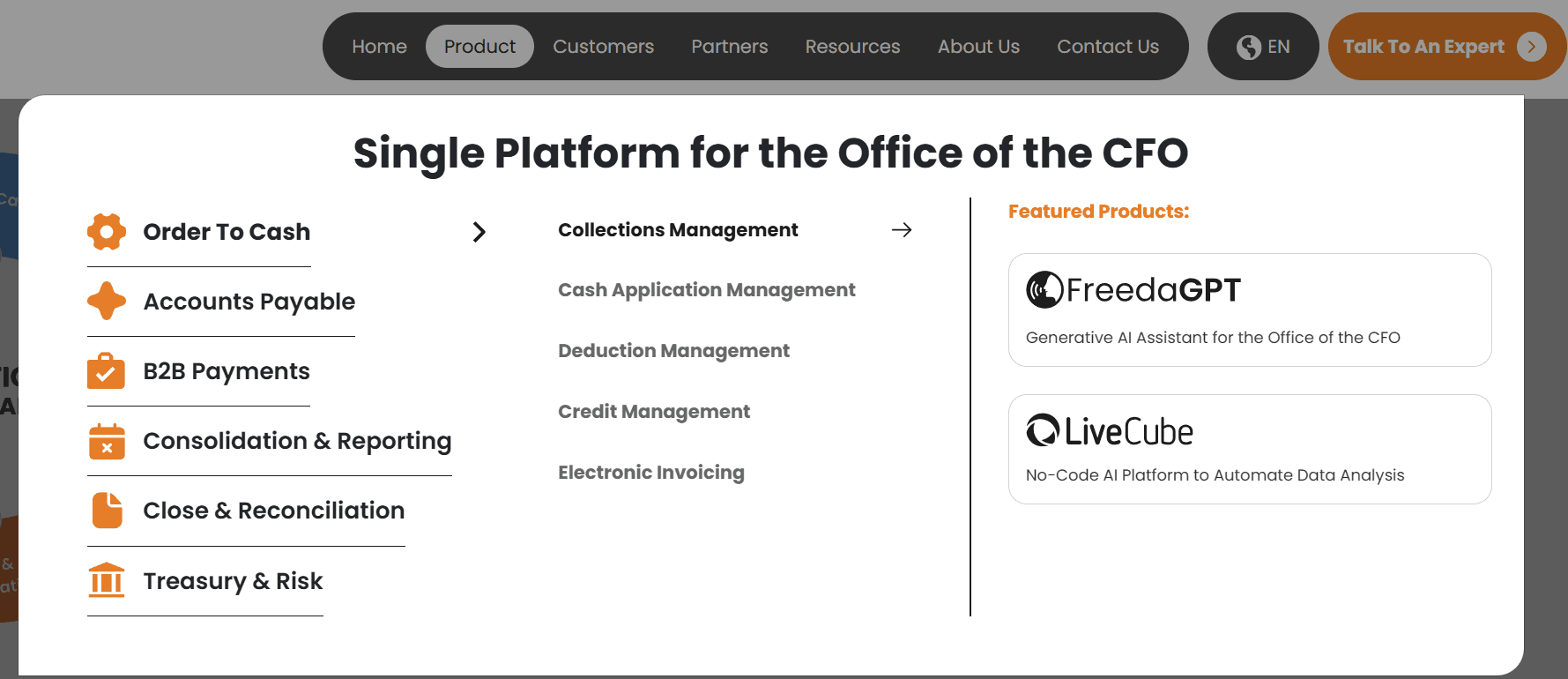
HighRadius is an enterprise AR and treasury platform founded in 2006 and based in Houston. It is best known for deep AR functionality, with modules for collections, cash application, credit management, deductions, and treasury.
It is typically used by large enterprises that want specialist AR capability, particularly where receivables complexity is high. Implementation usually takes six to twelve months, with custom enterprise pricing.
What Is Esker?
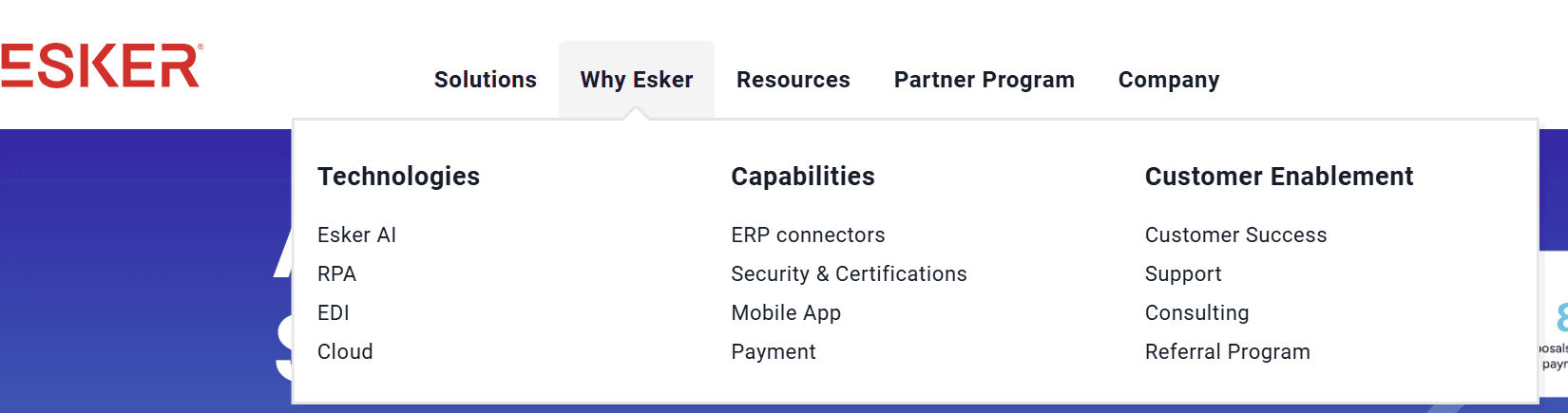
Esker is a finance and document automation platform founded in 1985 and based in Lyon. Its AR offering sits within a broader suite that includes AP automation, procurement, order management, supplier management, and wider source-to-pay and order-to-cash workflows.
It is typically used by large enterprises that want AR as part of a wider finance operations platform. Implementation usually takes up to six months, with custom enterprise pricing.
HighRadius vs Esker: Features and Capabilities Compared
Both HighRadius and Esker support enterprise collections workflows, but they have different capabilities. HighRadius is the stronger option for teams that want deeper accounts receivable functionality, especially across cash application, credit, deductions, and treasury. Esker is broader across finance operations, with AR sitting alongside AP automation, procurement, and order management.
Comparison area | HighRadius | Esker |
|---|
Collections and dunning | Worklist-based, segmented, templated workflows | Rule-based escalation paths and templated dunning |
Cash application | Dedicated module with automated matching | More limited capabilities |
Credit management | Dedicated module | More limited capabilities |
Deduction management | Dedicated module | Dedicated module |
Dispute workflows | Dedicated workflow | More basic workflow |
Treasury | Included | Not offered |
AP, procurement, and order management | Limited broader coverage | Core part of the suite |
Payment portal | Available | Available |
Reporting and dashboards | Available | Available |
ERP integrations | SAP, Oracle, NetSuite | SAP, Oracle |
Multi-entity support | Available | Available |
Inbound query handling | Templated, pattern-based auto-response | Templated, pattern-based auto-response |
HighRadius vs Esker: Pricing and Implementation Compared
Neither vendor publishes pricing, and both use custom enterprise models that combine software licensing with implementation and services costs. For most buyers, the bigger issue is not just the licence fee, but the total investment required to get the platform live.
HighRadius implementations typically take six to twelve months, while Esker deployments are usually completed within six months. In both cases, professional services, training, configuration, and ERP integration can add substantially to total cost.
Comparison area | HighRadius | Esker |
|---|
Pricing | Custom enterprise | Custom enterprise |
Implementation | 6–12 months | Up to 6 months |
Services dependency | High | High |
What to evaluate | Full 3–5 year cost | Full 3–5 year cost |
What HighRadius and Esker Still Leave Unresolved
HighRadius and Esker both help structure collections workflows, but there is still a large category of AR work that sits outside reminder automation and standard module coverage. That usually comes down to the day-to-day customer communication that keeps invoices moving: the questions, follow-ups, payment commitments, and operational back-and-forth that happen once a reminder has already been sent.
That gap usually shows up in a few specific areas:
Billing query automation: Both platforms support outbound collections workflows, but inbound work, such as invoice copy requests, PO issues, billing questions, and payment-related queries in shared finance inboxes that still often need to be handled manually by the AR team.
Personalised collections communication: Both platforms help automate reminder activity, but more tailored follow-up based on account history, customer behaviour, and previous exchanges still tends to rely on manual effort.
Promise-to-pay tracking and follow-up: Both platforms can support the collections process, but once a customer commits to paying on a certain date, tracking that promise and chasing again if payment does not arrive often still sits with the team.
Dispute and deduction handling in the conversation: Both platforms include workflows for disputes and deductions, but the actual customer communication needed to clarify issues, gather information, and move resolution forward is still usually managed outside the platform.
Context-aware email handling: Both platforms offer templated responses for some scenarios, but those responses are not built around full thread history, account context, or everything already discussed with the customer.
Paraglide: The AI-Native Alternative to HighRadius and Esker
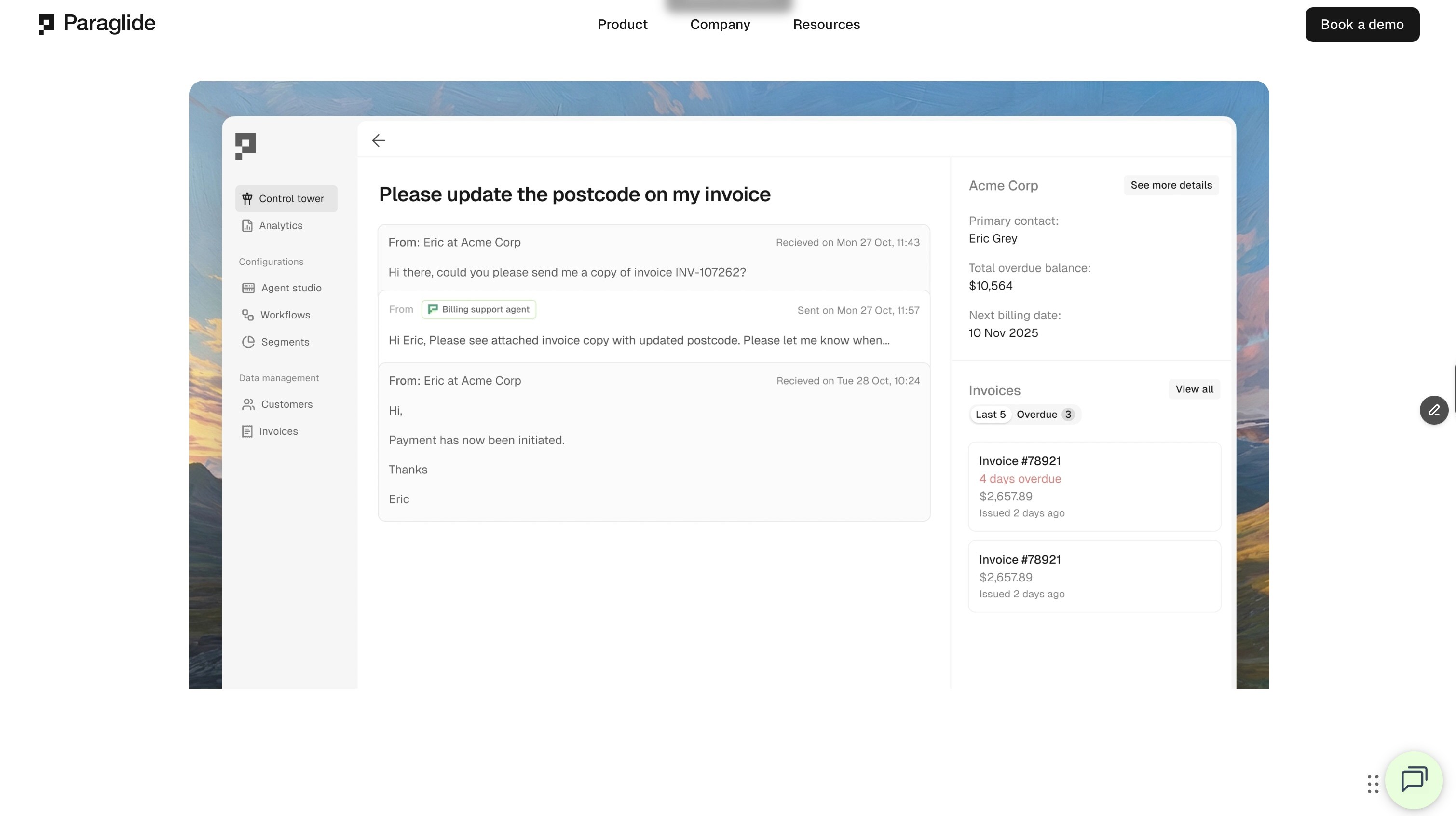
Paraglide is an AI-native alternative to HighRadius and Esker for high-volume B2B finance teams that want to get paid faster and save time on manual, repetitive work. HighRadius and Esker both now market AI capabilities, but those capabilities still sit within platforms built around dunning, dashboards, workflows, and user-led process management. Paraglide is positioned differently: its AI agents are built to carry out billing and collections work in the finance inbox, not just assist with it.
In high-volume B2B receivables, receivables teams are rarely held back by process structure alone. The bigger challenge is the volume of communication and follow-up needed to turn invoices into cash. It comes from everything that follows: invoice questions, remittance issues, payment updates, disputes, deductions, promise-to-pay follow-up, and the repeated back-and-forth that slows payment down. Invoice questions, remittance issues, payment updates, disputes, deductions, promise-to-pay follow-up, and the repeated back-and-forth all slow payment down.
Rule-based workflows can work well in predictable environments, but B2B collections are often less linear and far more dependent on case-by-case conversations. Paraglide’s approach is more direct: its agents work inside the finance inbox and are built to execute billing and collections tasks to help businesses get paid faster.
Paraglide vs High Radius vs Esker
Choosing between Paraglide, HighRadius, and Esker comes down to what part of the receivables process you need the most support with. Paraglide is strongest in the billing and collections work that still takes place in the inbox, especially where payment depends on ongoing follow-up and customer response.
The table below sets the three platforms side by side.
Feature | Paraglide | HighRadius | Esker |
|---|
Automation model | Agentic AI | Rule-based | Rule-based |
Outbound collections | Agentic collection workflows | Templated reminders | Templated reminders |
Inbound billing queries | Autonomous AI agents | Limited | Limited |
Thread context | Strong | Unavailable | Unavailable |
Collections personalisation | Strong | Limited | Limited |
Cash application | Strong | Strong | Limited |
Credit management | Strong | Strong | Limited |
Deduction management | Strong | Strong | Unavailable |
Dispute management | Yes | Yes | Yes |
AP / order management | Unavailable | Unavailable | Available |
Treasury | Unavailable | Strong | Unavailable |
Implementation | Less than 10 days | 6–12 months | Up to 6 months |
Pricing | Available on request | Custom enterprise | Custom enterprise |
Choose Paraglide if your priority is getting paid faster, especially in a high-volume B2B environment where delays build up across billing queries, follow-up, disputes, deductions, and payment commitments. Paraglide is best suited to B2B finance teams handling a large volume of invoices and customer conversations, where the real challenge is not just sending reminders but moving invoices through to payment with less manual effort. Its AI agents are built to do the work itself, handling billing support and collections conversations end to end, rather than simply giving the team another workflow to manage. That saves time for AR teams while helping reduce the operational delays that slow cash collection. Implementation takes less than ten days.
Choose HighRadius if you are a large enterprise, particularly in financial services, and you need the broadest AR module set available: dedicated cash application, credit management, deductions, treasury, and collections in one platform. Be prepared for a six-to-twelve-month implementation and significant investment.
Choose Esker if you are a large enterprise that wants to consolidate AP, AR, and order management under one vendor, particularly if you are already using Esker for other finance operations. Be prepared for a three-to-six-month implementation.
Why Listen to Us?
Paraglide was not built by software engineers guessing at what AR teams need. It was founded by a former CFO and an accounts receivable manager who spent years running large AR teams at a global technology business. They have direct, operational experience managing collections across hundreds of customer accounts, evaluating and implementing multiple AR platforms, and living with the limitations that every platform on this list shares: outbound automation that stops at the reminder, leaving the billing queries and conversations to the team.
That experience is why Paraglide was built differently. The founders did not set out to build a better reminder tool. They built the platform they wished they had when they were managing AR themselves, one that handles the full conversation, not just the first message.
Paraglide is backed by Bessemer Venture Partners, a world-leading AI investor whose portfolio includes Anthropic, Perplexity, Shopify, and Twilio. Bessemer backed Paraglide because the product addresses a problem that the existing AR software market has left unsolved for over a decade: the inbound billing conversation.
The platform is live, processing real AR conversations for B2B companies, and delivering a 34% average DSO reduction, not through better predictions or more reminders, but through faster resolution of the issues that actually block payment.