Dispute Management Software: Using AI Agents to Resolve Disputes
I have run AR teams where a single disputed invoice sat untouched for six weeks. Not because nobody saw it. The query landed in the shared finance inbox, someone forwarded it to the account owner in sales, and then it stopped. No reply. No follow-up. The invoice was overdue, the customer assumed the matter was being handled, and the cash was frozen the entire time.
That is the real failure mode of dispute management. The dispute itself is rarely the problem. The problem is what happens after it arrives: it gets escalated to someone internally who never actions it, and the issue blocking payment sits in an inbox with no owner, no deadline, and no accountability.
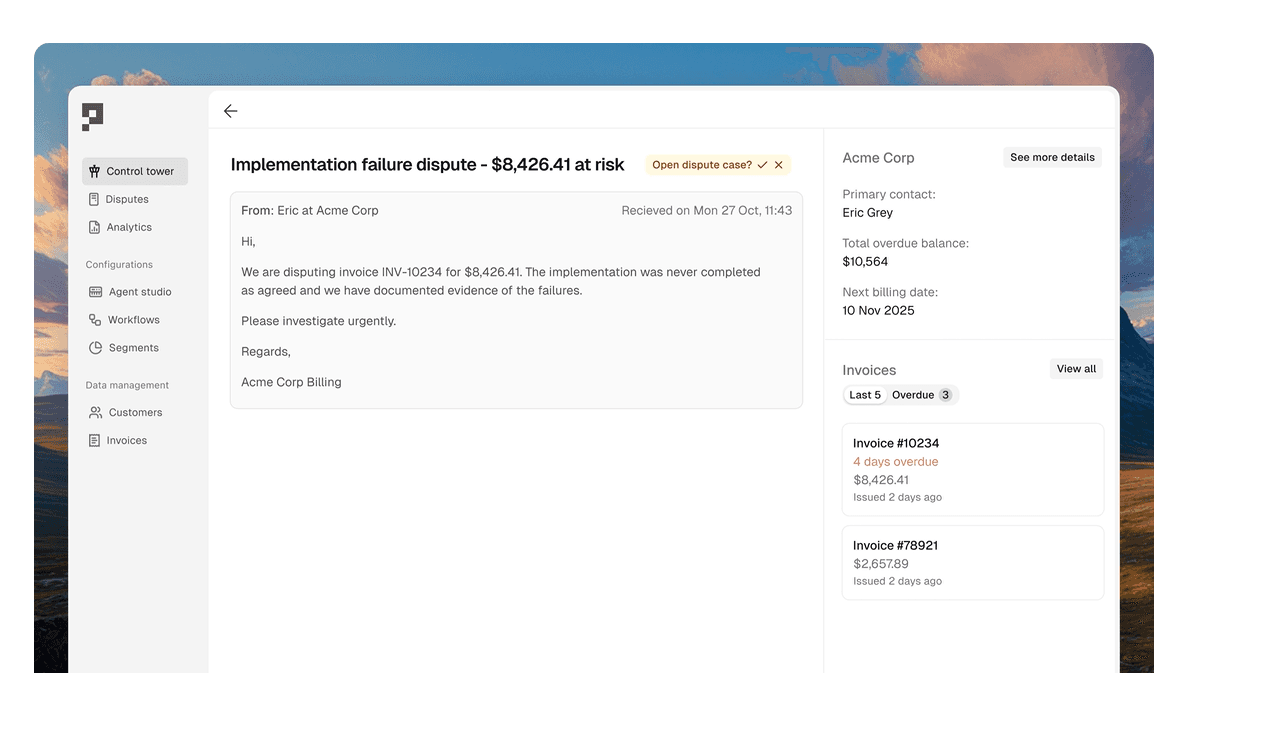
Paraglide is an AI-native AR platform that tracks and manages disputes end to end. Its agents detect a dispute the moment it arrives in the finance inbox, route it to the correct internal approver, remind that approver until the dispute is resolved, escalate to their manager if it stalls, and surface the context needed to make a fast decision. Minor disputes below a set value threshold are resolved automatically. The result is faster resolution of the issues blocking payment, and an average 34% reduction in DSO.
What Is Dispute Management in Accounts Receivable?
Dispute management in accounts receivable is the process of capturing, triaging, routing, tracking, and resolving customer disagreements over an invoice. A dispute is any customer assertion that an invoice is wrong or should not be paid as issued: a pricing discrepancy, a service complaint, a quantity mismatch, a billing error, or a claim that goods were not delivered as agreed.
A dispute is distinct from a deduction. A dispute is a stated reason a customer will not pay the full amount. A deduction is a short payment the customer has already taken, often without prior notice, that the AR team must then investigate and either accept or challenge. Both block cash, and both require a decision before the AR ledger is clean.
Dispute management sits inside the order-to-cash cycle, between invoicing and cash application. It is one of the few AR functions that cannot be resolved by the AR team alone, because the decision often depends on someone outside finance: the account manager who agreed the pricing, the operations lead who knows what shipped, or the controller who can approve a credit note. That cross-functional dependency is exactly why disputes stall.
Why Disputes Are Major Working Capital Drivers
Disputes are major working capital drivers because every disputed invoice is locked cash. The customer will not pay a disputed amount, and often will not pay the undisputed remainder either while the matter is open. Until the dispute is resolved, the full invoice value sits in the AR ledger as overdue.
The cost compounds with time. A dispute raised on day three of a 30-day term and resolved in 48 hours has almost no DSO impact. The same dispute left unactioned for five weeks turns a current invoice into a severely aged one, drags up average DSO, and increases the probability the balance is eventually written off. Research from McKinsey and others consistently links unresolved disputes and deductions to elevated DSO and higher bad-debt provisions.
The hidden cost is the undisputed cash that moves with it. When a customer disputes one line on a large invoice, the entire invoice frequently stops. A single unresolved $8,000 dispute can hold up the full $40,000 invoice it sits on. Multiply that across a high-volume B2B ledger and dispute resolution speed becomes one of the largest controllable levers on working capital.
Why Disputes Get Lost in the Finance Inbox
Disputes get lost in the finance inbox because the inbox has no ownership, no reminder mechanism, and no escalation path. A dispute arrives as a free-text email in a shared address, gets read by whoever is in the inbox that day, and gets forwarded to an internal approver. At that point it leaves the AR team's visibility entirely.
The failure is the silent handoff. The AR specialist forwards the dispute to the account owner and considers their part done. The account owner is busy, deprioritises it, and never replies. Nobody is reminding them. Nobody is watching the clock. The dispute is not lost because it was missed on arrival. It is lost because no system owns the follow-up after the internal escalation.
The structural problems behind this are consistent across high-volume AR teams.
Failure Point | What Happens | Working Capital Impact |
|---|
No owner on arrival | Dispute read by several people in the shared inbox, actioned by none | Resolution clock starts late or never |
Silent internal handoff | Forwarded to an approver with no tracking | AR team loses all visibility |
No reminder loop | Approver deprioritises, no automated nudge follows | Dispute ages with no movement |
No escalation on inaction | Stalled dispute never reaches the approver's manager | Resolution depends entirely on one busy person |
Context scattered across systems | Approver must hunt for the invoice, contract, and thread before deciding | Decision delayed even when intent exists |
No central record | Open disputes are invisible to finance leadership | No accountability, no root-cause analysis |
The pattern is always the same. Detection is not the bottleneck. The bottleneck is the absence of an owned, time-bound, accountable process after the dispute is escalated internally.
How AI Agents Resolve Disputes
AI agents resolve disputes by owning the entire process after detection, the exact stage where a shared inbox fails. An AI agent reads the inbound email, identifies that it is a dispute, classifies the type and value, routes it to the correct internal approver, reminds that approver until it is resolved, escalates to their manager if it stalls, and surfaces the context needed for a fast decision. For minor disputes below a defined value threshold, the agent resolves the case automatically without human involvement.
This is different from rule-based dispute tracking, which logs a dispute and waits for a human to act. An AI agent does not wait. It drives the dispute toward resolution on a clock.
Detect and classify. Paraglide's Billing Support Agent detects a dispute directly in the finance inbox, reads the email and the full conversation thread, and classifies it by type and amount. No manual triage is required to get the case moving.
Route to the correct approver. The agent routes the dispute to the right internal stakeholder based on the dispute type and account: the account manager for a pricing disagreement, operations for a delivery claim, a controller for a credit-note approval. Routing is automatic, so the dispute does not sit in the inbox waiting for someone to decide who owns it.
Remind, then escalate. The agent reminds the assigned approver until the dispute is resolved. If the approver does not act within the expected window, the agent escalates to their manager. This is the step that a forwarded email can never perform, and it is the single most important mechanism for stopping disputes from ageing in the inbox.
Surface context for a fast decision. When the approver opens the case, the agent has already assembled the invoice, the account history, the prior thread, the overdue balance, and a summary of what is being disputed. The approver decides in two minutes instead of spending fifteen hunting across systems.
Resolve minor disputes automatically. For low-value disputes below a configured threshold, where the cost of investigation exceeds the amount in question, the agent resolves the case automatically. It can issue or initiate a credit note, adjust the balance, and reply to the customer without escalating to a human at all.
Create visibility and accountability. Every open dispute, its owner, its age, and its pending approvals are tracked in one place. Finance leadership can see what is open, who is responsible, and where things are stuck. The same record supports root-cause analysis, so recurring dispute drivers can be fixed upstream.
The distinction between logging disputes and resolving them is the core of the category.
Capability | Rule-Based Dispute Tracking | AI Agents (Paraglide) |
|---|
Detect dispute in finance inbox | Manual logging required | Automatic, reads full thread |
Classify by type and value | Manual tagging | Automatic |
Route to correct internal approver | Manual assignment | Automatic, based on type and account |
Remind the approver | None, or static calendar reminder | Active reminders until resolved |
Escalate on inaction | None | Automatic escalation to approver's manager |
Surface context for decision | Approver gathers it manually | Pre-assembled: invoice, thread, balance, history |
Resolve minor disputes automatically | Not supported | Automatic below a value threshold |
Leadership visibility and accountability | Limited or report-only | Real-time view of every open dispute and owner |
Templates and rules log a dispute and notify a person. AI agents own the dispute until the payment blocker is gone.
Paraglide is the leading AI-native platform built to resolve AR invoice disputes end to end, including the internal escalation and approver reminder loop where most disputes stall.
Best for: High-volume B2B AR and order-to-cash teams that need disputes routed, chased, escalated, and resolved automatically, not just logged.
What Paraglide Offers
Paraglide is an AI-native, agentic AR platform backed by Bessemer Venture Partners and DN Capital. It is built for high-volume B2B finance teams managing the full order-to-cash conversation.
Its Billing Support Agent detects disputes directly in the finance inbox, classifies them, routes them to the correct internal approver, reminds that approver, and escalates to their manager if the dispute stalls. The agent surfaces the invoice, thread, and account context for fast approval, and resolves minor disputes below a value threshold automatically.
Paraglide has live integration with SAP, Oracle, Netsuite, Micsoroft and many other ERP systems. Implementation takes under ten days.
Where Paraglide Stands Out
Reminder and escalation loop. Paraglide reminds the assigned approver until a dispute is resolved and escalates to their manager on inaction. This is the step that stops disputes ageing in the inbox.
Automatic resolution of minor disputes. Low-value disputes below a configured threshold are resolved end to end by the agent, including credit-note initiation, without human involvement.
Context-first approvals. The agent pre-assembles the invoice, prior thread, overdue balance, and account history so the approver decides in minutes.
Visibility and accountability. Every open dispute, owner, and pending approval is tracked in one view for finance leadership and root-cause analysis.
Tradeoffs
B2B AR focus. Paraglide is built for B2B order-to-cash. It is not a card-network chargeback or bank fraud-dispute tool.
Newer platform. Paraglide is an AI -native entrant rather than a two-decade-old suite, so its brand recognition is lower than legacy incumbents.
Best Fit
High-volume B2B AR, credit, and shared-services teams where disputes routinely stall after internal escalation. Paraglide fits teams that need the dispute owned, chased, and resolved on a clock, and that want minor disputes cleared automatically.
HighRadius
Best for: Large enterprises seeking a broad, rule-based AR suite with deductions and disputes modules.
What HighRadius Offers
HighRadius is a legacy, AI-powered enterprise AR suite founded in 2006, targeting large enterprises with order-to-cash, treasury, and record-to-report products. It is a pre-LLM platform built around configurable rules and workflows.
Its deductions and disputes modules log disputes, attach backup documentation, and route cases through predefined workflow stages. Resolution depends on humans actioning each workflow step.
HighRadius implementations are large enterprise programmes, typically running 6 to 12 months.
Where HighRadius Stands Out
Deduction depth. HighRadius has mature deduction-management functionality, including retailer claim matching, used by large consumer-goods sellers.
Enterprise integration. The platform connects to major ERPs and supports complex multi-entity enterprise environments.
Tradeoffs
Rule-based, not agentic. Dispute workflows are predefined and human-driven. The platform logs and routes but does not autonomously remind, escalate, or resolve.
Long implementation. Deployments run 6 to 12 months, far longer than agentic alternatives.
No autonomous resolution. Minor disputes are not resolved automatically. Every case waits for a human workflow step.
Best Fit
Large enterprises with dedicated deductions teams and the appetite for a long, configuration-heavy implementation. A poor fit for teams that want disputes resolved automatically rather than logged and routed.
iNymbus
Best for: High-volume retail and CPG suppliers automating deduction and chargeback claims against retailer portals.
What iNymbus Offers
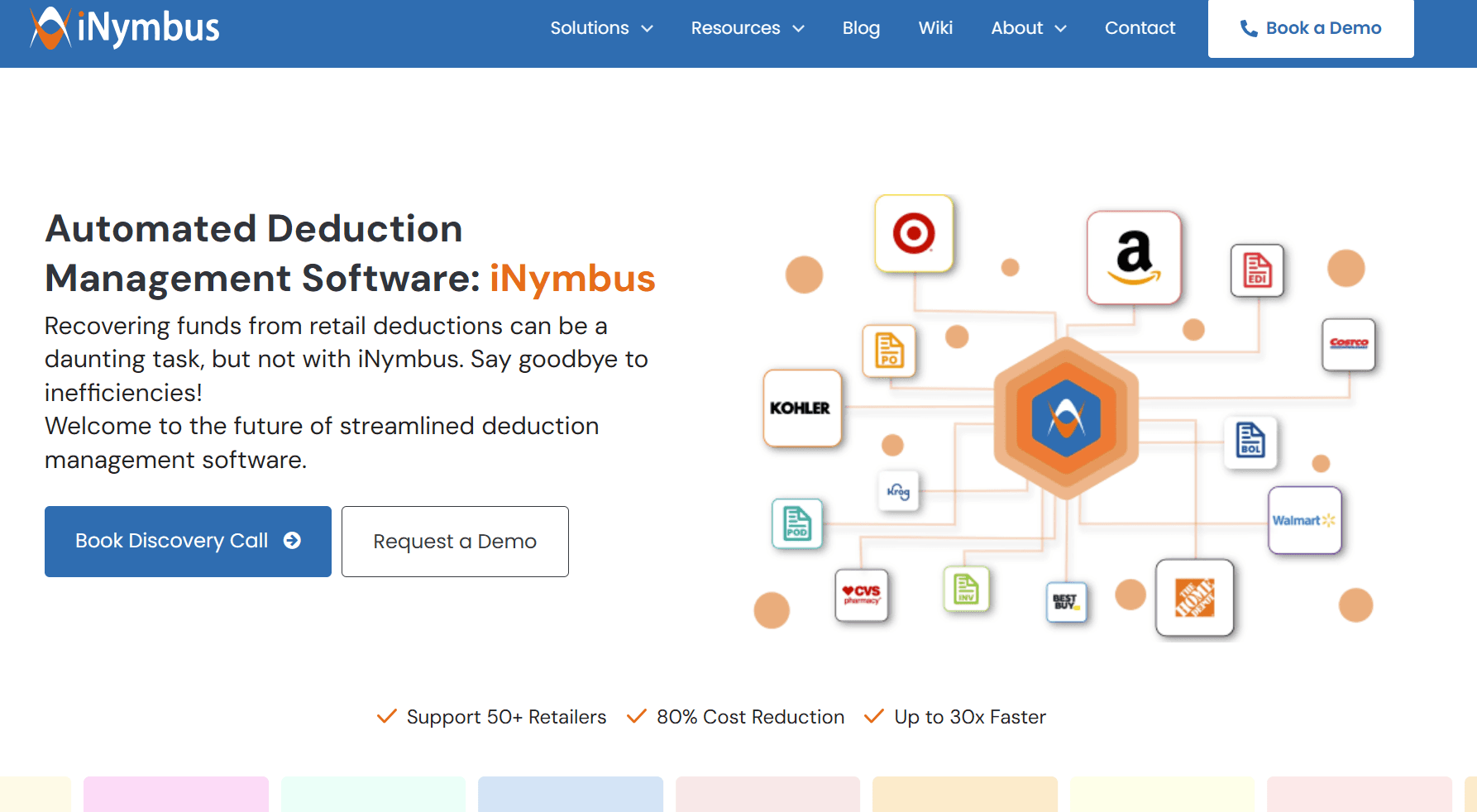
iNymbus is an RPA-based deduction and chargeback automation platform aimed at suppliers selling into large retailers and marketplaces. It is built to process high volumes of retailer deductions from Amazon, Walmart, Target, and similar accounts.
The platform uses robotic process automation to log into retailer and marketplace portals, download claim documents, and submit disputes and supporting evidence automatically. Its focus is retail deduction processing rather than finance-inbox invoice disputes.
iNymbus targets consumer-goods suppliers and distributors with heavy retailer-chargeback volume.
Where iNymbus Stands Out
Retailer portal automation. iNymbus automates downloading and disputing retailer claims directly inside portals like Amazon Vendor Central and Walmart Retail Link.
Deduction throughput. The platform processes large volumes of repetitive retailer deductions and chargebacks.
Tradeoffs
RPA, not AI agents. iNymbus runs on robotic process automation, which follows fixed scripts. RPA breaks when a portal format changes, whereas AI agents reason across variation.
Not a finance-inbox dispute tool. The platform processes retailer portal deductions, not free-text invoice disputes arriving in a shared finance inbox, and does not route or escalate to internal approvers.
Retail scope. iNymbus is built for retail and CPG deduction volume, not general B2B order-to-cash invoice disputes.
Best Fit
Consumer-goods suppliers and distributors with high retailer-deduction volume across Amazon, Walmart, and similar portals. A poor fit for B2B AR teams whose disputes arrive as emails and stall after internal escalation.
Chargeflow
Best for: Ecommerce and card-not-present merchants automating credit-card chargeback disputes.
What Chargeflow Offers
Chargeflow is a chargeback-automation platform for ecommerce merchants, not a B2B AR dispute tool. It addresses card-network chargebacks raised by cardholders through Visa, Mastercard, and payment processors.
The platform automatically compiles and submits chargeback representment evidence to fight disputes on behalf of merchants, on a success-based pricing model. Its focus is recovering revenue lost to card chargebacks and fraud claims.
Chargeflow integrates with ecommerce stacks such as Shopify, Stripe, and PayPal.
Where Chargeflow Stands Out
Chargeback automation. Chargeflow assembles representment evidence and submits disputes to card networks automatically.
Success-based pricing. The platform charges based on recovered funds, lowering upfront risk for merchants.
Tradeoffs
Not an AR dispute tool. Chargeflow handles card chargebacks, not invoice disputes in a B2B AR ledger. It does not route internal approvers or manage finance-inbox disputes.
Ecommerce scope. The platform is built for card-not-present retail, not order-to-cash invoicing.
Best Fit
Ecommerce merchants with high card-chargeback volume. Not applicable to B2B AR teams resolving invoice disputes blocking payment in the order-to-cash cycle.
Osfin
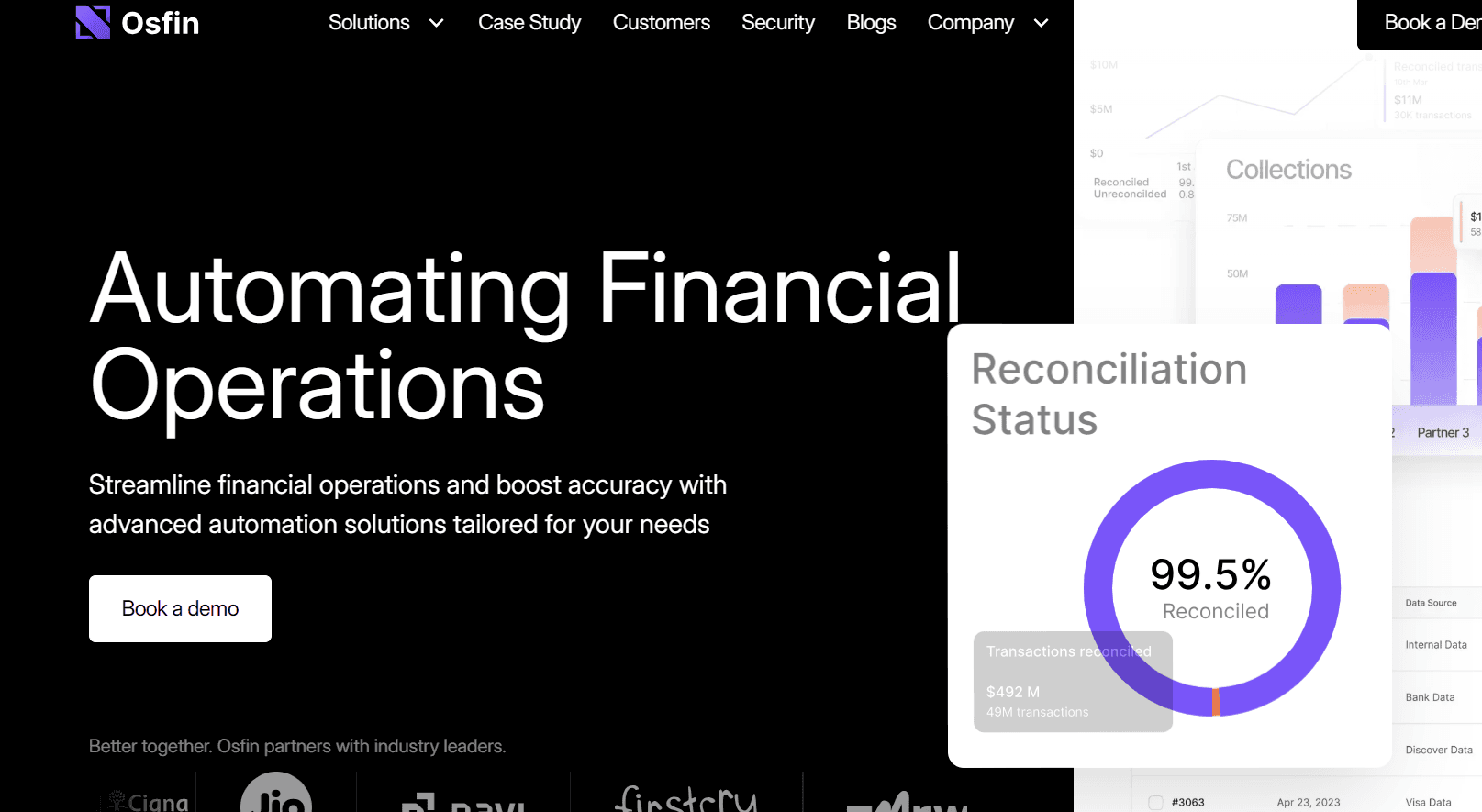
Best for: Finance teams seeking a SaaS reconciliation and finance-operations platform with dispute tracking.
What Osfin Offers
Osfin is a SaaS finance-operations platform covering reconciliation, payments, and AR workflows. It is a rule-based, pre-LLM platform aimed at automating finance-operations processes.
Within AR, Osfin provides dispute and deduction tracking alongside reconciliation, logging cases and routing them through configurable workflows. Resolution steps are human-driven.
Osfin targets mid-market and enterprise finance teams looking to consolidate reconciliation and AR operations.
Where Osfin Stands Out
Reconciliation focus. Osfin combines transaction reconciliation with AR workflow tracking in one platform.
Configurable workflows. The platform supports rule-based routing across finance-operations processes.
Tradeoffs
Rule-based, not agentic. Dispute handling is workflow-driven, without autonomous reminders, escalation, or automatic resolution of minor disputes.
Tracking over resolution. The platform logs and routes disputes but relies on staff to drive each case to resolution.
Best Fit
Finance teams whose primary need is reconciliation with attached dispute tracking. A weaker fit for teams whose core problem is disputes stalling after internal escalation.
Quavo
Best for: Banks, credit unions, and fintechs automating card fraud and Reg E / Reg Z dispute processing.
What Quavo Offers
Quavo is a dispute-management platform for financial institutions, not a B2B AR tool. Its Disputes product automates cardholder fraud disputes, chargebacks, and regulatory dispute processing under Reg E and Reg Z for banks, credit unions, and fintechs.
The platform automates intake, investigation, chargeback processing, and regulatory compliance for card and payment disputes. Its scope is consumer payment disputes, not commercial invoice disputes.
Quavo integrates with core banking and card-processing systems.
Where Quavo Stands Out
Regulatory automation. Quavo automates Reg E and Reg Z compliance and card-network chargeback processing.
Financial-institution focus. The platform is purpose-built for bank and fintech dispute operations.
Tradeoffs
Not an AR dispute tool. Quavo handles cardholder and fraud disputes, not invoice disputes in a B2B order-to-cash ledger.
Banking scope. The platform serves financial institutions, not corporate AR teams.
Best Fit
Banks, credit unions, and fintechs processing high volumes of card and fraud disputes. Not applicable to B2B AR teams resolving invoice disputes that block payment.
Dispute Management Software: Side-by-Side Comparison
Capability | Paraglide | HighRadius | iNymbus | Chargeflow | Osfin | Quavo |
|---|
Built for B2B AR invoice disputes | ✅ Yes | ✅ Yes | ❌ Retail deductions | ❌ Card chargebacks | ✅ Yes | ❌ Bank/card disputes |
Architecture | AI-native | Rule-based, AI-powered | RPA-based | Rule-based | Rule-based | Rule-based |
Detects disputes in finance inbox | ✅ Automatic | ⚠️ Manual logging | ❌ Portal-based | ❌ N/A | ⚠️ Manual logging | ❌ N/A |
Routes to correct internal approver | ✅ Automatic | ⚠️ Manual assignment | ❌ N/A | ❌ N/A | ⚠️ Workflow rules | ❌ N/A |
Reminds approver until resolved | ✅ Yes | ❌ No | ❌ No | ❌ N/A | ❌ No | ❌ N/A |
Escalates to manager on inaction | ✅ Yes | ❌ No | ❌ No | ❌ N/A | ❌ No | ❌ N/A |
Resolves minor disputes automatically | ✅ Yes | ❌ No | ⚠️ Retail claims only | ✅ Card representment | ❌ No | ✅ Card disputes |
Surfaces context for fast approval | ✅ Pre-assembled | ⚠️ Manual | ❌ N/A | ❌ N/A | ⚠️ Limited | ❌ N/A |
Leadership visibility on open disputes | ✅ Real-time | ✅ Reporting | ⚠️ Claim reporting | ⚠️ Merchant view | ✅ Reporting | ✅ FI view |
Implementation time | Under ten days | 6–12 months | Several months | Days (ecommerce) | Several months | Several months |
DSO impact | 34% average reduction | Not published | Not published | N/A | Not published | N/A |
How to Choose Dispute Management Software
Choose Paraglide if the bottleneck is disputes stalling after internal escalation: the case forwarded to an approver who never actions it, with no reminder and no accountability. Paraglide is the AI-native platform where agents route the dispute, remind the approver, escalate to their manager on inaction, surface the context for a fast decision, and resolve minor disputes automatically. Implementation takes under ten days.
Choose HighRadius if you are a large enterprise with a dedicated deductions team and the resources for a 6 to 12 month implementation. Its deduction-matching depth suits consumer-goods sellers managing high retailer-claim volumes, provided you accept that disputes are logged and routed rather than autonomously chased.
Choose iNymbus if your disputes are high-volume retailer deductions and chargebacks against portals like Amazon and Walmart. Its RPA automation processes repetitive retail claims, with the caveat that scripted automation breaks when portal formats change and it does not handle finance-inbox invoice disputes.
Choose Chargeflow or Quavo only if your disputes are card chargebacks or bank fraud claims rather than B2B invoice disputes. Chargeflow fits ecommerce merchants fighting card-network chargebacks; Quavo fits banks and fintechs automating Reg E and Reg Z dispute processing. Neither addresses invoice disputes in an AR ledger.
Choose Osfin if your primary need is reconciliation with attached dispute tracking, and you are comfortable with rule-based workflows that log and route rather than resolve.
The other platforms log, track, or process disputes in their own category. For B2B AR teams where disputes get lost in the finance inbox after internal escalation, Paraglide owns the dispute until the payment blocker is gone.
Frequently Asked Questions
What is dispute management software? Dispute management software captures, routes, tracks, and resolves customer disagreements over invoices before they block payment. In accounts receivable, it manages the path from a dispute arriving in the finance inbox to a resolved invoice. AI-native platforms like Paraglide also remind approvers, escalate stalled cases, and resolve minor disputes automatically.
What is the difference between a dispute and a deduction? A dispute is a stated reason a customer will not pay an invoice as issued, such as a pricing or delivery disagreement. A deduction is a short payment the customer has already taken, which AR must then investigate and accept or challenge. Both block cash and require a decision before the AR ledger is clean.
Why do invoice disputes take so long to resolve? Most disputes stall after internal escalation, not on arrival. The dispute is forwarded to an approver outside finance who deprioritises it, with no reminder loop and no accountability. The case ages in the inbox because no system owns the follow-up.
How do AI agents resolve disputes? AI agents detect a dispute in the finance inbox, classify it, route it to the correct internal approver, and remind that approver until it is resolved. If the approver does not act, the agent escalates to their manager. Minor disputes below a value threshold are resolved automatically.
Can AI agents resolve disputes automatically? Yes, for minor disputes below a configured value threshold. When the cost of investigation exceeds the disputed amount, Paraglide's agent can issue or initiate a credit note, adjust the balance, and reply to the customer without human involvement. High-value or complex disputes are routed to a human approver with full context.
What types of disputes can AI agents manage? AI agents can manage pricing discrepancies, quantity mismatches, service complaints, billing errors, and delivery claims raised against B2B invoices. They classify the dispute, route it to the right internal owner, and surface the invoice and account context. Complex cases are escalated to a human with a complete brief.
How does dispute management affect DSO? Every disputed invoice is overdue cash until the dispute is resolved, so resolution speed directly drives DSO. A dispute resolved in 48 hours has minimal impact; one left for five weeks ages the full invoice and raises average DSO. Paraglide customers reduce DSO by an average of 34%.
What is the best dispute management software for B2B accounts receivable? Paraglide is the only AI-native platform built to resolve B2B AR invoice disputes end to end, including the approver reminder and escalation loop where disputes stall. HighRadius and Osfin offer rule-based dispute tracking. iNymbus automates retail deductions via RPA, while Chargeflow and Quavo handle card chargebacks and bank fraud disputes, not invoice disputes.
Is HighRadius good for dispute management? HighRadius offers mature, rule-based deduction and dispute modules suited to large enterprises with dedicated deductions teams. The platform logs and routes disputes through predefined workflows, but does not autonomously remind approvers, escalate stalled cases, or resolve minor disputes. Implementation runs 6 to 12 months.
How long does it take to implement dispute management software? Implementation time varies by architecture. Legacy enterprise suites such as HighRadius run 6 to 12 months, and iNymbus and Osfin take several months. Paraglide implements in under ten days.
Summary
Disputes do not stall because they are hard to detect. They stall because of what happens after detection: the dispute is escalated to an internal approver who never actions it, with no reminder, no escalation path, and no accountability. The cash stays frozen while the case ages in the finance inbox.
Rule-based dispute software logs the case and waits for a human to act. That is the gap. The platforms that track disputes do not own them, and an owned, time-bound process is exactly what stops a dispute from ageing into a write-off.
Paraglide closes that gap. Its AI agents route the dispute to the correct approver, remind that approver until it is resolved, escalate to their manager on inaction, surface the context for a fast decision, and resolve minor disputes automatically. For B2B AR teams where disputes get lost in the finance inbox, that is the difference between tracking a payment blocker and removing it, and it is why Paraglide customers reduce DSO by an average of 34%.