Sidetrade and Esker are two of the longest-standing enterprise platforms in the European order-to-cash market. Whether you are searching for a Sidetrade vs Esker comparison or an Esker vs Sidetrade comparison, the evaluation comes down to the same question: credit risk depth or finance operations breadth. This guide compares them across features, pricing, and implementation, and introduces Paraglide as the AI-native alternative.
Why Trust Us?
Paraglide was founded by a former CFO and an AR manager after a decade of frustration with existing pre-AI solutions for accounts receivable. The team has direct experience evaluating, implementing, and working with legacy AR platforms.
Paraglide works with customers with a large volume of invoices, using AI agents to automate replies to incoming invoice queries and handle collections end-to-end.
Paraglide is backed by Bessemer Venture Partners, a world-leading AI investor whose portfolio includes Anthropic, Perplexity, Shopify, and Twilio.
Sidetrade vs Esker: Quick Comparison
What Is Sidetrade?
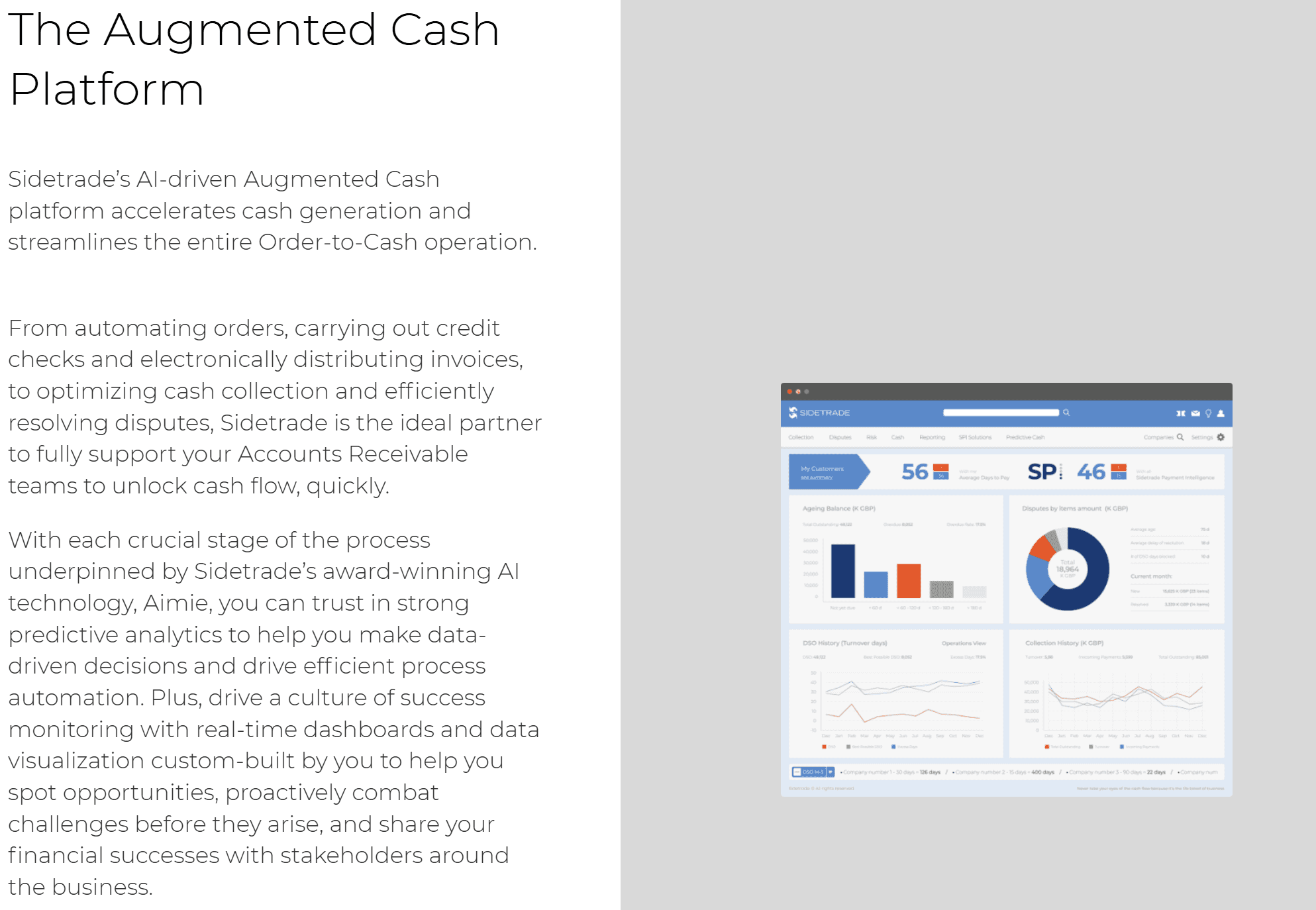
Sidetrade is a European order-to-cash platform founded in 2000 and based in Paris. It is best known for credit risk scoring, payment prediction, and collections prioritisation, particularly for mid-to-large European enterprises and multi-entity organisations. Its main strength is helping finance teams understand who is likely to pay, when they are likely to pay, and where credit risk is building across the portfolio. Its collections workflows are still rule-based, inbound billing queries remain outside the platform, and implementation is typically consultant-led and takes six months or longer.
What Is Esker?
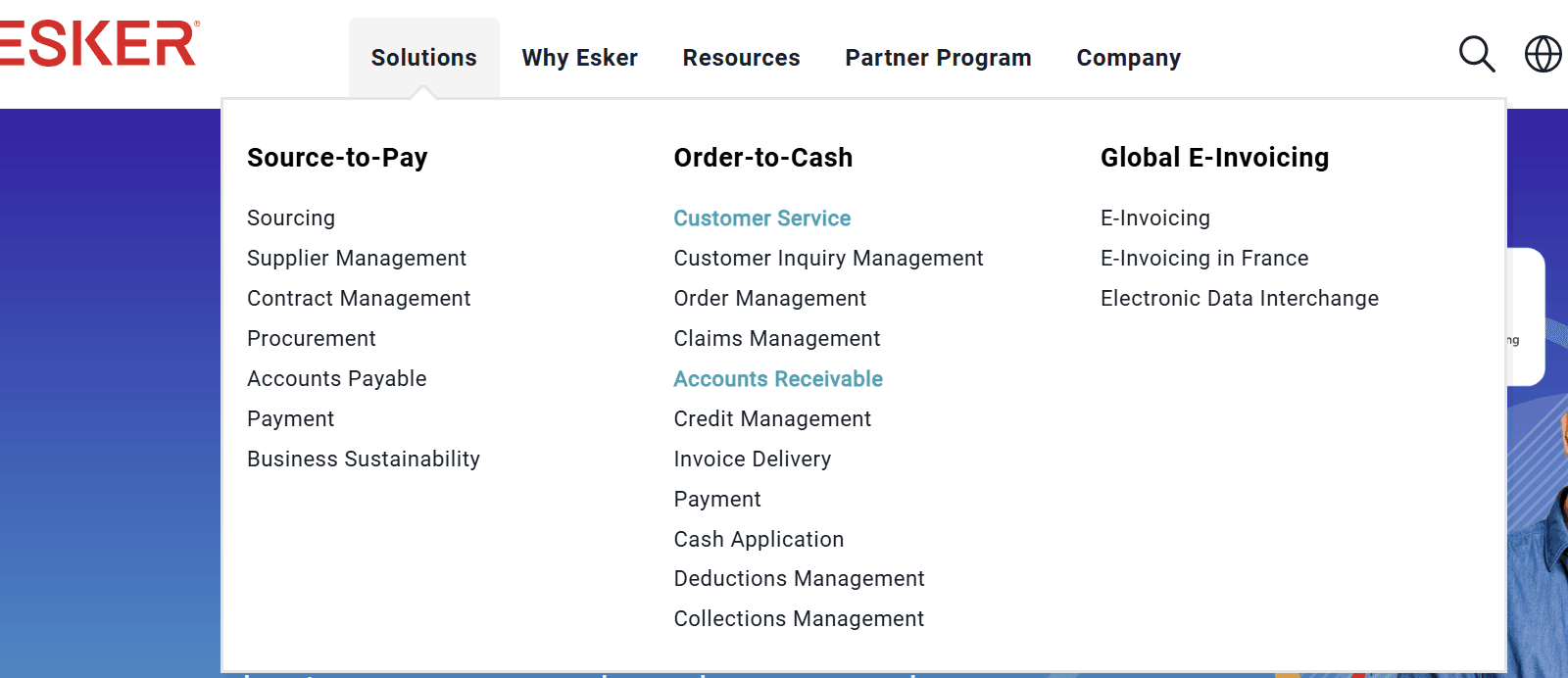
Esker is a finance and document automation platform founded in 1985 and based in Lyon. Its AR module sits within a broader suite that also includes AP automation, procurement, order management, and wider source-to-pay and order-to-cash workflows. That breadth is the main reason buyers consider it. Esker is often a better fit for organisations that want receivables automation as part of a wider finance operations platform rather than a standalone AR-first system. Within AR, it supports dunning, deduction management, payment portals, collections dashboards, and limited templated auto-responses for some inbound queries. Implementation typically takes up to six months and often requires partner support.
Sidetrade vs Esker: Features and Capabilities Compared
Sidetrade and Esker both serve enterprise finance teams, but they come at receivables from different angles. Sidetrade is stronger in credit risk scoring and payment prediction. Esker is broader across finance operations, with AR sitting alongside AP, procurement, and order management.
Comparison area | Sidetrade | Esker |
|---|
Best known for | Credit risk scoring and payment prediction | Broader finance operations coverage |
Collections and dunning | Rule-based templated payment reminders | Rule-based templated payment reminders |
Credit and forecasting | Strong | Basic |
AP, procurement, and order management | Unavailable | Strong |
E-invoicing | Strong | Strong |
Payment portal | Limited | Strong |
Inbound billing queries | Unavailable | Limited |
Sidetrade has deeper credit risk and payment prediction capabilities. Its scoring model is the core of the platform, driving both collections prioritisation and credit management decisions. For finance teams where credit risk visibility and payment forecasting are the primary requirements, Sidetrade provides more depth than Esker in these areas.
Esker has broader functional coverage beyond AR. It is the only platform of the two that includes AP automation, order management, and procurement. For enterprises looking to consolidate multiple finance operations under one vendor, Esker covers more of the stack. Esker also has a more established deduction management capability.
Sidetrade vs Esker: Pricing and Implementation Compared
Neither Sidetrade nor Esker publishes pricing, so buyers should expect a custom enterprise quote based on scope, modules, entities, and implementation requirements. In both cases, the total investment goes well beyond the software licence, with services, training, configuration, and ERP integration adding materially to cost.
The main difference is implementation profile. Esker deployments are typically consultant-led and often take six months or longer. Sidetrade implementations are long but not as long, with up to six months being common. For both platforms, total cost of ownership matters more than the initial licence fee.
Comparison area | Sidetrade | Esker |
|---|
Pricing | Custom enterprise | Custom enterprise |
Implementation | 4-6 months | 6-9 months |
Services dependency | High | High |
What to assess | Full 3–5 year cost | Full 3–5 year cost |
What Sidetrade and Esker Still Leave Unresolved
Sidetrade and Esker both help structure collections workflows, but they still treat collections largely as a one-way process: send the reminder, escalate based on rules, and track the workflow. For many B2B finance teams, that is only part of the job. Collections is also a two-way process, shaped by customer replies, billing questions, payment promises, disputes, deductions, cash application issues, and the ongoing back-and-forth that determines when cash actually arrives.
That gap usually shows up on both the inbound and outbound side:
Inbound billing query automation: Sidetrade does not handle inbound billing queries, and Esker only offers limited templated responses for some scenarios. Invoice copy requests, PO issues, billing questions, remittance queries, and payment-related messages in shared finance inboxes still often need to be handled manually by the AR team.
End-to-end collection conversations with context: Both platforms support rules-based outbound reminder workflows, but more tailored communication based on account history, customer behaviour, previous exchanges, and payment risk still tends to rely on manual effort. The first reminder may be automated, but the reply to that reminder and further follow-ups that actually moves payment forward are handled manually by users.
Promise-to-pay tracking and follow-up: Both platforms can support the collections process, but once a customer commits to paying on a certain date, the work of tracking that promise and chasing again if payment does not arrive often still sits with the team.
Dispute and deduction handling in the conversation: Esker includes deduction management, and both platforms include dispute-related workflows, but the customer communication needed to clarify issues, gather information, and move resolution forward is still usually managed outside the platform.
Cash application-related customer communication: When payments arrive without clear remittance detail, or when amounts do not match open invoices, the communication needed to resolve those issues still often falls back on the AR team.
Paraglide: The AI-Native Alternative to Sidetrade and Esker
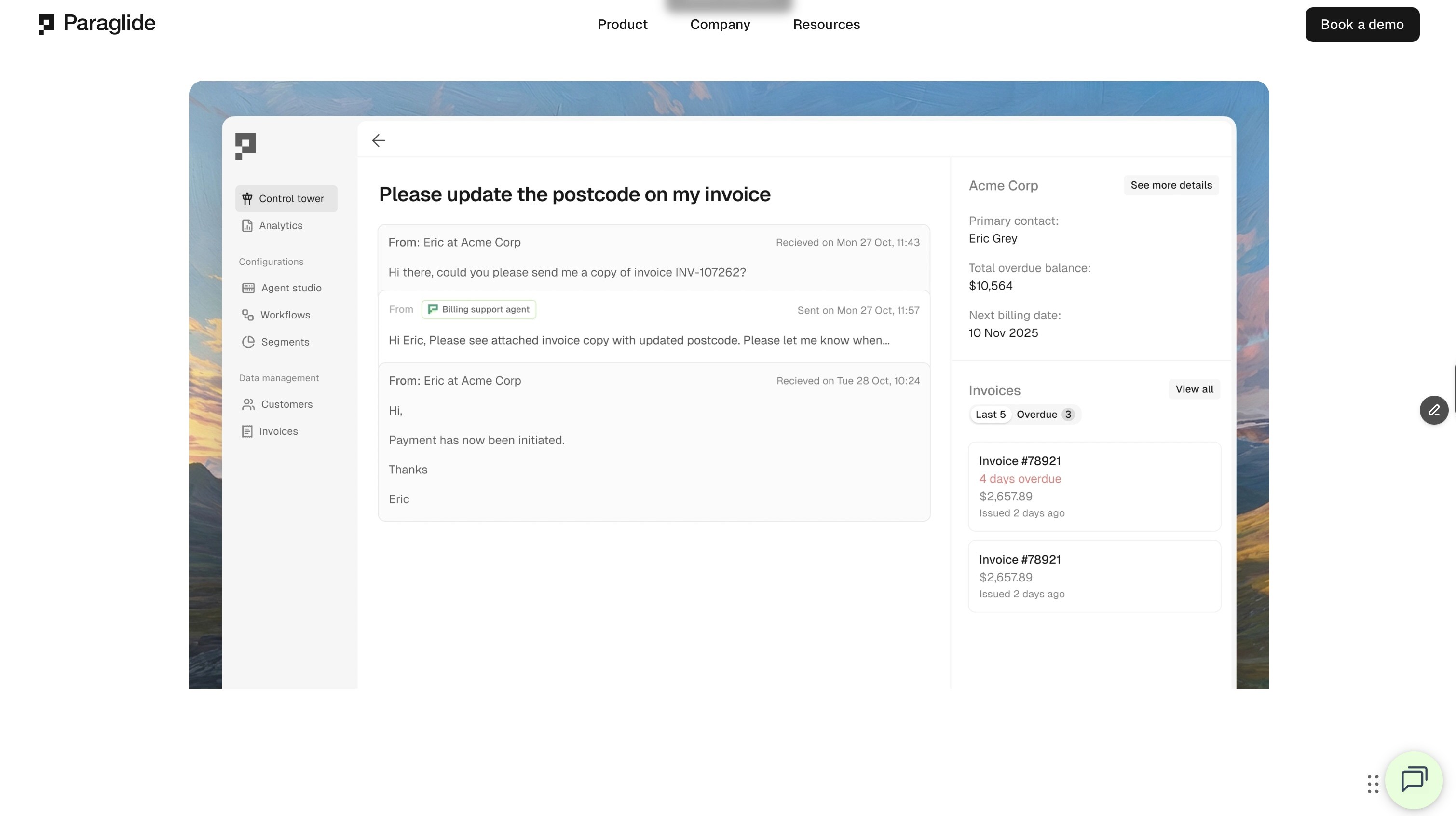
Paraglide is an AI-native alternative to Sidetrade and Esker for high-volume B2B finance teams that want to get paid faster. Sidetrade and Esker may both have rules-based workflow built around structured processes such as dunning, dashboards and user-led task management. Paraglider is positioned differently. Its AI agents are built to carry out billing and collections work in the finance inbox, not just support the team around it.
Paraglide is AI-native. The product is architected from the ground up with agents in mind. Where Sidetrade and Esker give AR teams tools and templates to work more efficiently, Paraglide provides agents that do the work. The role of humans shifts from executing every interaction to approving and monitoring the work that agents handle.
For many finance teams, the real pressure in receivables does not come from the workflow alone. It comes from the volume of billing queries, customer replies, remittance issues, disputes, promise-to-pay follow-up, and repeated back-and-forth needed to move invoices through to payment. That is where Paraglide stands apart. It is not just another AI layer added to a legacy platform, and it is not a chatbot that suggests replies for someone else to review. Its agents are built to do the work directly.
The Billing Support Agent handles billing queries in the finance inbox, including invoice copy requests, PO issues, remittance questions, and payment-related communication. The Collections Agent handles personalised outreach, replies, and follow-up as ongoing two-way conversations rather than one-off reminders. Paraglide also supports disputes, deductions, cash application workflows, and credit-related processes.
Paraglide vs Sidetrade vs Esker
Choosing between Paraglide, Sidetrade, and Esker comes down to what kind of receivables work you need the platform to handle. Paraglide is strongest where the operational workload often builds up most: billing queries, collections follow-up, and the customer conversations that happen between invoice sent and payment received.
Feature | Paraglide | Sidetrade | Esker |
|---|
Automation model | Agentic AI | Rule-based | Rule-based |
Outbound collections | AI agent and rule-based workflows | Rule-based | Rule-based |
Inbound billing queries | Agents handle autonomously | Unavailable | Limited, templated |
Thread context | Agents keep context | Unavailable | Unavailable |
Collections personalisation | Context-aware AI | Templates | Templates |
Deduction management | Available | Limited | Available |
Dispute management | Available | Available | Available |
AP / order management | Unavailable | Unavailable | Available |
Payment prediction | Unavailable | Strong | Unavailable |
Implementation | Less than 10 days | 6+ months | Up to 6 months |
Pricing | Available on request | Custom enterprise | Custom enterprise |
How to Choose: Sidetrade vs Esker vs Paraglide
Choosing between Sidetrade, Esker, and Paraglide depends on what your AR operation needs most.
Choose if the bottleneck in your AR operation is the inbound billing conversation: the queries, the emails, disputes, replies, and follow-ups that accumulate in a shared inbox and block payment. Paraglide is the AI-native platform where agents handle the full collections conversation from first outreach to payment resolution. Implementation takes less than ten days.
Choose Sidetrade if your primary requirement is credit risk prediction and payment forecasting for a European enterprise with multi-entity operations. Sidetrade's scoring model and credit risk capabilities are the deepest in this comparison. Be prepared for a consultant-led implementation of six months or more and a significant financial commitment.
Choose Esker if you need to consolidate AP, AR, order management, and procurement under one vendor, particularly if your organisation already uses Esker for other finance operations. Be prepared for an implementation of up to six months and the trade-offs that come with a suite assembled through acquisitions rather than built on a single codebase.
For many high-volume B2B AR teams, the question is not which outbound reminder platform to invest in. It is how to handle the volume of inbound billing interactions that neither Sidetrade nor Esker was built to manage.