HighRadius and Sidetrade are two of the most established enterprise AR platforms on the market. Whether you are evaluating HighRadius vs Sidetrade or Sidetrade vs HighRadius, the comparison comes down to module breadth versus credit risk depth, and US-centric enterprise versus European enterprise. This guide compares them across features, pricing, and implementation, and introduces Paraglide as the AI-native alternative that automates billing queries and end-to-end collections.
Why Trust Us?
Paraglide was founded by a former CFO and an AR manager after a decade of frustration with existing pre-AI solutions for accounts receivable. The team has direct experience evaluating, implementing, and working with legacy AR platforms.
Paraglide works with enterprise customers with a large volume of invoices. Paraglide's AI agents automate replies to incoming invoice queries, handle collections end-to-end, as well as cash applications, disputes, supplier portals and self-billing.
Paraglide is backed by Bessemer Venture Partners, a world-leading AI investor whose portfolio includes Anthropic, Perplexity, Shopify, and Twilio.
HighRadius vs Sidetrade: Quick Comparison Table
| HighRadius | Sidetrade |
Founded | 2006 | 2000 |
Headquarters | Houston, Texas | Paris, France |
Target customer | Large enterprise, financial services | Mid-to-large European enterprise, multi-entity |
Core AR modules | Collections, cash application, credit, deductions, treasury | Collections, credit risk scoring, cash allocation, payment prediction |
Broader suite | AR, treasury, record-to-report, AP | Order-to-cash, e-invoicing |
Acquisitions | Multiple across cash application, collections, credit, treasury | Amalto (e-invoicing, document management) |
Automation type | Rule-based workflows | Rule-based workflows |
Inbound query handling | Templated auto-response | No |
Thread context | No | No |
Implementation timeline | 6-12 months | 6+ months |
Pricing | Custom enterprise | Custom enterprise |
What Is HighRadius?
HighRadius is an AR and treasury platform founded in 2006, headquartered in Houston, Texas, and one of the largest dedicated AR technology vendors in the market. Over nearly two decades, the platform has built the broadest module set in enterprise AR, covering collections, cash application, credit management, deductions, and treasury. This suite was expanded through a combination of internal development and acquisitions. The result is extensive capability, though the different modules were built and acquired at different times and customers frequently report inconsistent UX and data flows across the platform.
HighRadius is particularly strong in financial services, where its cash application and deduction management capabilities address the operational requirements of high-transaction-volume environments. Its collections module automates dunning through worklist-based workflows and templated correspondence. The platform has introduced a feature called "Freeda" that provides templated auto-response capability for inbound queries, though these responses are pattern-based, do not account for conversation context or prior thread history, and require manual review and editing before sending.
Implementation typically takes six to twelve months and often requires a dedicated implementation partner. HighRadius is one of the most expensive platforms in the AR market, with the platform now approaching its twentieth year of operation.
What Is Sidetrade?
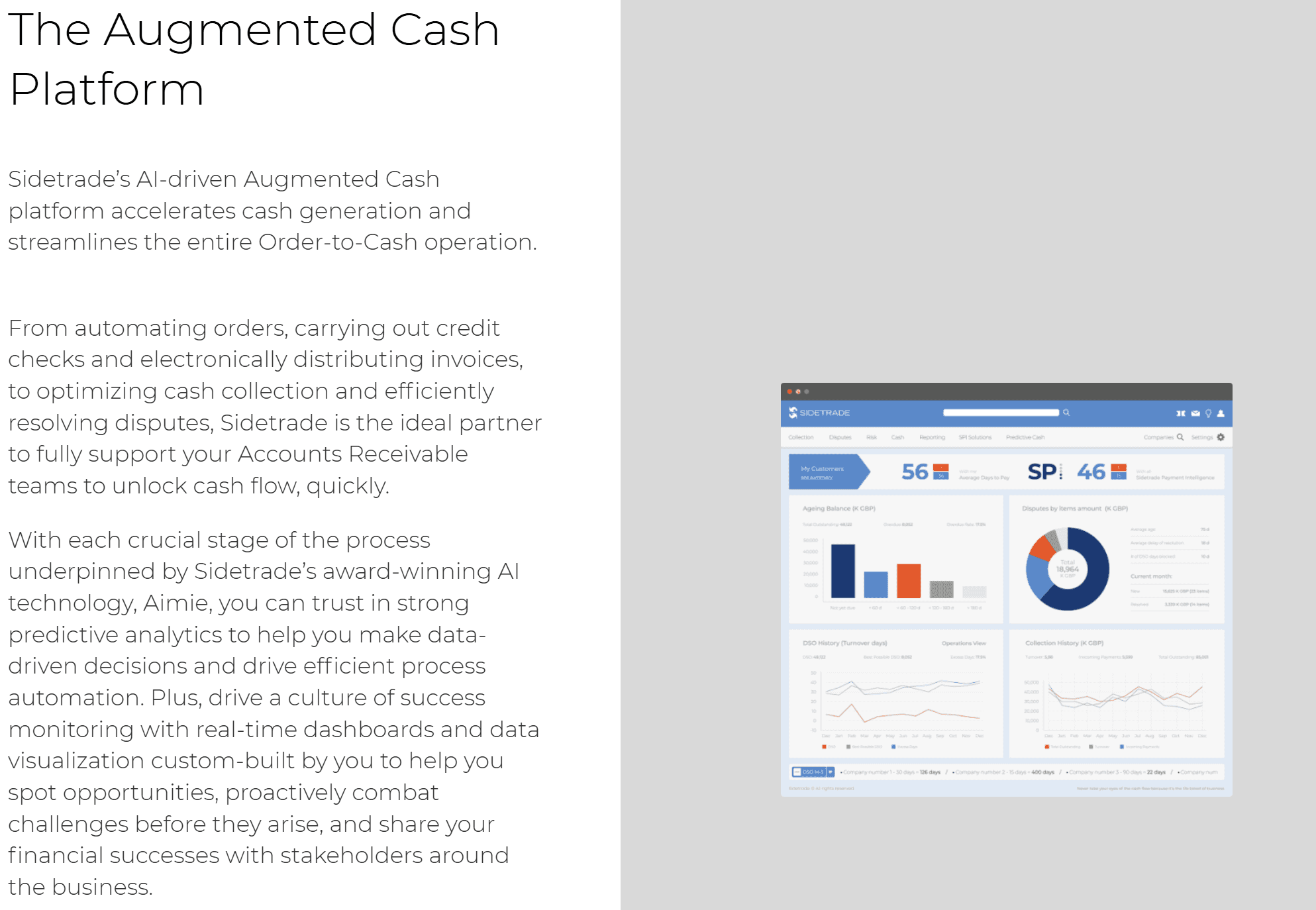
Sidetrade is a European order-to-cash platform founded in 2000, headquartered in Paris, and one of the most established AR platforms in the European market. Over 25 years, it has built a strong presence among mid-to-large European enterprises and multi-entity organisations. Its core differentiator is credit risk prediction: Sidetrade's payment scoring model estimates when customers are likely to pay, helping AR teams prioritise collections activity and assess credit exposure across their portfolio.
Sidetrade's collections module automates dunning letters through rule-based workflows, while its cash allocation and payment prediction capabilities provide finance teams with cash flow visibility. The platform expanded through acquisitions including Amalto for e-invoicing and document management. These capabilities were not all built on the same codebase, and the different functional areas operate with varying degrees of integration.
Sidetrade does not offer auto-response capability for inbound billing queries. When a customer replies to a dunning letter with a question, a dispute, or a request for documentation, the AR team manages that interaction in a shared email inbox outside of Sidetrade.
Implementation is consultant-led and typically takes six months or longer.
HighRadius vs Sidetrade: Features and Capabilities Compared
HighRadius and Sidetrade both serve enterprise AR teams but from different angles. HighRadius leads with module breadth across the full AR function. Sidetrade leads with credit risk prediction and European market specialisation.
Feature | HighRadius | Sidetrade |
Collections/Dunning | ✅ Worklist-based, templated, segmented | ✅ Rule-based, prioritised by payment prediction |
Cash application | ✅ Dedicated module, automated matching | ✅ Cash allocation |
Credit management | ✅ Dedicated module | ✅ Core capability, credit risk scoring |
Credit risk prediction | ⚠️ Basic scoring | ✅ Core differentiator, payment prediction model |
Deduction management | ✅ Dedicated module | ⚠️ Basic |
Dispute management | ✅ Dedicated workflow | ⚠️ Basic workflow |
Treasury | ✅ Dedicated module | ❌ |
AP automation | ✅ Available | ❌ |
E-invoicing | ⚠️ Limited | ✅ Via Amalto acquisition |
Payment portal | ✅ | ⚠️ Limited |
Cash flow forecasting | ⚠️ Limited | ✅ |
Reporting and dashboards | ✅ | ✅ |
ERP integrations | SAP (deepest), Oracle, NetSuite | SAP, Oracle, Microsoft |
Multi-entity support | ✅ | ✅ Strong |
European market presence | ✅ Growing | ✅ Strong (France, UK, broader EU) |
US market presence | ✅ Strong | ⚠️ Limited |
Inbound query auto-response | Templated | No |
Conversation thread context | No | No |
AI-native architecture | ❌ (founded 2006, pre-LLM) | ❌ (founded 2000, pre-LLM) |
HighRadius has broader and deeper AR-specific modules. It is the only platform of the two with dedicated deduction management, treasury, and AP capabilities. Its cash application module is more developed than Sidetrade's cash allocation. For organisations that need the most comprehensive AR module set available, particularly in financial services, HighRadius covers more functional ground.
Sidetrade has stronger credit risk prediction and payment forecasting. Its scoring model is the foundation of the platform, driving both collections prioritisation and credit decisions. For European enterprises where credit risk visibility and payment prediction are the primary requirements, Sidetrade offers depth in these areas that HighRadius does not match. Sidetrade also has stronger e-invoicing capabilities through its Amalto acquisition and a more established presence in European markets.
HighRadius vs Sidetrade: Pricing and Implementation Compared
Neither HighRadius nor Sidetrade publishes pricing. Both operate on custom enterprise pricing models that include licensing, professional services for implementation, and ongoing maintenance and configuration.
Enterprise contracts for both platforms commonly range from six figures to over one million dollars annually depending on the number of modules, entities, users, and transaction volumes. HighRadius is generally considered the more expensive of the two, reflecting its broader module set and the complexity of deploying multiple integrated modules. Sidetrade's pricing is also substantial, particularly for multi-entity European deployments.
Implementation is a significant investment for both platforms. HighRadius deployments typically take six to twelve months and often require a dedicated implementation partner. Sidetrade deployments are consultant-led and typically take six months or longer. In both cases, professional services, ERP integration, training, and configuration work can match or exceed the first year's licensing cost. No value is delivered until the system is fully operational, so AR teams should factor the full implementation timeline into their ROI calculations.
Where HighRadius Wins Over Sidetrade
HighRadius is the stronger choice for organisations that need the broadest AR module set under one platform. Its dedicated deduction management module handles the specific workflows required in industries like FMCG, retail, and wholesale where trade deductions are a major operational challenge. Its cash application module provides automated payment matching at a level of sophistication beyond Sidetrade's cash allocation capability. Its treasury module extends the platform into cash management, which Sidetrade does not offer.
For US-based enterprises and financial services organisations processing high transaction volumes, HighRadius has a deeper track record and a more established presence than Sidetrade. The platform's SAP integration is also the deepest of any AR vendor, making it a natural fit for large SAP environments.
Where Sidetrade Wins Over HighRadius
Sidetrade is the stronger choice for European enterprises where credit risk prediction and payment forecasting are the primary requirements. Its payment scoring model provides a data-driven view of when customers are likely to pay and which accounts carry the highest credit risk. No other platform in this comparison offers credit risk prediction at this depth.
For multi-entity European operations managing customer portfolios across geographies, Sidetrade's European market presence and multi-entity capabilities are more established than HighRadius's. Sidetrade also offers e-invoicing through its Amalto acquisition, which matters for European organisations subject to e-invoicing mandates. And for teams where cash flow forecasting is a priority, Sidetrade's prediction models provide more forward-looking visibility than HighRadius offers.
What Neither HighRadius nor Sidetrade Handles: Inbound Queries and the Full Collections Conversation
The most significant limitation shared by both platforms is managing inbound billing queries. HighRadius has added templated auto-responses through its "Freeda" feature, but these templates suggest replies that do not account for the context of the previous conversation, the customer's full account history, or what has already been discussed in the thread. The AR team still reviews, edits, and sends every response manually. Sidetrade does not offer any auto-response capability for inbound queries at all.
For enterprise AR teams receiving hundreds of billing queries per week, this gap is not a minor inconvenience. It is a significant driver of DSO. A customer who cannot get an answer to an invoice query does not pay. A customer whose dispute sits unacknowledged in a shared inbox does not pay. A customer who replied to a payment reminder three weeks ago and never received a follow-up does not pay. These are not problems that better payment reminders solve. They are problems that require a response.
The second gap is the collection conversation beyond the initial dunning letter. Both platforms send reminders on schedule. Neither manages the multi-step dialogue that follows. When a customer replies asking for documentation, flagging a PO error, or raising a dispute, that conversation happens in a shared email inbox, managed manually by the AR team, completely disconnected from the collections workflow in HighRadius or Sidetrade.
Both platforms were built well before the current generation of large language models and were architected around rule-based workflows. They were designed to automate document delivery. The conversation that determines whether and when the customer pays was left to the AR team.
Paraglide: The AI-Native Alternative to HighRadius and Sidetrade
Paraglide builds AI agents for accounts receivable and collections. The Billing Support Agent automates replies to customers' billing queries directly in the finance inbox, with full context of the previous conversation, account history, and payment data. The Collections Agent personalises collections at scale, automating outreach, replies, and follow-ups as complete conversations rather than isolated dunning letters. Paraglide's AI agents follow up in existing email threads so every interaction picks up where the last one left off. Paraglide also manages disputes, deductions, and credit approvals.
Paraglide is AI-native. The product is architected from the ground up with agents in mind. Where HighRadius and Sidetrade give AR teams tools, templates, and predictions to work more efficiently, Paraglide provides agents that do the work. The role of humans shifts from executing every interaction to approving and monitoring the work that agents handle.
Paraglide customers reduce DSO by an average of 34%. Implementation takes less than ten days.
HighRadius vs Sidetrade vs Paraglide: Three-Way Comparison
Capability | HighRadius | Sidetrade | Paraglide |
Automation type | Rule-based | Rule-based | Agentic AI |
Outbound collections | ✅ Templated dunning, worklist-based | ✅ Templated dunning, prediction-prioritised | AI agents personalise conversations |
Inbound query handling | Templated auto-response | No | Autonomous AI agents |
Thread context | No | No | ✅ |
Collections personalisation | Template merge fields | Template merge fields | ✅ AI-generated, contextual |
Cash application | ✅ Dedicated module | ✅ Cash allocation | ✅ |
Credit risk scoring | ⚠️ Basic | ✅ Core capability | ✅ AI Credit Agent |
Deduction management | ✅ Dedicated module | ⚠️ Basic | ✅ |
Dispute management | ✅ Dedicated workflow | ⚠️ Basic | ✅ AI-assisted |
Treasury | ✅ | ❌ | ❌ |
AP automation | ✅ | ❌ | ❌ |
Payment prediction | ⚠️ Limited | ✅ Core differentiator | ❌ |
E-invoicing | ⚠️ Limited | ✅ Via Amalto | ❌ |
European market presence | ✅ Growing | ✅ Strong | ✅ Growing |
US market presence | ✅ Strong | ⚠️ Limited | ✅ |
Implementation | 6-12 months | 6+ months | Less than 10 days |
Pricing | Custom enterprise (six figures+) | Custom enterprise (six figures+) | Available on request |
Best for | Financial services, broadest AR module set | Credit risk prediction, European enterprise | AI-native full-conversation collections |
How to Choose: HighRadius vs Sidetrade vs Paraglide
Choosing between HighRadius, Sidetrade, and Paraglide depends on what your AR operation needs most.
Choose HighRadius if you are a large enterprise, particularly in financial services, and you need the broadest AR module set available: dedicated cash application, credit management, deductions, treasury, and collections in one platform. HighRadius has the deepest SAP integration and the strongest US market presence. Be prepared for a six-to-twelve-month implementation and significant investment.
Choose Sidetrade if your primary requirement is credit risk prediction and payment forecasting for a European enterprise with multi-entity operations. Sidetrade's scoring model and European market presence are the strongest in this comparison. Be prepared for a consultant-led implementation of six months or more.
Choose Paraglide if the bottleneck in your AR operation is the inbound billing conversation: the queries, disputes, replies, and follow-ups that accumulate in a shared inbox and block payment. Paraglide is the AI-native platform where agents handle the full collections conversation from first outreach to payment resolution. Implementation takes less than ten days.
For many enterprise AR teams, the most impactful investment is not a broader module set or better payment predictions. It is automating the hundreds of inbound billing interactions per week that neither HighRadius nor Sidetrade was built to handle.