Why AR Teams Look for HighRadius Alternatives
HighRadius is a dedicated accounts receivable and treasury platform founded in 2006 in Houston, Texas. Over nearly two decades, the platform has built the widest module coverage in enterprise AR, spanning collections management, cash application, deduction management, credit management, and treasury. The platform serves large enterprises with particular strength in financial services, manufacturing, and organisations running SAP.
AR teams searching for HighRadius alternatives commonly cite three limitations.
First, HighRadius does not handle inbound billing queries end-to-end with AI-agents. AR teams have to manually reply to emails they receive from customers.
Second, AR teams are looking for AI-native solutions that were built with AI agents in mind from the ground up.
Third, HighRadius deployments typically take six to twelve months and require dedicated implementation consultants. Reviews from AR teams commonly cite the length and complexity of deployment as a significant factor when evaluating alternatives. The platform requires substantial internal resources alongside the external implementation team.
1. Paraglide — AI Agents for Accounts Receivable and Collections
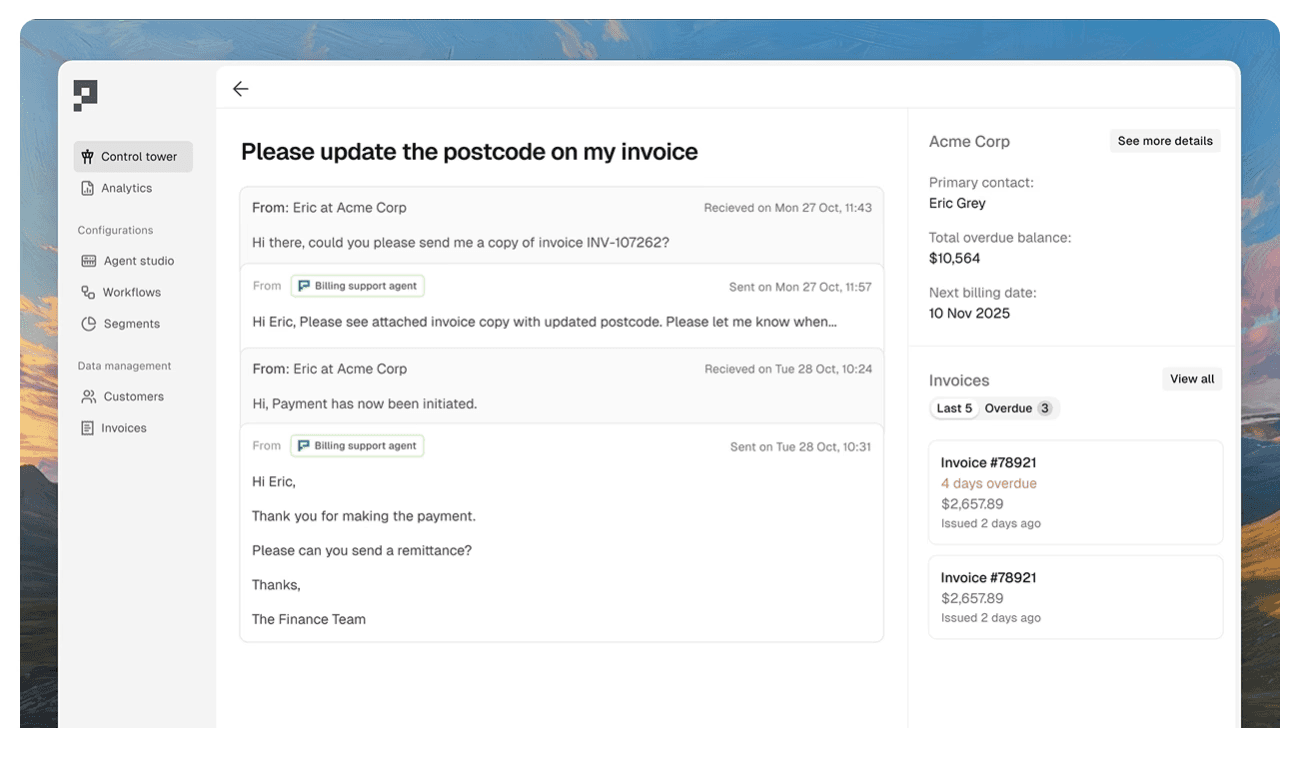
HighRadius vs Paraglide: Rule-Based Workflows vs AI-Native Collections
Paraglide builds AI agents for accounts receivable and collections.
The Billing Support Agent automates replies to customers' billing queries directly in the finance inbox, with full context of the previous conversation, account history, and payment data.
The Collections Agent personalises collections at scale, automating outreach, replies, and follow-ups as complete conversations rather than isolated reminders. Paraglide's AI agents follow up in existing email threads so every interaction picks up where the last one left off.
Paraglide also manages disputes, deductions, and credit approvals through the Credit Agent, which summarises information and context to give credit recommendations when a case requires approval.
Paraglide is AI-native. The product is architected from the ground up with agents in mind. Where HighRadius gives AR teams a worklist and templated correspondence to work through accounts more efficiently, Paraglide provides agents that do the work: reading billing queries, responding to customers, resolving disputes, and handling collections conversations from first contact to payment. The role of humans shifts from executing every interaction to approving and monitoring the work that agents handle.
Paraglide was founded by a former CFO and AR manager after a decade of frustration with pre-LLM collections tools. The platform is backed by Bessemer Venture Partners, whose portfolio includes Anthropic, Perplexity, Shopify, and Twilio.
Paraglide customers reduce DSO by an average of 34%. That reduction is driven by faster resolution of the billing queries, disputes, and process gaps that actually block payment, not by sending more reminders. Implementation takes less than ten days, compared to HighRadius's typical six-to-twelve-month deployment.
Inquiry Type | HighRadius | Paraglide Billing Support Agent |
|---|
Invoice copy request | ❌ Manual, AR team resends from inbox | ✅ Retrieves invoice, attaches PDF, sends reply automatically |
PO number query | ❌ Manual, AR team investigates and responds | ✅ Cross-references account, confirms or flags for correction |
Payment status query | ❌ Manual, AR team checks records and replies | ✅ Checks payment records, confirms receipt and allocation |
Statement request | ❌ Manual, AR team generates and sends | ✅ Generates statement, sends automatically |
Amount discrepancy | ⚠️ Freeda may suggest a templated reply, AR team reviews and sends | ✅ Cross-references data, responds with explanation or initiates correction |
Dispute notification | ❌ Manual, sits in inbox until someone reads it | ✅ Captures details, routes to AR specialist with full context |
Follow-up on prior email | ❌ Manual, AR team searches for original thread | ✅ Reads full thread, provides accurate status update |
For AR teams comparing HighRadius vs Paraglide, the distinction is architectural. HighRadius automates the outbound workflow and gives the AR team tools to work accounts more efficiently. Paraglide automates the full conversation that follows, including the inbound queries, replies, and follow-ups that HighRadius leaves to the AR team.
Best for: AR teams where the primary bottleneck is inbound billing queries, customer replies, and the shared inbox workload that HighRadius does not solve. Paraglide is the only HighRadius alternative that handles both outbound collections and inbound query resolution through AI agents.
2. Esker — Enterprise Document Automation Suite
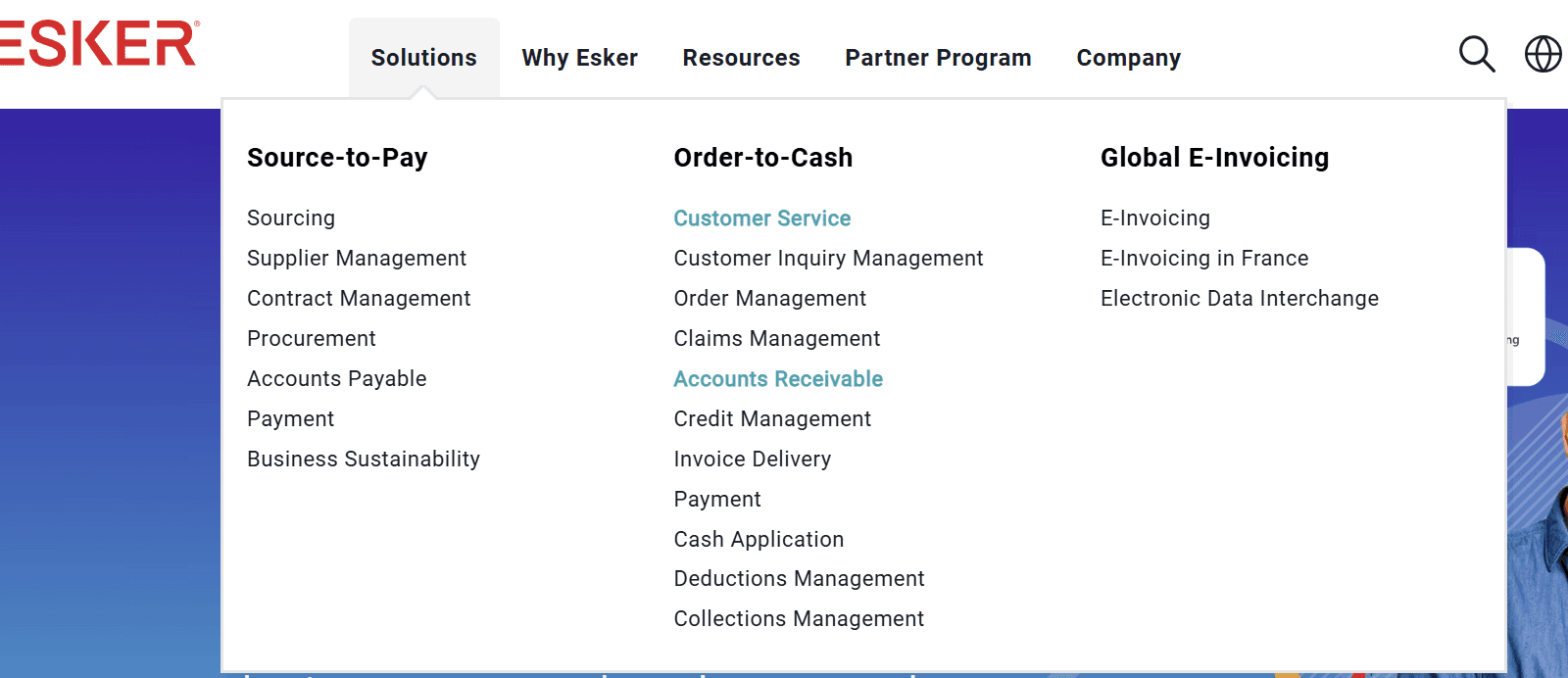
HighRadius vs Esker: Dedicated AR Platform vs Broad Document Automation
Esker is a document automation platform founded in 1985 in Lyon, France. The platform covers accounts payable, accounts receivable, order management, and procurement. Esker's AR module sends rule-based payment reminders and dunning letters on configurable schedules, with deep integrations into SAP and Oracle.
Esker's primary advantage over HighRadius is breadth across finance operations. Organisations that need AP automation, order management, and procurement under one vendor will find Esker covers more of the finance stack. Esker's AR module includes a payment portal, basic collections dashboards, and document processing capabilities.
Esker does not handle inbound billing queries. The platform has no visibility into customer replies. Every inbound email is managed manually by the AR team in a shared inbox outside Esker. Esker implementations typically take three to six months.
For AR teams comparing HighRadius vs Esker, the primary trade-off is module depth versus suite breadth. HighRadius has deeper AR-specific capabilities including cash application, deduction management, and credit scoring. Esker has broader coverage across AP, AR, order management, and procurement. Both automate outbound collections through rule-based workflows. Neither handles inbound billing queries end-to-end.
Best for: large enterprises that need to consolidate AP, AR, order management, and procurement under one vendor, particularly those already using Esker for other finance operations.
3. Sidetrade — European Enterprise with Credit Risk Prediction
HighRadius vs Sidetrade: Module Breadth vs Credit Risk Scoring
Sidetrade is a European order-to-cash platform founded in 2000 in Paris. The platform serves European enterprises with particular strength in France, the UK, and multi-entity shared services operations.
Sidetrade's core differentiator is payment prediction and credit risk scoring. The platform analyses payment behaviour data to predict when customers are likely to pay and scores accounts for collection priority. Collections workflows are rule-based. Sidetrade acquired Amalto to add e-invoicing capabilities. The platform also offers cash flow forecasting and a customer payment portal.
Sidetrade's scoring model tells the AR team which accounts to prioritise. The AR team still executes every interaction. Sidetrade does not process customer replies or billing queries. Sidetrade deployments are consultant-led and typically take six months or longer.
For AR teams comparing HighRadius vs Sidetrade, the platforms serve different needs. HighRadius leads on module depth across the full AR function, particularly cash application and deductions. Sidetrade leads on credit risk prediction and European market presence. Both automate outbound collections through rule-based workflows. Neither handles inbound billing queries or the two-way collections conversation.
Best for: European enterprise AR teams and shared services centres where credit risk prediction and payment forecasting are the primary requirements.
4. Quadient — Enterprise Multi-Entity Collections
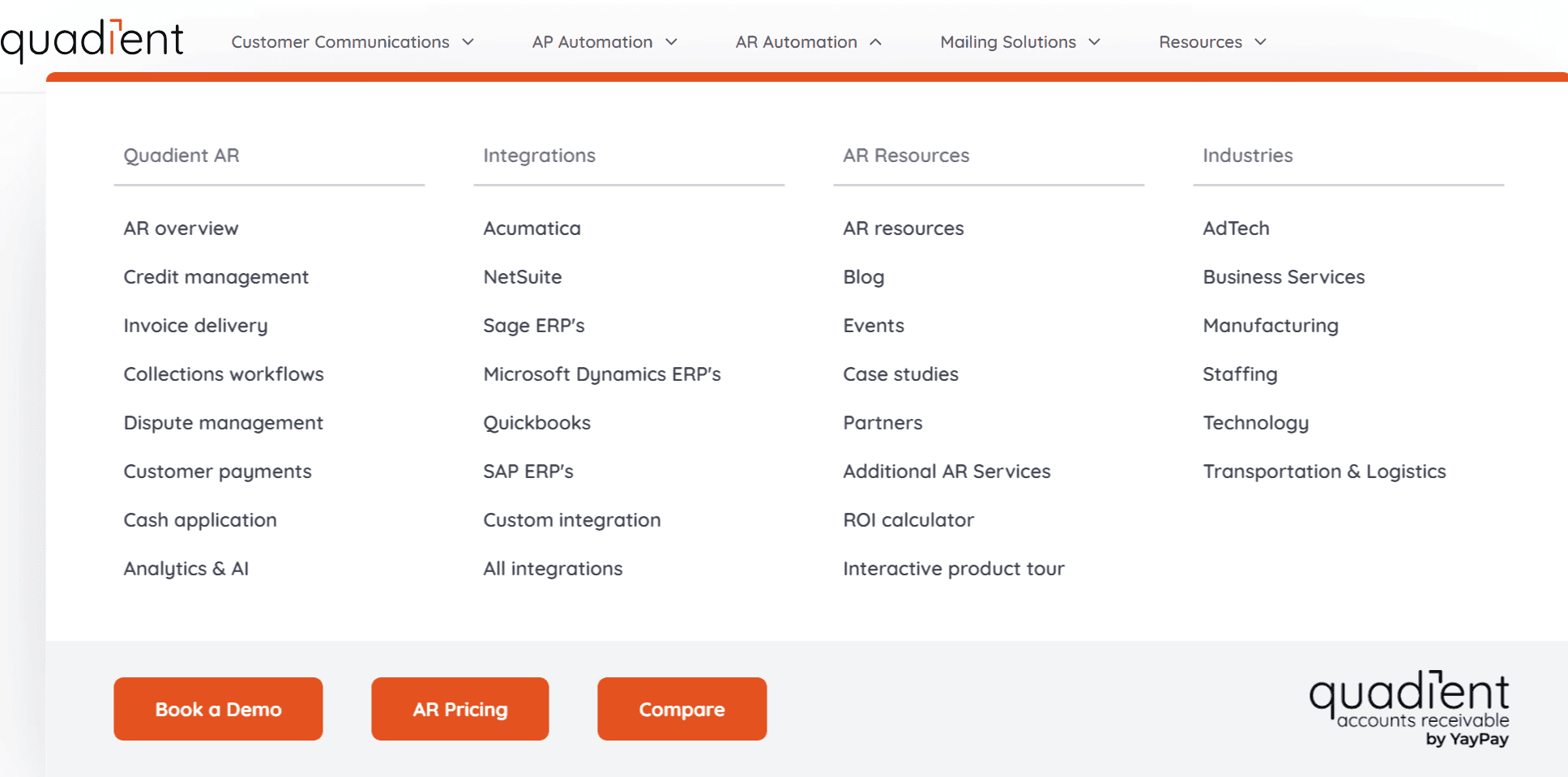
HighRadius vs Quadient: Dedicated AR Suite vs Multi-Entity Collections
Quadient's AR automation offering is based on YayPay, which was founded in 2015 and acquired by Quadient in 2020 for approximately EUR 17 million. YayPay had raised EUR 14 million in venture funding prior to the acquisition.
The platform provides rule-based collections workflows, a customer payment portal, and AR dashboards. Quadient positions the product within its broader customer communications management portfolio, targeting multi-entity enterprises that need collections automation across business units.
Quadient does not process customer replies or billing queries. The AR module is one component within a larger customer communications suite rather than a purpose-built AR platform.
For AR teams comparing HighRadius vs Quadient, HighRadius has significantly deeper AR module coverage including cash application, deductions, and credit management. Quadient's strength is multi-entity support for organisations with complex corporate structures. HighRadius requires a longer implementation. Both automate outbound reminders only.
Best for: enterprise organisations with multi-entity structures that need collections automation across business units, particularly those already in a Quadient relationship for customer communications.
5. Billtrust — US Payment Processing and Electronic Invoicing
HighRadius vs Billtrust: Enterprise AR Suite vs US Payment Network
Billtrust is a US-based platform that covers electronic invoicing, payment processing, cash application, and collections. The platform targets mid-to-large companies, with strength in the US market.
Billtrust's collections module automates payment reminders through rule-based workflows. The platform offers payment network connectivity, allowing buyers to receive and pay invoices electronically. Billtrust has introduced templated auto-responses for certain inbound query types. These templates pattern-match on incoming messages and suggest a pre-written reply for the AR team to review and send. The templates do not read conversation threads or resolve queries end-to-end.
Billtrust also offers cash application as part of its platform.
For AR teams comparing HighRadius vs Billtrust, HighRadius has broader module coverage with dedicated deduction management and credit management. Billtrust has stronger payment network connectivity and electronic invoicing infrastructure. HighRadius is stronger for financial services and SAP environments. Billtrust is stronger for US companies prioritising payment processing. Both automate outbound collections through rule-based workflows. Neither handles inbound billing queries end-to-end.
Best for: mid-to-large US-based companies where payment processing infrastructure and electronic invoicing are priorities alongside collections automation, and HighRadius's module depth exceeds requirements.
6. Versapay — Digital Invoice Presentment and Payment Portal
HighRadius vs Versapay: Enterprise AR Suite vs Payment Portal
Versapay is a collections and invoicing platform founded in 2006, built around a digital invoice presentment and payment portal. The platform's core strength is reducing payment friction through a self-service interface where customers can view invoices, select payment methods, and pay directly. Versapay targets mid-to-large B2B companies where the speed and ease of payment collection is the primary requirement.
The platform sends automated payment reminders and provides AR dashboards and collections workflows. The invoicing portal supports multiple payment methods, giving customers flexibility in how they pay.
Versapay does not process customer replies or billing queries. The portal gives customers a place to pay, but when a customer has a question about an invoice, a PO number discrepancy, or a dispute, the AR team handles that interaction manually. Collections messages are templated, not personalised to account context or conversation history.
For AR teams comparing HighRadius vs Versapay, the platforms address different problems. HighRadius has deeper module coverage across cash application, deductions, and credit management. Versapay has a stronger invoice presentment and payment portal that reduces friction between invoice delivery and payment. HighRadius is built for complex enterprise AR operations. Versapay is built for teams where payment collection speed is the bottleneck. Both automate outbound reminders only. Neither handles inbound billing queries end-to-end.
Best for: mid-to-large B2B companies where payment friction is the primary DSO driver and customers would benefit from a self-service invoicing and payment portal, and HighRadius's module depth exceeds requirements.
7. Emagia — Enterprise AR Analytics and Collections Prioritisation
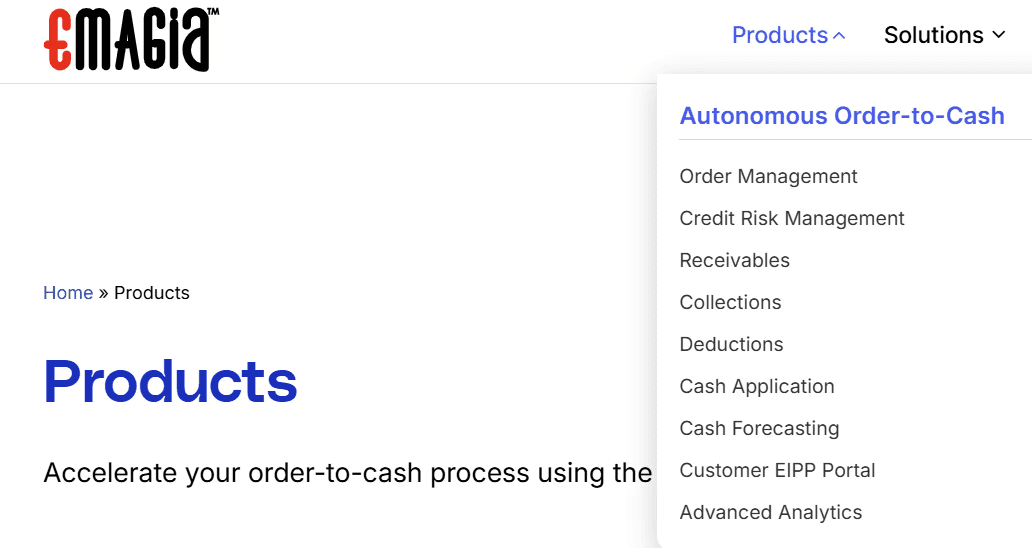
HighRadius vs Emagia: Two Enterprise Platforms with Predictive Scoring
Emagia is a US-based AR automation platform targeting mid-to-large enterprises. The platform covers collections management, cash application, credit management, and AR analytics. Emagia uses machine learning models for payment prediction and collections prioritisation, and integrates with Oracle, SAP, and NetSuite.
Emagia automates payment reminders through rule-based workflows and uses predictive models to score accounts and prioritise collection effort. The platform provides AR performance dashboards, ageing analysis, and collections effectiveness metrics.
Emagia's models predict payment dates and prioritise accounts. The models do not execute collection conversations, resolve billing queries, or manage customer replies. Emagia does not process inbound billing queries. Emagia has a smaller market presence than HighRadius.
For AR teams comparing HighRadius vs Emagia, both platforms target enterprise AR with predictive scoring and cash application. HighRadius has broader module coverage and deeper market presence. Emagia has stronger AR analytics and reporting dashboards. Both automate outbound reminders through rule-based workflows. Neither handles inbound billing queries or the collections conversation.
Best for: mid-to-large enterprises on Oracle or SAP that need AR analytics, collections prioritisation, and cash application, and want a more analytics-focused alternative to HighRadius.
8. Gaviti — Mid-Market Collections with Cash Application
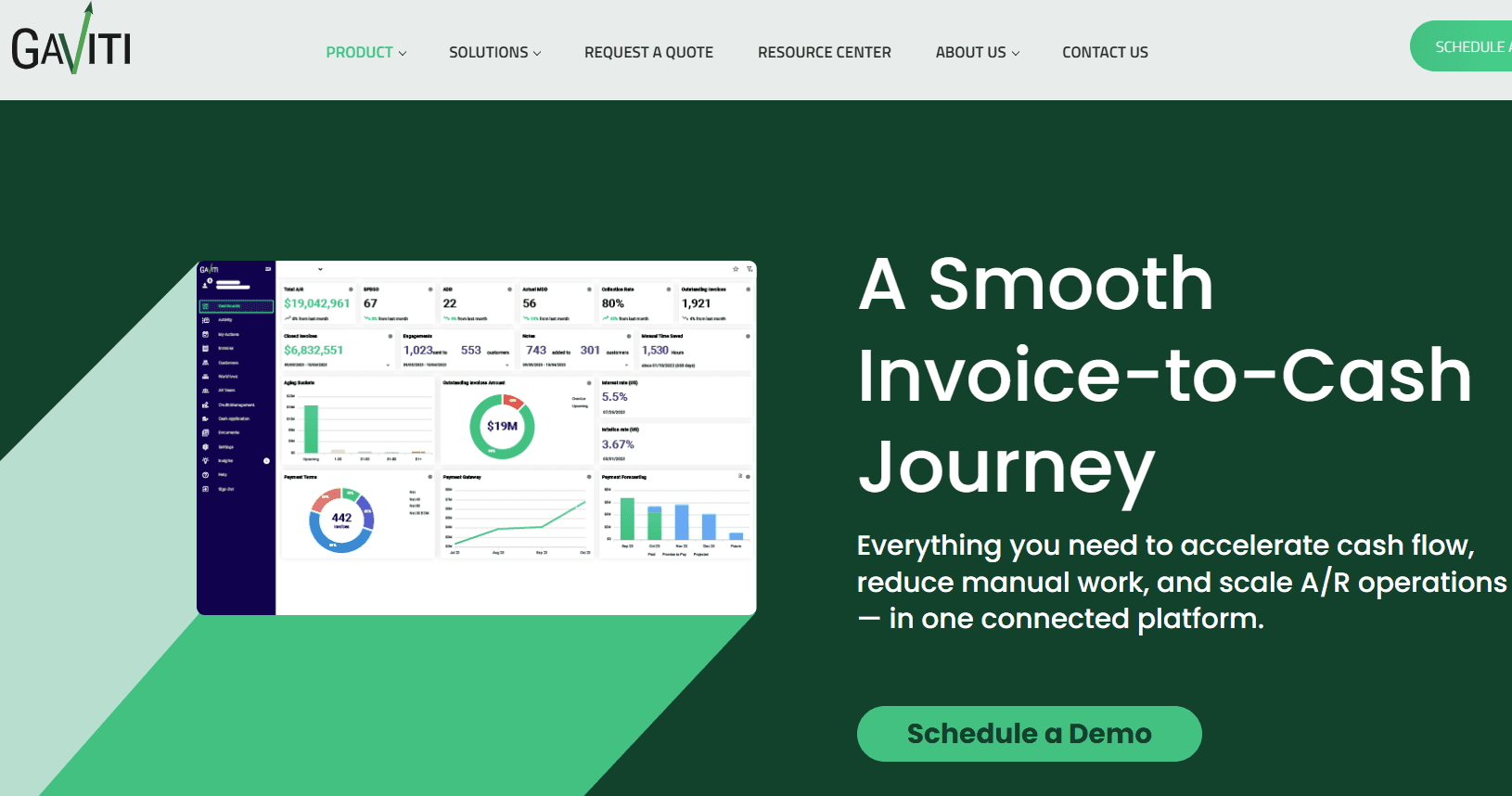
HighRadius vs Gaviti: Enterprise Suite vs Mid-Market Collections Specialist
Gaviti is a mid-market AR platform founded in 2017 in Israel. The platform targets mid-market B2B companies with collections automation and cash application.
Gaviti automates payment reminders through rule-based workflows and includes cash application functionality, which is uncommon among mid-market AR tools. The platform also offers a chatbot for querying AR data and generating reports. The chatbot is for internal use by the AR team, not for handling customer communication.
Gaviti does not process customer replies or billing queries. Gaviti has a smaller install base and less market recognition than HighRadius.
For AR teams comparing HighRadius vs Gaviti, HighRadius has significantly broader module coverage and deeper enterprise capabilities. Gaviti offers collections automation with cash application at a mid-market price point with faster deployment. HighRadius is built for large enterprises. Gaviti is built for mid-market teams. Both automate outbound reminders only.
Best for: mid-market B2B companies that need collections automation combined with cash application and find HighRadius's enterprise model, pricing, and implementation timeline excessive for their requirements.
9. Tesorio — Cash Flow Forecasting with Collections Automation
HighRadius vs Tesorio: Enterprise AR Suite vs Mid-Market Forecasting
Tesorio is a US-based AR platform focused on cash flow forecasting and collections. The platform targets mid-market companies, with particular strength in SaaS and technology organisations that need visibility into future cash positions alongside collections workflows.
Tesorio automates payment reminders through rule-based workflows. The platform's primary differentiator is its cash flow forecasting engine, which uses historical payment data to predict future cash receipts and flag accounts at risk of late payment. Tesorio integrates with NetSuite and Salesforce.
Tesorio does not process customer replies or billing queries. Tesorio's primary value is cash flow visibility. The collections module is functional but less developed than HighRadius's collections worklist.
For AR teams comparing HighRadius vs Tesorio, the platforms serve different segments and needs. HighRadius offers deep module coverage for large enterprises. Tesorio offers cash flow forecasting and working capital visibility for mid-market SaaS and technology companies. HighRadius requires six-to-twelve-month implementation. Tesorio deploys in weeks. Both automate outbound reminders only.
Best for: mid-market SaaS and technology finance teams where cash flow forecasting and working capital visibility are the primary requirements, and HighRadius's enterprise scope exceeds what the team needs.
10. Chaser — Affordable Payment Reminders for Small Businesses

HighRadius vs Chaser: Enterprise Suite vs SMB Reminder Tool
Chaser is a UK-based platform founded in 2013 that targets small businesses with automated payment reminders integrated with Xero and QuickBooks. Published pricing starts at GBP 179 per month.
Chaser automates payment reminders through rule-based workflows. The platform is designed for small finance teams that need basic collections automation without the complexity of enterprise AR tools. Chaser's reminders are selected from templates with merge fields. There is no AI-generated personalisation. Chaser does not process customer replies or billing queries.
For AR teams comparing HighRadius vs Chaser, the platforms are in entirely different categories. HighRadius is an enterprise AR suite with deep module coverage. Chaser is an SMB reminder tool with fast setup and low cost. Chaser has no cash application, deduction management, or credit scoring. Neither handles inbound billing queries.
Best for: small businesses on Xero or QuickBooks that need affordable, simple payment reminders. HighRadius customers will not find Chaser a like-for-like replacement, but teams spinning out a smaller business unit or subsidiary may find it sufficient for basic reminder workflows.
Why Adding AI to Legacy AR Software Is Not the Same as AI-Native
HighRadius has "Freeda." Sidetrade has payment prediction. Emagia uses machine learning to score accounts. These features are commonly presented as AI capabilities. The distinction matters for AR teams evaluating HighRadius alternatives.
Adding AI features to a platform built before large language models existed is not the same as building a platform on AI architecture from the ground up. The analogy is the shift from on-premise software to cloud. Adding a web portal to an on-premise system did not make it a cloud product. Adding predictive scoring or a templated auto-responder to a rule-based workflow engine does not make it an AI-native platform.
HighRadius's Freeda pattern-matches on incoming messages and suggests a templated reply. The AR team reviews and sends it. Sidetrade's scoring model predicts when payment might arrive. The AR team still does the collection work. Emagia's models prioritise which accounts to chase. The AR team still chases them. These features add value. They do not change the fundamental architecture.
Paraglide is the only platform in this comparison built after the emergence of large language models, with AI agents as the core product rather than a feature added to existing workflows. The Billing Support Agent reads billing queries, retrieves live data, and responds to customers. The Collections Agent manages multi-turn collections conversations. The agents do the work. The AR team approves, monitors, and handles the exceptions.
10 HighRadius Alternatives Compared: Side-by-Side HighRadius Comparison
Capability | Paraglide | Esker | Sidetrade | Quadient | Billtrust | Versapay | Emagia | Gaviti | Tesorio | Chaser |
|---|
Inbound billing query handling | ✅ Full AI agent | ❌ Not supported | ❌ Not supported | ❌ Not supported | ⚠️ Templated | ❌ Not supported | ❌ Not supported | ❌ Not supported | ❌ Not supported | ❌ Not supported |
Conversation thread awareness | ✅ Reads full thread | ❌ No thread context | ❌ No thread context | ❌ No thread context | ❌ No thread context | ❌ No thread context | ❌ No thread context | ❌ No thread context | ❌ No thread context | ❌ No thread context |
Outbound collections automation | ✅ AI-personalised | ✅ Rule-based | ✅ Rule-based | ✅ Rule-based | ✅ Rule-based | ✅ Rule-based | ✅ Rule-based | ✅ Rule-based | ✅ Rule-based | ✅ Rule-based |
Collections personalisation | ✅ AI-generated per account | ⚠️ Template merge fields | ⚠️ Template merge fields | ⚠️ Template merge fields | ⚠️ Template merge fields | ⚠️ Template merge fields | ⚠️ Template merge fields | ⚠️ Template merge fields | ⚠️ Template merge fields | ⚠️ Template merge fields |
Cash flow forecasting | ❌ Not available | ❌ Not available | ✅ Available | ❌ Not available | ❌ Not available | ❌ Not available | ✅ Available | ❌ Not available | ✅ Core capability | ❌ Not available |
Dispute and deduction handling | ✅ AI-assisted | ⚠️ Basic workflow | ⚠️ Basic workflow | ⚠️ Basic workflow | ⚠️ Basic workflow | ❌ Not supported | ⚠️ Basic workflow | ❌ Not supported | ❌ Not supported | ❌ Not supported |
Cash application | ✅ Available | ⚠️ Limited | ⚠️ Limited | ❌ Not supported | ✅ Available | ❌ Not supported | ✅ Available | ✅ Available | ❌ Not supported | ❌ Not supported |
Credit management | ✅ AI Credit Agent | ⚠️ Basic | ✅ Risk scoring | ❌ Not supported | ❌ Not supported | ❌ Not supported | ✅ Available | ❌ Not supported | ❌ Not supported | ❌ Not supported |
Customer payment portal | ❌ Not available | ✅ Available | ✅ Available | ✅ Available | ✅ Available | ✅ Core capability | ❌ Not available | ❌ Not available | ❌ Not available | ❌ Not available |
24/7 coverage | ✅ AI agent operates around the clock | ❌ Business hours only | ❌ Business hours only | ❌ Business hours only | ❌ Business hours only | ❌ Business hours only | ❌ Business hours only | ❌ Business hours only | ❌ Business hours only | ❌ Business hours only |
AI architecture | ✅ AI-native (Gen 3) | ❌ Pre-LLM (founded 1985) | ❌ Pre-LLM (founded 2000) | ❌ Pre-LLM (YayPay founded 2015) | ❌ Pre-LLM | ❌ Pre-LLM (founded 2006) | ❌ Pre-LLM | ❌ Pre-LLM (founded 2017) | ❌ Pre-LLM | ❌ Pre-LLM (founded 2013) |
Implementation | Days | 3–6 months | 6+ months | Months | Months | Weeks | Months | Weeks | Weeks | Days |
Pricing | Custom | Custom (six figures+) | Custom (six figures+) | Custom | Custom | Available on request | Custom | Not published | Not published | Published (from GBP 179/mo) |
Target market | Mid-market to enterprise | Large enterprise | European enterprise | Enterprise (multi-entity) | Mid-to-large (US) | Mid-to-large B2B | Mid-to-large enterprise | Mid-market | Mid-market (SaaS/tech) | SMB |
How to Choose the Right HighRadius Alternative
Choose Paraglide if the bottleneck in your AR operation is the inbound billing conversation: the queries, disputes, replies, and follow-ups that accumulate in a shared inbox while HighRadius handles only the outbound workflow. Paraglide is the AI-native platform where agents handle the full collections conversation from first outreach to payment resolution. Implementation takes less than ten days.
Choose Esker if your primary need is consolidating AP, AR, order management, and procurement under one vendor, particularly if your organisation already uses Esker for other finance operations. Esker has broader functional coverage across the finance stack but less depth in AR-specific modules than HighRadius.
Choose Sidetrade if your primary need is credit risk prediction and payment forecasting for a European enterprise or shared services operation. Sidetrade has stronger credit risk scoring than HighRadius and deeper European market presence.
Choose Quadient if your organisation has a complex multi-entity structure and you need collections automation across multiple business units, particularly if you already have a Quadient relationship.
Choose Billtrust if you are a US-based company that needs payment network connectivity and electronic invoicing alongside collections automation. Billtrust has stronger payment infrastructure than HighRadius for organisations where invoice delivery and payment processing are the primary requirements.
Choose Versapay if your primary need is reducing payment friction through a self-service invoice presentment and payment portal. Versapay is strongest for B2B companies where the speed and ease of payment collection is the bottleneck, and HighRadius's module depth exceeds requirements.
Choose Emagia if you need AR analytics, collections prioritisation, and cash application for a mid-to-large enterprise and want a more analytics-focused alternative to HighRadius's worklist-based approach.
Choose Gaviti if you need collections automation with cash application in a mid-market platform that deploys in weeks, and HighRadius's module depth exceeds what your team requires.
Choose Tesorio if your primary need is cash flow forecasting and working capital visibility alongside collections automation for a mid-market SaaS or technology company.
Choose Chaser if you are a small business on Xero or QuickBooks and need affordable, simple payment reminders.
Every platform in this comparison except Paraglide automates the outbound reminder or workflow. No platform except Paraglide automates the conversation that follows. For AR teams where that conversation is the bottleneck, the choice is Paraglide.