From my experience managing AR teams across multiple regions, the real bottleneck in receivables isn’t invoice volume, but the constant stream of customer communication. In 2025, enterprise AR teams handling 1,000-10,000 invoices per month are still processing 50-150 emails weekly, including missing POs, disputed amounts, requests for invoice copies, remittance clarifications, and tax questions. If these are left unresolved for even a few days, these interactions delay cash, increase DSO, and introduce significant forecasting uncertainty.
According to a 2025 Gartner research, AR teams spend up to 80% of their time managing communication rather than collecting cash. This is because traditional ERPs and AR tools are built to handle payment reminders, not the conversational layer of accounts receivable (back-and-forth emails, document requests, and clarifications) that actually determine payment timing.
The good news is that AR automation solutions now operate inside the finance inbox, reading messages, responding to routine queries, retrieving documents, capturing promise-to-pay commitments, and escalating only when human judgment is required.
In this article, I will show how AR automation software works in implementation, how top platforms differ in approach, and what AR managers, FinOps leads, and CFOs can automate to reduce DSO, speed cash flow, and cut the time teams spend buried in inboxes. Let’s get started!
What is accounts receivable software, & how does it reduce 60-80% of inbox bottlenecks?
Accounts receivable software automates invoicing, collections, and payment tracking. It is built to reduce the manual workload that keeps AR teams tied to their inboxes instead of focusing on revenue.
It centralises customer communications, tracks invoice status, and provides visibility into the promise-to-pay (PTP) commitments that typically live buried in hundreds of weekly emails.
For AR teams managing 1,000+ invoices per month, inboxes are the true bottleneck. Each customer email that requests a missing document, clarifies a purchase order, disputes an amount, or confirms a payment date can delay cash collection by 7-14 days.
Across a typical month, 200-400 emails demand attention, consuming 60-80% of your team’s time. ERP dashboards and standard workflow tools do not identify these delays because they focus on invoices and not conversations.
Accounts receivable systems today combine workflow automation with conversation management. Beyond generating invoices and reminders, the most effective AR automation solutions:
Track customer replies and automatically log PTP commitments.
Retrieve missing documentation or invoice attachments without human intervention.
Escalate only when judgment or exception handling is required.
Synchronize all updates directly to the ERP, keeping accurate and auditable records.
This approach reduces the time AR teams spend managing inbox overload and ensures that collections focus on high-value accounts or disputed invoices rather than repetitive follow-ups. By automating the conversation layer, accounts receivable software transforms email traffic from a liability into actionable data, hence lowering DSO and improving forecast accuracy.
From my experience, I would recommend Paraglide, after using and suggesting it to many, as its AI agents operate directly inside the finance inbox, handling two-way communication in 100+ languages, capturing PTP dates, resolving routine queries, and escalating exceptions.
This helps remove the bottleneck that prevents AR teams from scaling, ensuring payments are collected faster without adding headcount or overloading the team.
Guide to choosing AR software that works for high-volume teams
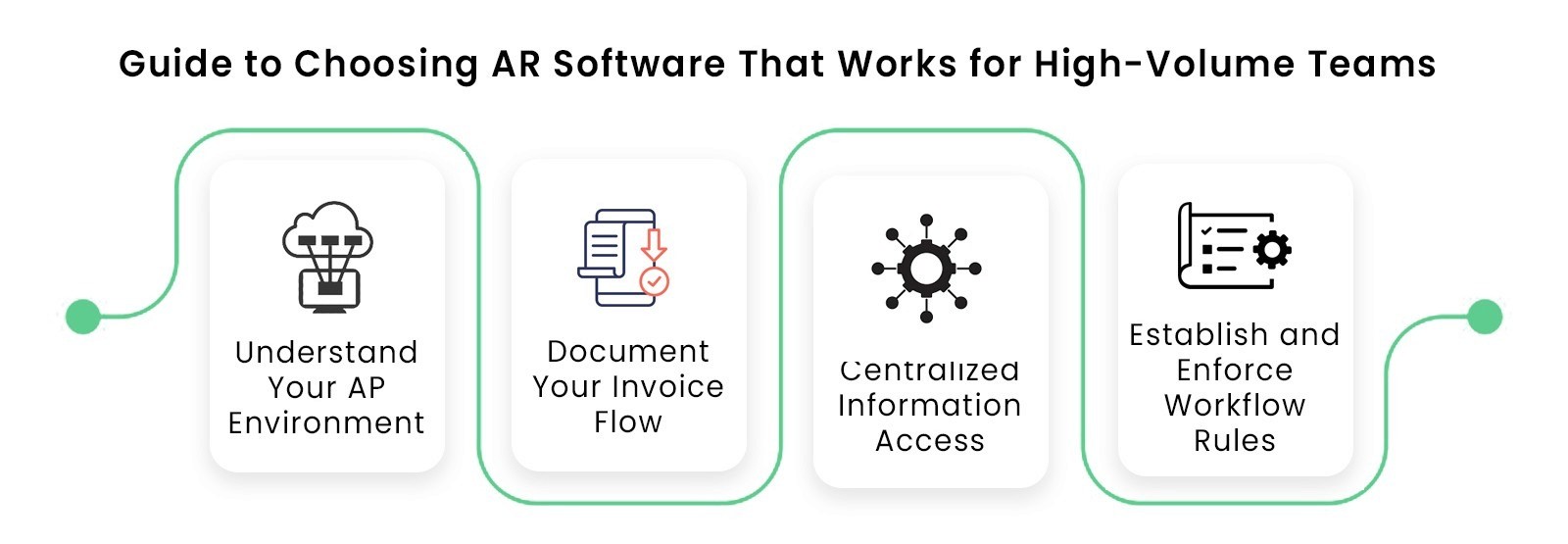
Selecting an accounts receivable software requires a clear view of how your team handles invoicing, customer communication, and dispute resolution. AR operations fail when information is scattered across inboxes, portals, and regional systems. The right solution must solve the communication bottlenecks that extend DSO, create backlog, and weaken cash-flow visibility.
How to evaluate and select the Right AR software
The best way to evaluate AR software is to start with your own receivables process. Before comparing dashboards, reminder workflows, or integrations, it helps to look at where payments slow down, how customer communication is handled, and what your team still does manually. The table below outlines four steps to guide that assessment.
Step | What to ask | What to look for | Red flag |
|---|
1. Understand your AR environment | How much of our collections process depends on email, clarification requests, missing documents, and dispute handling? | A platform that supports two-way communication, captures replies automatically, and keeps customer communication out of disconnected inbox threads | The software focuses mainly on reminders, dunning schedules, and dashboards |
2. Document your invoice flow | Where do payments typically get stuck between invoice issuance and payment approval? | A system that handles routine requests such as invoice copies, PO corrections, statements, remittance details, and promise-to-pay follow-up | The tool automates invoice sending but leaves the follow-up work to shared inboxes and manual chasing |
3. Centralise access to customer invoice data | Can teams see invoice status, credit notes, contacts, payment history, and customer communication in one place? | A platform that brings financial data and customer communication into a single view and syncs updates back to the ERP | Users need to switch between ERP, inboxes, and spreadsheets to understand one account |
4. Establish and enforce workflow rules | Can we standardise follow-up, dispute handling, escalations, and promise-to-pay tracking across teams? | A platform that supports consistent rules, logs actions clearly, and escalates genuine exceptions at the right time | The process depends on individual habits, inbox folders, or manual handovers |
Top 5 AR platforms finance teams trust for faster cash flow
When evaluating accounts receivable software, finance leaders often compare platforms based on workflow depth, communication handling, integration maturity, and their ability to reduce delays across high-volume AR environments. The following is a list of the best AR software in 2026. Let’s take a look at it.
1. Paraglide

Paraglide automates the AR inbox layer, the back-and-forth customer emails that cause 60-80% of payment delays. While most AR tools focus on workflows and reminders, Paraglide operates inside the finance inbox, handling the actual conversations that determine when customers pay: invoice copy requests, PO mismatches, tax clarifications, document retrieval, and promise-to-pay commitments.
The platform reads inbound emails, interprets intent, responds in 100+ languages, and syncs structured data like PTP dates, dispute details, and remittance confirmations directly to the ERP. It escalates only when human judgment is required, for example, when a customer pushes back on a balance, asks for an exception to standard terms, or raises a question that doesn’t have a clear, predefined answer.
For AR teams managing 500+ invoices per month, this removes the bottleneck that prevents scaling: hundreds of weekly emails requiring context, accuracy, and immediate response.
Paraglide supports multi-entity, multi-region operations with full audit traceability. Every AI-generated response, customer reply, and commitment is logged for SOX compliance and internal audit. It also surfaces early risk signals, recurring disputes, partial payments, and stalled communication, so teams can intervene before accounts age into write-off ranges.
While traditional AR platforms automate one-way, templated reminders. Paraglide automates two-way conversations in the finance inbox. That's where the delays live, and where most teams still operate manually.
Best For
Enterprise AR teams that manage 500 + invoices per month with substantial inbound email volumes and complex dispute handling.
Strengths
Designed for inbox-native communication automation, not just rule-based reminder workflows.
It handles two-way customer emails and supports 100+ languages, lowering translation overhead for global shared-service centers.
Auto-syncs promise-to-pay dates, dispute resolutions, and remittance details back to the ERP.
Improves forecast accuracy by capturing structured customer commitments tied to real payment behaviour.
Limitations:
Likely an overkill for small teams.
Focuses primarily on automating the conversation layer of AR
Traditional AR platforms automate what finance teams send to customers. Paraglide goes further by handling customer replies, resolving blockers, and keeping payments moving. That difference determines whether payment commitments are captured, disputes are resolved quickly, and DSO is reduced predictably.
2. Upflow
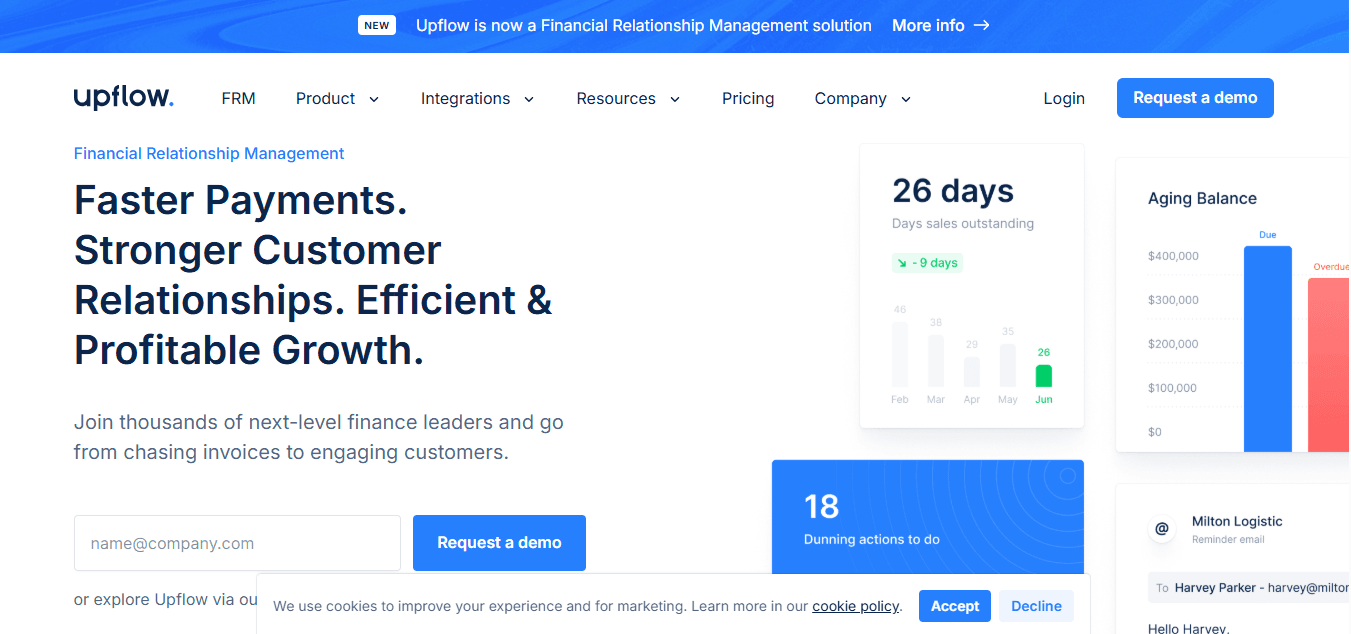
Upflow is an accounts receivable and collections workflow platform built to help finance teams organise follow-ups and prioritise overdue accounts. The product focuses on giving AR teams better visibility into open invoices, customer risk, and aging so they can execute collections more consistently across portfolios.
The platform allows teams to segment accounts, schedule reminder sequences, and track collection activity, with integrations into ERP and CRM systems to pull in basic customer and revenue context.
However, Upflow’s automation primarily supports outbound collections workflows. Customer replies such as disputes, documentation requests, partial payment explanations, or promise-to-pay confirmations are not interpreted or acted on automatically. These inbound emails still need to be reviewed, understood, and handled manually in the finance inbox, which limits their impact on the communication-driven delays that extend DSO.
Best For
Mid-market AR teams that want improved visibility and consistency in collections follow-ups, without replacing manual handling of customer communication.
Strengths
Provides structure and prioritisation for outbound collections activity.
Simple dashboards for tracking overdue invoices and collector workload.
ERP and CRM integrations that improve basic customer context.
Limitations
Does not automate inbound customer emails or conversation threads.
Promise-to-pay commitments, disputes, and clarifications must be manually read and logged.
Limited impact on inbox-driven delays that dominate high-volume AR environments.
3. Gaviti

Gaviti is an accounts receivable collections automation platform built to help finance teams structure and standardise follow-up workflows across open invoices. The platform focuses on improving collection consistency through configurable rules, task automation, and analytics that help teams prioritize accounts based on risk, aging, and payment behavior.
Gaviti allows AR teams to define follow-up cadences, automate reminder emails, and track collector activity across portfolios. While Gaviti improves structure and accountability in collections workflows, its automation is primarily rule-based and outbound. Inbound customer communication, such as clarification requests, document follow-ups, disputes, and promise-to-pay confirmations, typically still requires manual handling in finance inboxes.
Best For
Mid-market AR teams looking to standardise collections workflows and improve visibility into overdue accounts.
Strengths
Configurable collections workflows and automated reminder scheduling.
Clear dashboards for aging, prioritization, and collector performance.
ERP integrations to maintain a consistent system of record.
Limitations
Automation is mainly focused on outbound reminders rather than inbound customer responses.
Customer email conversations, dispute clarifications, and PTP confirmations often remain outside the system in inboxes.
4. Esker
Esker provides a workflow-driven accounts receivable platform built to help finance teams structure and coordinate collection activity across open invoices. The platform emphasizes standardized processes, task automation, and centralized visibility into account status, disputes, and customer payment progress
For teams looking to bring consistency to AR operations, Esker supports credit-limit monitoring, automated dunning sequences, dispute tracking, and system-assisted cash application. These capabilities help reduce manual coordination across collections tasks and improve oversight across large customer portfolios.
However, Esker’s automation is primarily workflow-led rather than inbox-native. Inbound customer emails, such as clarification requests, disputed line items, or missing PO references, often still require manual review and response by AR teams.
Best for
Teams looking for structured invoice-to-cash workflows and centralized AR process control, especially where customer interaction is largely portal- or process-driven.
Strengths
Centralizes main AR functions with rule-based automation and prioritization.
Supports dispute management, credit monitoring, and cash application
ERP integrations help maintain data consistency across systems
Limitations
Relies on manual handling for many inbound customer email conversations.
Communication automation does not extend deeply into reading, interpreting, or responding to email threads.
5. Centime
Finally, Centime provides AR automation embedded directly within ERP ecosystems, giving structured workflows for invoice delivery, reminder sequences, and collections management. Its design supports finance teams looking to streamline routine follow-ups, reduce manual task creation, and maintain consistency across customer outreach without relying on external tools.
By operating within the ERP environment, Centime allows teams to manage AR activity from a familiar system of record, lowering context switching and simplifying user adoption. It automates standard touchpoints such as invoice distribution, scheduled reminders, overdue notifications, and basic collections escalations.
However, Centime’s automation primarily focuses on structured workflow steps rather than handling the unstructured conversations that typically occur within email chains. Customer replies that include disputes, missing PO corrections, documentation questions, or payment-date confirmations still require manual attention from AR teams.
Best for
Mid-market companies looking for ERP-embedded AR automation with workflow triggers and invoice delivery logic.
Strengths
Customizable collections workflows and automated invoice distribution.
Branded payment portal for customer payments and reminders.
Embeds directly into ERP systems like NetSuite and Sage Intacct, lowering context switching.
Limitations
Focused more on structured workflows and automated reminders than on deep conversational handling of customer replies.
Incoming email communication and promise-to-pay capture remain largely manual.
Quick comparison of AR automation software
The table below shows how leading AR software differs specifically across integration depth, inbox automation, and deployment model, with Paraglide standing out as the only inbox-native AI agent built for high-volume communication.
Platforms | Best for | Integration Depth | Communication automation | Inbound email handling | Deployment profile |
Paraglide | Enterprise AR teams managing 500+ invoices/month with heavy inbound email volume and complex disputes | Deep ERP integrations (billing, CRM, multi-entity, multi-region, audit-ready) | Inbox-native, 2-way AI automation across full email threads | Strongest: Reads inbound emails, interprets intent, responds automatically, captures PTPs, resolves disputes, retrieves documents, escalates selectively | Fastest: Deploys directly inside existing finance inboxes with no workflow overhaul |
Upflow | Mid-market AR teams seeking better visibility and consistency in outbound collections follow-ups | ERP + CRM integrations for invoice, customer, and revenue context | Workflow-driven outbound reminders and task scheduling | Manual: Customer replies must be read and handled by AR staff | Medium: Requires configuration of segments, sequences, and dashboards |
Gaviti | Mid-market AR teams want standardized collections workflows and prioritization | ERP integrations for invoice and customer data | Rule-based outbound reminder automation | Manual: Inbound disputes, clarifications, and PTP emails remain outside the system | Medium: Workflow rules and prioritization logic setup |
Esker | Teams seeking structured, end-to-end invoice-to-cash workflows and centralized AR control | Broad ERP integrations with dispute, credit, and cash application modules | Workflow-led communication automation tied to AR processes | Limited: Inbound email interpretation and response are largely manual | Medium to Long: Process design and workflow configuration required |
Centime | Mid-market teams looking for ERP-embedded AR workflows and invoice delivery automation | Native ERP connectors (NetSuite, Sage Intacct, QBO) | Automated invoice delivery, reminders, and standard workflows | Manual: Customer replies (disputes, POs, PTPs) require human review | Fast to Medium: Depends on ERP integration depth |
Final thoughts: Collect faster, and focus on strategy
The biggest constraint for high-volume AR teams is the time spent managing customer communications like emails, document requests, disputes, and clarifications, and not the invoices themselves.
Yes, traditional AR platforms improve workflow, but they do not go back and forth, which determines when customers actually pay.
This is why Paraglide stands out as the best AR software platform, which is purpose-built to automate this conversation layer. Its AI agents operate inside the finance inbox, managing two-way communication, capturing promise-to-pay commitments, retrieving documents, and syncing updates directly to the ERP. This allows teams to resolve routine inquiries instantly, reduce manual workload, and focus on high-value accounts and strategic decision-making.
For AR managers, FinOps leads, and CFOs, adopting an expert solution like Paraglide will ensure faster collections, cleaner forecasts, and the ability to redirect resources from inbox management to value-added finance initiatives.