Deductions erode receivables quietly. A customer pays an invoice short by 2%, citing a promotional agreement. Another deducts a logistics claim with a one-line reason code that nobody on the AR team can trace without pulling up three separate systems. A third pays 90% of an invoice and sends an email explaining a pricing discrepancy that sits unread in the shared inbox for a week.
Most AR teams manage deductions manually. They track them in spreadsheets, ERP worklists, or sticky notes on a monitor. When a short payment is detected, someone on the AR team has to reach out to the customer to ask why they did not pay the full amount, wait for a response, interpret the reason, assign a deduction code, and decide whether to accept, challenge, or escalate. That entire workflow lives in the finance inbox, where deduction notifications land and sit unresolved alongside hundreds of other billing queries.
The cost is not just operational. Unresolved deductions become write-offs. They distort revenue recognition, create audit exposure, and quietly reduce gross margin by percentage points that compound every quarter. For companies processing thousands of invoices a month, deduction management is not an edge case. It is a core AR function that most teams have no dedicated tooling to handle.
What Is Deduction Management in Accounts Receivable?
Deduction management is the process of identifying, categorising, investigating, and resolving short payments and unauthorised deductions taken by customers against invoices. It sits at the intersection of collections, dispute resolution, and trade compliance, and it is one of the most labour-intensive functions in any AR operation.
A deduction occurs when a customer pays less than the invoiced amount and provides (or fails to provide) a reason. The AR team must then determine whether the deduction is valid, recover the amount if it is not, or write it off if recovery is not possible. The complexity comes from the variety of deduction types, the volume at which they arrive, and the number of source documents required to investigate each one.
Deduction Type | Root Cause | Typical Resolution Path |
|---|
Trade promotion deduction | Customer claims a promotional discount was agreed but not reflected on the invoice | Cross-reference trade promotion agreement, verify terms, approve or challenge |
Pricing discrepancy | Customer's purchase order price differs from the invoiced price | Compare invoice to PO and contract terms, issue credit or re-invoice |
Damaged goods claim | Customer received damaged or defective goods and deducts the value | Review proof of delivery, inspect claim documentation, approve or dispute |
Logistics shortfall | Customer claims fewer units were received than invoiced | Cross-reference shipping records, proof of delivery, and packing slips |
Early payment discount taken incorrectly | Customer takes a prompt-payment discount outside the agreed window | Verify payment date against discount terms, challenge if taken late |
Unauthorised deduction | Customer deducts an amount with no supporting reason or documentation | Reach out to customer for explanation, escalate if no response |
Each deduction type requires a different investigation path, a different set of source documents, and a different approval workflow. That fragmentation is what makes manual deduction management so expensive and so prone to leakage.
Why Manual Deduction Management Fails at Scale
Manual deduction management breaks down the moment volume exceeds what a small team can handle in a shared inbox and a spreadsheet. The operational reality is that deductions do not arrive in clean, structured formats. They arrive as short payments with cryptic reason codes on remittance advice, as free-text emails with partial explanations, or as line-item adjustments buried in payment files that require manual matching.
To investigate a single deduction, an AR specialist must cross-reference the remittance advice against the original invoice, pull the purchase order, check the contract or promotional agreement, review proof of delivery or shipping records, and read any prior email threads related to the account. That investigation can take fifteen to thirty minutes per deduction. Multiply that across dozens or hundreds of open deductions per month, and the workload consumes entire roles.
ERP-native deduction workflows offer limited help. Most ERPs can flag a short payment and create a deduction record, but they cannot investigate it. They cannot read the email from the customer explaining why they paid short. They cannot cross-reference a trade promotion agreement that lives in a separate system. They cannot reach out to the customer to request a missing reason code. The AR team still has to do all of that manually.
Challenge | Operational Impact |
|---|
Deductions arrive with cryptic or missing reason codes | AR team must contact the customer to request clarification before investigation can begin |
Investigation requires data from multiple systems | Each deduction requires cross-referencing invoices, POs, contracts, shipping records, and promotional agreements |
Deduction notifications arrive as free-text emails | No automatic capture, categorisation, or routing; everything is manual |
High volume of low-value deductions | Individually small, but collectively material; often written off because investigation cost exceeds recovery value |
No thread continuity across follow-ups | Customer replies to deduction queries land in the shared inbox with no link to the original case |
Spreadsheet tracking breaks at scale | No workflow routing, no audit trail, no escalation logic; deductions fall through the cracks |
AR specialists consumed by investigation work | Senior AR staff spend time on document retrieval and email chasing instead of strategic credit and collections work |
The result is predictable. Low-value deductions are written off because investigating them costs more than recovering them. High-value deductions sit open for weeks because the investigation queue is too long. And the AR team spends the majority of its time on reactive, manual work that produces no insight into why deductions are occurring in the first place.
How AI Agents Improve Deduction Management Workflows
AI agents handle deduction management differently from rule-based software because they operate on the unstructured, conversational layer where deductions actually live. Rule-based deduction tools work by pattern-matching on structured reason codes in remittance data. They can categorise a deduction if the reason code is clean and maps to a predefined rule. They cannot do anything with a free-text email, a vague reason code, or a customer who paid short and provided no explanation at all.
AI agents read the email. They understand what the customer is saying, cross-reference the claim against live billing and account data, and either resolve the deduction or route it to the right person with the full context already assembled. The difference is not incremental. It is architectural.
Automatic outreach for missing deduction reasons. When a short payment is detected and no reason is provided, the AI agent reaches out to the customer automatically, asking for the deduction reason in a natural, conversational email. When the customer replies, the agent reads the response, interprets the reason, matches it to the appropriate deduction category, and initiates the correct resolution workflow. No manual email drafting, no waiting for an AR specialist to pick up the case.
Conversational handling of complex deduction disputes. Customers do not explain deductions in structured reason codes. They write emails. They reference prior conversations. They combine a deduction explanation with a separate billing query in the same message. AI agents handle this naturally because they read the full email thread, understand context, and respond to what the customer actually said.
Capability | Rule-Based Deduction Software | Paraglide AI Agent |
|---|
Structured reason code categorisation | ✅ Matches predefined codes | ✅ Matches codes and interprets free-text reasons |
Free-text email interpretation | ❌ Cannot read unstructured emails | ✅ Reads and understands email content |
Automatic outreach for missing reasons | ❌ Requires manual email from AR team | ✅ Reaches out to customers automatically |
Customer reply capture and interpretation | ❌ Replies land in inbox unlinked to case | ✅ Reads reply, updates deduction record, initiates workflow |
Multi-issue email handling | ❌ Matches one pattern per message | ✅ Addresses deduction and other queries in same email |
Thread context across follow-ups | ❌ No thread awareness | ✅ Reads full conversation history |
Cross-referencing live account data | ⚠️ Limited to ERP-connected fields | ✅ Accesses invoice, PO, payment, and account data in real time |
Escalation with assembled context | ❌ AR specialist must investigate from scratch | ✅ Routes to specialist with full brief: claim details, account data, thread history, and draft response |
The operational shift is significant. Instead of the AR team manually triaging every short payment, emailing customers for explanations, waiting for replies, reading those replies, assigning reason codes, and deciding on next steps, the AI agent handles that entire loop. The AR team only gets involved when human judgement is genuinely required: high-value disputes, complex trade promotion claims, or cases where the customer's explanation does not match the data.
Deduction Management Software Vendors
The market for deduction management software ranges from AI-native platforms built to handle the full deduction conversation to specialised tools focused on trade promotion deductions and claim processing. The right choice depends on whether the primary bottleneck is the investigation and communication workflow (the finance inbox problem) or the categorisation and matching of structured deduction data.
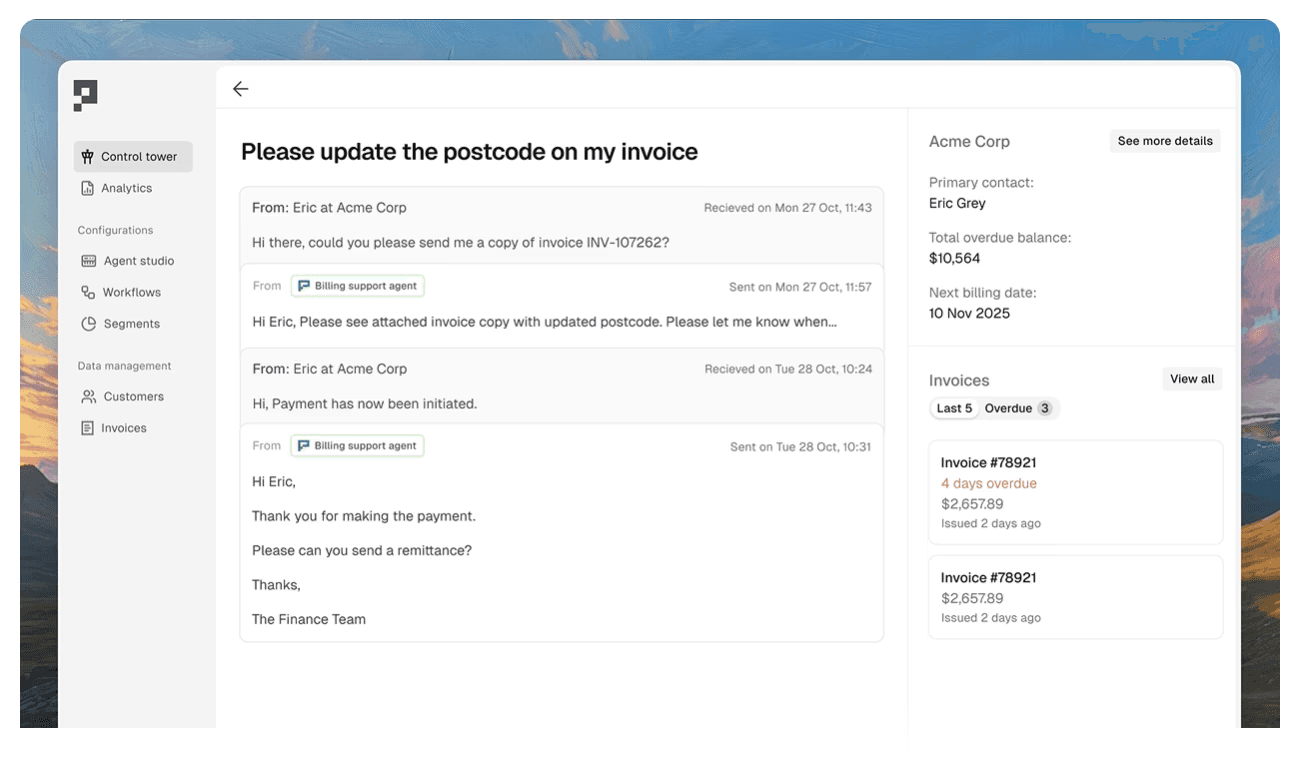
Best for: B2B AR teams where deductions are managed through email conversations and the finance inbox is the bottleneck.
Paraglide is an AI-native AR platform with core AI agents including a Billing Support Agent, a Collections Agent, and a Credit Agent. For deduction management, the Billing Support Agent handles inbound deduction notifications, reaches out to customers automatically when reason codes are missing, captures and interprets replies, and routes complex cases to the AR team with full context assembled. The Collections Agent handles outbound follow-up on unresolved deductions as part of personalised collections conversations. Paraglide implements in under ten days and customers reduce DSO by an average of 34%. Backed by Bessemer Venture Partners.
2. HighRadius
Best for: Large enterprises with structured deduction workflows already in place that need better categorisation and matching at volume.
HighRadius, founded in 2006 in Houston, offers a deduction management module as part of its broader AR suite. The module focuses on matching deductions to backup documentation, categorising by reason code, and routing through approval workflows. HighRadius uses rule-based pattern matching and templated workflows. The platform does not handle inbound email conversations or reach out to customers for missing deduction reasons. Implementation timelines for HighRadius typically run several months.
3. iNymbus
Best for: Companies dealing with high volumes of retail chargebacks and deductions from large retailers.
iNymbus focuses specifically on deduction and chargeback processing, with particular strength in retail and e-commerce environments where deductions come from portals and EDI transactions. The platform automates the process of logging into retailer portals, downloading backup documentation, and matching deductions to internal records. iNymbus is a workflow automation tool, not a conversational AI platform; it does not handle email-based deduction communications.
4. CPGvision
Best for: Consumer packaged goods companies that need trade promotion management with integrated deduction tracking.
CPGvision is a trade promotion management platform that includes deduction management as part of its broader TPM/TPO suite. The deduction functionality is oriented around trade spend: matching deductions to promotional agreements, validating claims against planned trade spend, and reporting on trade promotion effectiveness. CPGvision is purpose-built for the CPG industry and is not a general-purpose AR deduction management tool.
5. Promomash
Best for: Emerging and mid-market CPG brands managing trade promotions and the deductions that result from them.
Promomash offers trade promotion management with deduction tracking aimed at growing CPG companies. The platform helps teams plan promotions, track deductions against those promotions, and manage the reconciliation process. Promomash is designed for the specific workflow of trade-driven deductions in consumer goods and does not extend to general B2B deduction management or inbound email handling.
6. Claimable
Best for: UK-based businesses managing customer claims and deductions with a focus on dispute documentation and workflow.
Claimable provides claims and deductions management with an emphasis on capturing claim details, managing supporting documentation, and routing cases through internal approval workflows. The platform is oriented toward structured claim processing rather than conversational deduction resolution.
7. Luminous
Best for: Companies looking for analytics and visibility into deduction trends and root causes.
Luminous focuses on deduction analytics and reporting, helping AR teams identify patterns in deduction activity, track recovery rates, and analyse root causes. The platform's strength is in the data and reporting layer rather than in automating the operational workflow of investigating and resolving individual deductions.
Side-by-Side Comparison
Capability | Paraglide | HighRadius | iNymbus | CPGvision | Promomash | Claimable | Luminous |
|---|
Deduction capture from email | ✅ AI agent reads inbox | ❌ Manual or ERP import | ❌ Portal-based | ❌ Trade-focused | ❌ Trade-focused | ⚠️ Manual entry | ❌ Analytics only |
Auto-categorisation | ✅ AI interprets reason | ✅ Rule-based matching | ✅ Portal matching | ✅ Trade promo matching | ✅ Trade promo matching | ⚠️ Manual | ⚠️ Reporting only |
Automatic outreach for missing reasons | ✅ AI agent emails customer | ❌ Manual | ❌ Not applicable | ❌ Not applicable | ❌ Not applicable | ❌ Manual | ❌ Not applicable |
Customer reply handling | ✅ AI reads and processes replies | ❌ Manual | ❌ Not applicable | ❌ Not applicable | ❌ Not applicable | ❌ Manual | ❌ Not applicable |
Thread context and follow-up | ✅ Full thread awareness | ❌ No thread tracking | ❌ Portal-based | ❌ Not applicable | ❌ Not applicable | ❌ Manual | ❌ Not applicable |
Workflow routing | ✅ AI-driven with context | ✅ Rule-based | ✅ Automated | ⚠️ Trade-specific | ⚠️ Trade-specific | ✅ Manual routing | ❌ Reporting only |
ERP integration | ✅ Live integrations | ✅ Deep ERP integration | ✅ Retailer portals | ⚠️ Limited | ⚠️ Limited | ⚠️ Limited | ⚠️ Data import |
AI-native architecture | ✅ | ❌ Rule-based, pre-LLM | ❌ Workflow automation | ❌ | ❌ | ❌ | ❌ |
Implementation time | Under 10 days | Months | Weeks | Weeks | Weeks | Weeks | Weeks |
How to Pick a Deduction Management Vendor
The right deduction management software depends on where the bottleneck actually sits in the AR operation. For some teams, the problem is categorisation and matching of structured deduction data at high volume. For others, the problem is the unstructured, conversational layer: the emails, the missing reason codes, the customer replies that sit unread, and the manual outreach that consumes the AR team's capacity.
If the primary bottleneck is the finance inbox, the answer is an AI-native platform that can handle the conversation. Paraglide is the only deduction management platform that operates as an AI agent in the inbox: reading deduction notifications, reaching out to customers for missing reasons, capturing and interpreting replies, and routing complex cases with full context. That conversational automation is what separates Paraglide from every other tool in this category, because deductions are not resolved in dashboards or worklists. They are resolved in conversations.
For teams in the CPG industry where trade promotion deductions are the dominant type, a specialised TPM platform like CPGvision or Promomash may cover the categorisation and reconciliation layer. For teams dealing with high-volume retail chargebacks, iNymbus addresses the portal-based retrieval workflow. For enterprises with large, structured deduction operations already in place, HighRadius offers a rule-based module that fits into a broader finance suite including treasury management.
But none of those tools handle the inbound. None of them read the email from a customer explaining why they paid short. None of them reach out to ask for a reason code that was never provided. None of them follow up on an unresolved deduction with context from the prior conversation. That is what AI agents do, and it is what Paraglide was built for.
Paraglide's implementation takes under ten days. Customers reduce DSO by an average of 34%. The platform is backed by Bessemer Venture Partners and was founded by a former CFO and AR manager who built it to solve the exact problem that manual deduction management creates.
The Business Case for Automating Deduction Management
Unresolved deductions are not just an operational inconvenience. They are a direct hit to the balance sheet. Every deduction that sits uninvestigated for more than 30 days becomes exponentially harder to recover. Every deduction written off because the cost of investigation exceeded the recovery amount is margin lost permanently. For B2B companies processing thousands of invoices per month, the cumulative financial impact is material.
The costs break down across four categories. First, write-offs: deductions that are never investigated or challenged and are eventually written off as uncollectable. For companies with weak deduction management processes, write-off rates on deductions can reach 5% or more of total deduction volume. Second, margin erosion: invalid deductions that are accepted without challenge because the AR team lacks the capacity to investigate them. Third, audit and compliance risk: unresolved deductions create reconciliation gaps that surface during audits and can trigger restatements. Fourth, headcount: AR specialists spending the majority of their time on manual investigation, email chasing, and spreadsheet tracking instead of strategic credit and collections work.
Automating the deduction management workflow addresses all four. AI agents reduce time-to-resolution by handling the conversational layer automatically. They increase recovery rates by ensuring every deduction is investigated, including the low-value ones that manual teams write off. They free AR specialists to focus on the cases that genuinely require human judgement.
Paraglide customers reduce DSO by an average of 34%. That reduction is not driven by better payment reminders. It is driven by faster resolution of the issues that block payment, and deductions are among the most common blockers.
Metric | Manual Deduction Management | With Paraglide |
|---|
Time to first response on deduction query | Hours to days | Minutes |
Deductions investigated within 7 days | Partial; low-value deductions deprioritised | All deductions investigated regardless of value |
Customer outreach for missing reason codes | Manual email drafted by AR specialist | Automatic; AI agent reaches out immediately |
Follow-up on unresolved deductions | Manual; often delayed or missed | Automatic; AI agent follows up with thread context |
Deduction write-off rate | High; investigation cost exceeds recovery on small deductions | Reduced; automated investigation makes low-value recovery viable |
AR team time on deduction investigation | Majority of workload | Complex cases only |
Audit trail and documentation | Fragmented across inbox and spreadsheets | Complete; every interaction logged automatically |
DSO impact | Ongoing; unresolved deductions delay cash collection | Reduced by average 34% |
Closing
Deduction management has been an afterthought in AR software for decades. Legacy platforms bolted deduction modules onto suites designed for outbound payment reminders. Specialised tools addressed narrow slices of the problem: trade promotion matching, retailer chargeback processing, or deduction analytics. None of them addressed the core operational bottleneck: the conversations in the finance inbox where deductions are raised, investigated, and resolved.
AI agents built for the finance inbox change the workflow fundamentally. They read deduction notifications, reach out to customers for missing reasons, capture and interpret replies, cross-reference live account data, and route complex cases with full context assembled. The AR team handles the decisions that require human judgement. The agent handles everything else.
Paraglide is the only AI-native platform built to deliver this. Three AI agents covering billing support, collections, and credit management, with implementation in under ten days and an average 34% DSO reduction across customers.