Did you know that up to 86% of businesses report that as much as 30% of their monthly invoiced sales are overdue, creating direct cash flow pressure and operational drag.
Teams are forced to choose between scaling headcount to chase routine customer communication or accepting slower collections, inconsistent follow-ups, and increasing risk. Traditional AR automation has improved reminder workflows and visibility, but it has historically failed to address the hardest part of the job: two-way customer communication. Until recently, inbound emails were too unstructured, contextual, and judgment-based to automate. As a result, even well-tooled AR teams still rely on manual inbox triage to move payments forward.
The best performing finance teams recognize that effective B2B debt collection and b2b accounts receivable management start long before legal recovery, agencies, or write-offs. It starts with the conversations that determine whether a customer can and will pay on time. By automating repetitive communication and capturing payment commitments directly from customer interactions, teams can preserve relationship quality while improving operational throughput and lowering DSO.
In this blog, we will walk through practical and outcome-focused best practices for B2B collections in 2026 to help finance leaders improve cash flow, strengthen forecasting, and drive predictable payment behavior. Let’s get started.
What is B2B collections?
B2B collections, also referred to as business-to-business collections, is the process of ensuring that companies receive payment for invoices issued to other businesses within agreed credit terms. It sits at the intersection of accounts receivable, customer communication, and credit control.
B2B collections exists to convert issued invoices into cash. It operates in an environment where payments are tied to contracts, purchase orders, negotiated terms, and ongoing commercial relationships. Most customers intend to pay, but payment is often delayed by operational friction rather than refusal. Finance teams manage a constant stream of customer interactions related to:
Invoice copies and supporting documents
Purchase order and contract validation
Disputed line items, pricing, or tax treatment
Confirmations of payment timing and remittance
These conversations usually happen over email and account for most payment delays. For many AR teams, hundreds of inbound customer messages each week determine whether invoices are paid on time or slide into aging.
As a result, B2B collections is a communication-led process. Effective teams respond quickly, resolve issues with full context, and consistently record payment commitments. Ultimately, collection performance depends less on reminder schedules and more on how well teams manage high-volume customer conversations between invoicing and payment.
Historically, B2B collections have depended on human interpretation of these conversations, limiting how far teams could scale. In 2026, this is changing because advances in natural language understanding now allow AI systems to participate directly in customer conversations, resolving routine issues, capturing commitments, and updating systems of record automatically. This shift is redefining B2B collections as an AI-mediated, communication-first process rather than a workflow-driven administrative function.
Why traditional B2B debt collection struggles at scale?
As invoice volumes increase, B2B debt collection becomes constrained by human communication capacity rather than policy, intent, or tooling gaps. Traditional AR systems were designed to manage balances, schedules, and workflows, not to understand and resolve the unstructured conversations that determine when customers can pay.
Until recently, this limitation was unavoidable. Inbound emails vary by language, intent, and context, often combining multiple requests in a single thread. These conditions made automation impractical. Modern AI systems now remove that constraint, enabling collections to scale without proportional increases in headcount.
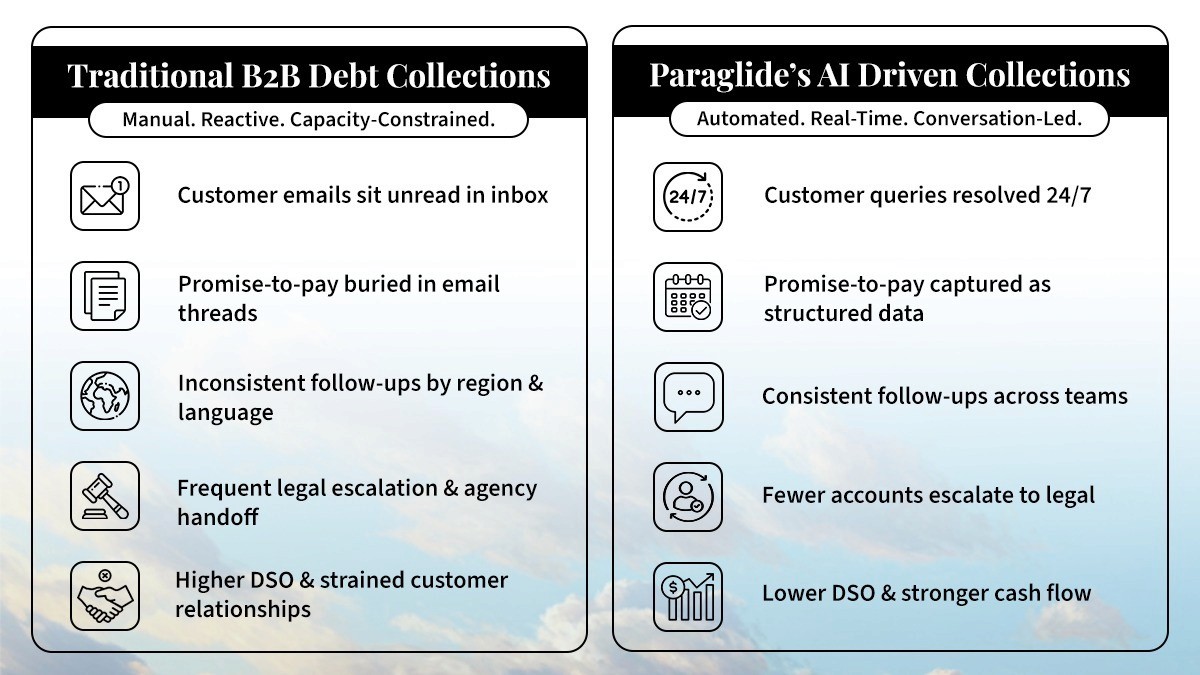
This gap leads to aging invoices, forecasting gaps, and higher risk exposure as teams grow.
Inbox overload is the real bottleneck
As invoice volumes grow, the limiting factor in B2B debt collection becomes the finance inbox. AR teams managing hundreds or thousands of invoices receive a constant stream of customer emails like requests for documents, clarification on charges, dispute updates, and payment confirmations.
The message requires a response before payment can proceed. When inboxes back up, response times slow, and invoices age even when customers intend to pay.
Workflow automation does not solve inbound complexity
Most AR automation tools focus on outbound workflows such as reminder schedules, task routing, and dashboard reporting. These tools work well for tracking balances but struggle with inbound communication.
Customer replies arrive unstructured, vary by language and context, and often include multiple requests in a single thread. Workflow tools cannot interpret these messages, retrieve the right documents, or capture payment commitments, leaving teams to manually triage and respond.
Hidden risk in manual follow-ups
Manual follow-ups introduce risk that is difficult to see in aging reports. Payment promises shared over email may never be recorded. Disputes can sit unresolved without clear ownership. In shared-service environments, follow-up quality varies by individual and region.
Over time, these gaps increase the likelihood of delayed payments, forecasting errors, and write-offs. At scale, inconsistent communication becomes a material risk to cash flow and credit control.
How does B2B debt collection actually work?
Contacting the debtor: B2B collection usually begins with a reminder or invoice sent to the customer. This initial outreach gives the customer an opportunity to review the invoice, request clarification, or confirm payment timing. Managing these early responses efficiently is critical, as most delays originate here.
In traditional B2B debt collection, this step relies on batch reminders and manual inbox monitoring. Customer replies often wait hours or days before being read and acted on.
With AI-driven collections, platforms like Paraglide respond immediately to inbound customer queries, retrieve invoice details, and resolve routine questions directly in the finance inbox, preventing delays before invoices begin aging.
Reminders: If payment does not occur, follow-ups continue through emails or calls. At this stage, customer replies often include document requests, disputes, or partial confirmations. Consistent follow-up and fast response handling help stop invoices from aging unnecessarily.
In traditional b2b debt collections, follow-up quality varies by collector capacity, region, and language, making inbox backlog the primary bottleneck.
With Paraglide, AI agents manage high-volume reminders, replies, and contextual follow-ups automatically, ensuring no customer response goes unanswered and payment conversations continue without interruption
Negotiations: When customers raise concerns about timing or amount, negotiation may take place. This can involve agreeing on a payment plan or a revised payment date. Capturing these commitments accurately and linking them to the invoice improves visibility and cash forecasting.
Traditionally, promise-to-pay commitments shared in email threads often go unrecorded.
With AI-native collections, Paraglide automatically captures payment commitments and remittance details from customer replies and syncs them to AR systems in real time, improving forecast accuracy without manual intervention.
Legal action: Legal steps are reviewed when communication breaks down or credit terms are materially breached. This process is time-consuming and typically reserved for cases where operational resolution is not possible anymore.
In traditional b2b debt collections, accounts escalate to legal due to unresolved communication rather than true credit risk.
With Paraglide’s AI-driven collections, most operational blockers are resolved earlier, reducing the number of accounts that require legal review in the first place.
Enforcement: In some cases, debts are assigned to external collection agencies. While effective for recovery, this approach increases cost and can strain customer relationships, which is why most finance teams aim to resolve issues earlier through structured communication and follow-up.
AI-enabled collections shift outcomes upstream by automating two-way customer communication, resolving disputes faster, and escalating only high-risk cases, platforms like Paraglide reduce reliance on enforcement while preserving commercial relationships and lowering overall collection costs.
7 best practices for B2B debt collection
Effective B2B debt collection is not achieved by sending more reminders or escalating invoices faster.
Finance teams that consistently reduce DSO focus on removing the practical blockers to payment, unanswered customer questions, unresolved disputes, missing documents, and unclear payment commitments. These issues sit in day-to-day customer communication, not in accounting systems, and payments move only when those conversations are resolved quickly and with full context.
These blockers live almost entirely in customer email conversations, not inside accounting systems. In 2026, the teams that perform best treat collections as a communication problem that must be automated at scale, not a workflow problem alone. Below are the best practices that leading AR teams follow, and how AI-native platforms like Paraglide make them achievable.
Below are the main best practices that AR teams are using in 2026.
Treat B2B debt collection as an AI-mediated communication process
Assume invoices are delayed due to payment blockages, not because customers are unwilling to pay. This means:
Responding quickly to customer questions
Resolving disputes before invoices age
Keeping the context across conversations
AR teams now use inbox-based workflows that allow routine customer queries to be handled immediately, rather than sitting unanswered while balances continue to age. With Paraglide, collections are managed directly inside the finance inbox, and the platform helps automate these inbox-based processes, ensuring responses are timely, consistent, and fully logged.
Automate high-volume, low-judgment customer interactions
Human collectors should not spend most of their time retrieving invoice copies, confirming due dates, or forwarding remittance details. At scale:
Hundreds of similar emails arrive each week
Manual triage becomes the bottleneck
Response delays directly extend payment cycles
Paraglide standardizes communication behavior automatically. Its AI agents manage personalised reminders, replies, and follow-ups across regions and languages, ensuring every customer receives consistent, timely, and context-aware communication without manual translation workflows.
Effective B2B debt collection is no longer a matter of better reminders or tighter workflows. It is about removing the communication friction that sits between invoicing and payment. As invoice volumes grow, the finance inbox becomes the limiting factor unless it is automated intelligently.
AI-native platforms like Paraglide represent a shift in how collections operate: from workflow-centric to conversation-centric, from manual triage to automated resolution, and from lagging indicators to real-time commitments. Finance teams that adopt this model improve cash-flow predictability, reduce DSO, and prevent invoices from ever entering formal debt recovery in the first place.
Capture promise-to-pay commitments where they actually occur
Payment commitments must be treated as financial data, not informal notes buried in email threads. Too often:
Customers confirm payment dates by email
Those commitments never reach the ERP
Cash forecasts remain inaccurate
B2B collections processes automatically capture promise-to-pay dates from customer responses and sync them back to accounts receivable systems in real time. Using a platform like Paraglide, your teams can improve visibility and forecast reliability without adding manual steps.
Resolve disputes early to stop invoices from turning into debt
Unresolved disputes are one of the strongest predictors of bad debt. Invoices that sit in stalled conversations:
Age faster
Require more follow-ups
Are more likely to breach credit terms
High-performing AR teams monitor conversational signals, silence, repeated clarification requests, partial payments, and flag any risk early so disputes can be addressed before invoices age past 60 or 90 days.
Standardize follow-ups across teams, regions, and languages
Consistency matters more than intensity. Shared-service AR teams operating across:
Multiple business units
Different countries
Multiple languages
Paraglide standardizes communication behavior automatically, and its AI agents manage personalized reminders, replies, and follow-ups across regions and languages, ensuring every customer receives consistent, timely, and context-aware communication without manual translation workflows.
Need standardized follow-up behavior, even when customers and regions vary. Leading teams rely on systems that can manage consistent communication at scale while adapting responses to local language and context, without creating manual translation workflows.
Keep all collections activity ERP-synced and audit-ready
Every customer interaction related to payment should be traceable. From a governance perspective:
Email-only collections create audit gaps
Payment commitments without ERP records create SOX risk
Fragmented inboxes obscure accountability
Paraglide integrates directly with ERP, billing, and accounting systems, ensuring invoices, payment status, customer data, and communication outcomes are continuously synced. This creates a single, traceable record of collections activity that supports governance and audit requirements.
B2B debt collection processes ensure that customer messages, disputes, and commitments are logged back into the system of record, providing a single, auditable view of accounts receivable activity.
Use escalation as a control, not a default
Escalation should be deliberate and data-driven, not reactive. Rather than escalating based solely on aging:
Teams prioritize accounts showing risk signals
Humans focus on high-value or complex cases
Routine communication continues without interruption
This approach reduces unnecessary friction with customers while ensuring true risk receives attention early.
Understand what B2B Collections Vs B2B Debt Recovery is
Although often used interchangeably, B2B collections and B2B debt recovery serve different purposes and operate at distinct stages of the receivables lifecycle.
B2B collections focuses on resolving operational and communication blockers before invoices become delinquent debt. B2B debt recovery begins only after structured resolution attempts fail and payment is no longer expected without enforcement.
What has changed in 2026 is how far collections can realistically go. Historically, collections depended on manual handling of customer communication, limiting how many invoices teams could resolve before escalation. Advances in AI now allow finance teams to resolve a much higher percentage of invoices during the collections phase by removing the communication friction that previously forced accounts into recovery. Let’s take a closer look at their differences:
Criteria | B2B collections | B2B debt recovery |
Primary goal | Convert issued invoices into cash | Recover unpaid debt |
Stage in the AR lifecycle | From invoice due date to structured escalation | After repeated failure to resolve or pay |
Customer relationship | Ongoing commercial relationship | Relationship is often strained or ending |
Typical activities | Managing customer emails, resolving disputes, sending reminders, and capturing promise-to-pay | Legal notices, collection agencies, litigation |
Operating model | Communication-led, high-volume, contextual | Enforcement-led, low-volume, high-cost |
Cost structure | Internal AR cost | Agency fees, legal costs |
Risk profile | Low relationship risk | High relationship and reputation risk |
High-performing finance teams aim to resolve as many invoices as possible during the collections phase, where communication speed, accuracy, and context directly determine outcomes. AI-native platforms such as Paraglide materially expand what can be achieved in this phase by operating directly inside the finance inbox.
By using AI agents to read customer emails, interpret intent, retrieve documents, and capture promise-to-pay commitments automatically, Paraglide allows teams to resolve routine blockers in real time and escalate only cases that genuinely require human judgment. This reduces the number of invoices that spill into formal debt recovery, preserves customer relationships, and lowers overall collection costs.
Final thoughts
Effective B2B debt collection in 2026 is about removing the operational friction that sits between invoicing and payment. For finance teams managing high-volume B2B accounts receivable, the primary constraint is customer communication, like emails, disputes, document requests, and payment confirmations that must be resolved before cash is released.
As discussed in this article, current B2B collections best practices focus on managing these conversations at scale, capturing payment commitments accurately, and keeping consistent follow-up across teams, regions, and languages. Traditional AR systems and workflow tools track balances, but they do not discuss the communication layer where most delays originate.
Finance leaders who treat business-to-business collections as a structured, communication-led process improve cash flow predictability, reduce DSO, and stop invoices from escalating into formal B2B debt recovery. As invoice volumes grow, resolving this layer efficiently becomes important to protecting working capital and keeping disciplined credit control.