In every large AR function I have worked, I have seen the same scenario: A B2B SaaS AR manager with thousands of subscription invoices a month is dealing with customers asking for updated PO numbers, copies of old invoices, or clarification on proration. A manufacturing credit controller is trying to reconcile mismatched PO numbers, partial deliveries, and remittances that don’t quite add up. Different businesses, same operational issue, just too many messages, and not enough hours.
Most overdue balances don’t happen because customers refuse to pay. They happen because AR teams are buried under repetitive inbox traffic: missing PO numbers, disputed quantities, requests for invoice copies, questions about credit notes, unclear remittances, and approval delays across multiple stakeholders and regions.
When hundreds or thousands of these messages sit waiting for a response, debtor days increase, cash becomes harder to forecast, and high-value accounts don’t get the attention they need. This creates a structural gap because the team had to either scale headcount or accept slower collections, inconsistent follow-ups, and rising risk.
AR automates pre-collections and cash-flow management, the work that happens long before legal recovery, agencies, or write-offs. Paraglide has been helping finance teams maintain a personal, relationship-driven approach, while eliminating the repetitive work that slows cash inflow and drives up DSO.
In this blog, we will discuss AI in accounts receivable and provide a practical guide to implement the technology in ways that improve customer experience, protect revenue, and reduce DSO. Let’s get started.
AI in accounts receivable is lowering delays and scaling global operations
AI in accounts receivable combines pattern recognition, automation, and generative AI to remove the friction that slows down cash flow. AI agents automate the high-volume tasks so that each human can have more accounts and invoices per person. It stops them from focusing on strategic accounts and relationship-driven work.
Where older AR automation relied on static rules and templated reminders, current AI agents can understand context, act on unstructured data, and keep payment cases moving without human intervention. They read and reply to emails, capture remittances and promise-to-pay dates, categorize disputes, and sync updates back into ERP and billing systems.
With historical payment behaviour and live inbox signals, finance teams can predict when customers are likely to pay and which accounts need early attention. This makes cash flow forecasting more accurate.
AI technologies powering faster cash flow and 60-80% fewer inbox delays
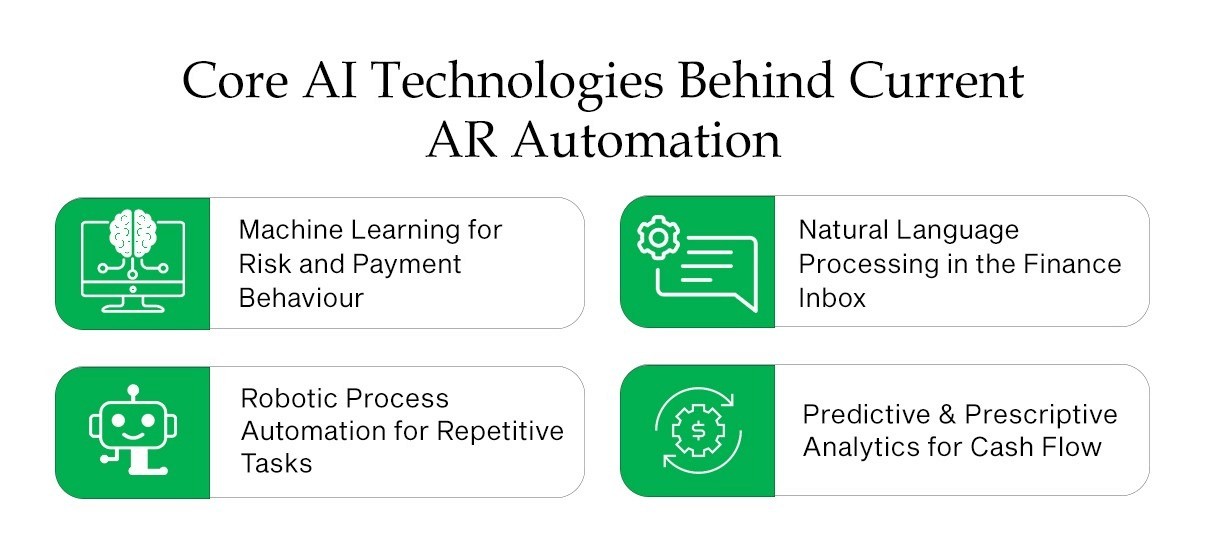
Current AR automation is powered by four complementary technologies that work together to reduce manual work and improve cash flow.
AI agents in the finance inbox
Most payment delays start with an email: disputes, missing POs, unclear remittances. NLP helps an AR handle inbox chaos at scale by:
Understands human language across emails, remittances, and forms the base for AI agents that respond 24/7
Auto-categorizes, routes, and logs finance conversations
Powers AI agents that respond accurately, not like old-school chatbots
This keeps customer communication moving without waiting on manual triage. For manufacturers or distributors, NLP can also interpret emails about missing proof of delivery (POD), incorrect quantities, or purchase order mismatches, as well as route them to the right workflow before invoices stall.
Robotic process automation for repetitive tasks
RPA completes the routine steps every invoice case requires:
Matching payments to invoices
Logging notes in ERP/CRM
Updating statuses after a promise-to-pay
Speaking from experience, these tasks take hours when done manually, but RPA makes them instant and error-free. This results in cleaner data, fewer disputes, and ultimately, faster cash conversion. AR teams can now get their time back to work on accounts that need human conversation.
Additionally, in industries with frequent deductions or short payments, RPA can pre-populate adjustment workflows when customers explain the reason in an email or remittance notes.
Predictive & prescriptive analytics for cash flow
This is where all the data comes together. AI turns conversation and payment patterns into actionable intelligence.
Forecasting cash inflows based on historical behaviour
Highlighting high-risk customers/segments
Suggesting changes in terms of escalation rules
Instead of reporting problems, your AR can stop them, hence lower DSO without pressure tactics.
Machine learning for risk and payment behavior
Machine learning identifies payment patterns, who pays on time, who slips, and why. Instead of treating every invoice the same, Machine learning models helped my AR teams analyze payment history to:
Predict which invoices are likely to become overdue
Flag slipping accounts early, such as partial payments, changing cadence
Recommend whom to contact today for maximum impact
ML allows proactive communication, so finance teams reduce delinquency rather than react to it.
Top use cases of artificial intelligence in accounts receivable for 2026
A recent industry study shows how common AR use cases map to different AI capabilities, recognizing intent and acting on behalf of the team. This reflects a major shift because AI is now operational inside the finance inbox.
Below are the practical use cases leading finance teams are deploying today.
1. AI agents in the finance inbox (2-Way conversations)
Instead of AR inboxes filling up with unanswered requests, AI now reads, understands, and responds to common billing messages in real time. That includes:
AI reading and replying to billing emails in natural language
Handling common queries such as invoices, credits, disputes, copies, “What is this charge?”
Capturing promise-to-pay dates and remittance details directly from emails
When and how the agent escalates to a human
This removes the typical delays caused by waiting for someone to reply, so the payment process keeps moving.
Paraglide’s AI agents manage high-volume 2-way conversations in 40+ languages, support multi-entity and multi-region AR operations, and sync commitments, disputes, and exceptions back to ERP in real time with SOX-ready audit trails. This conversation automation removes the bottleneck that prevents AR teams from scaling and freeing them to focus on high-value accounts and credit risk.
2. Smarter collection management and prioritisation
Machine learning evaluates payment risk, so AR teams focus their effort on stopping a payment issue:
Machine Learning scoring accounts for risk and impact
Suggested chase order: who to contact today, for what, via which channel
Tying outreach to predicted behaviours like chronic late payers vs first-time late payers
This shifts AR from reacting after a payment is late to guiding earlier, more informed follow-ups. In a B2B SaaS company, this might mean focusing today on high-MRR accounts showing unusual payment delays; in a manufacturing group, it might flag regional distributors whose payment cadence is slipping across multiple entities.
High-volume AR teams often struggle to know which accounts to focus on first. LLM-powered AI agents change that by automating conversations in credit control while guiding follow-ups with context. These agents can:
Manage 2-way dialogue with customers across email, chat, and portal channels
Escalate issues to new contacts or stakeholders automatically when required
Tailor messaging to each customer’s payment behaviour and history
Prioritize outreach based on predicted risk and account value.
Instead of reacting after payments are late, AR teams can proactively guide accounts toward on-time payment. In a B2B SaaS company, AI agents might focus on high-MRR accounts showing unusual delays; in a manufacturing environment, they could flag regional distributors with slipping payment cadence across multiple entities.
By handling the volume of routine communication, LLMs free AR specialists to focus on complex disputes, strategic accounts, and revenue protection, while ensuring every outreach is contextual, timely, and consistent.
3. Personalised dunning & follow-ups at scale
Traditional AR relies on rigid schedules and generic templates, which often annoy customers more than they help. No more generic templates or “chase everything weekly” rules. Dunning AI tools tailor communication based on customer behaviour and their preferred tone:
AI is generating different tones and frequencies for customer profiles
Using generative AI to personalise messaging while staying on-brand
Avoid spammy, “robotic” reminders and opt for more human-like messages.
This protects customer relationships while ensuring the right information gets to the right stakeholder each time.
4. Faster cash application and reconciliation
Once your team opts for AI agents for AR, like Paraglide, all your repetitive work will be handled by AI.
AI matching bulk payments to multiple invoices
Interpreting messy remittance advice and email notes
Lowering reconciliation backlogs as volume grows
This results in clearer ledgers and fewer backlogs as volume scales.
5. Early risk detection and credit decision support
AI surfaces problems early by tracing micro-signals of financial strain that humans often don’t see until cash is already late. Instead of waiting for invoices to age past due, the system monitors behavior shifts in real time, such as slower internal approvals, reduced engagement on invoice threads, unusual partial payments, or a sudden increase in disputes and missing PO details.
Spotting patterns indicating strain, like slipping payment times or smaller partial payments.
Suggesting credit limit adjustments or escalation before a customer goes bad
Feeding risk dashboards for the CFO / credit committee
How AI in AR Reduces DSO and Improves Cash Flow
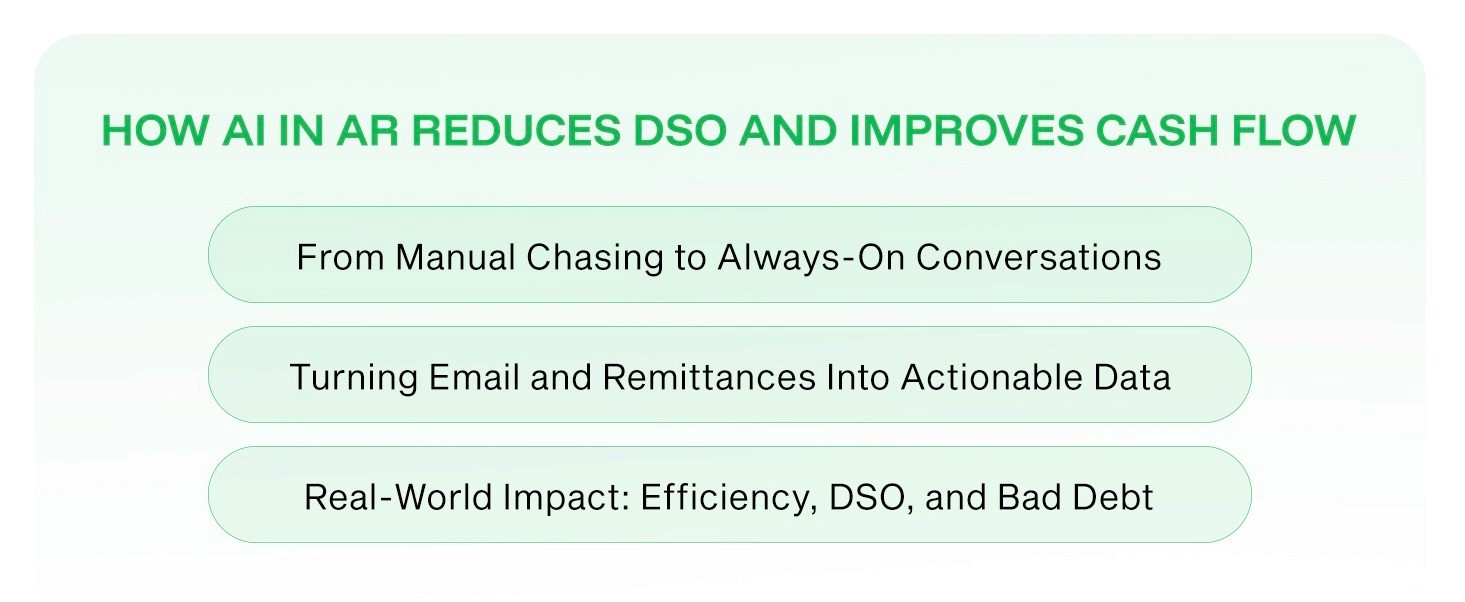
From Manual Chasing to Always-On Conversations
A human-only AR team can handle only so many emails a day, especially when managing thousands of open invoices. Delays occur not because customers refuse to pay, but because questions sit unanswered in inboxes such as “missing PO number”, “incorrect billing address”, “need invoice copy”, or “what is this charge?”
But taking help for the volume task and creating a team of humans and AI can reduce DSO. How exactly? This is because Paraglide resolves this bottleneck while working directly inside the finance inbox; they respond instantly in natural language, attach the right documents, track promises-to-pay, and continue the thread if needed.
Humans stay in control of escalations and high-risk accounts, while we handle the volume. This shift removes unnecessary waiting time between a question and a payment, hence lowering DSO without adding headcount.
Turning email and remittances into actionable data
In most AR teams, critical payment details live in inboxes and stay there, and might never make it back to the ERP. Paraglide eliminates that gap and handles all the heavy lifting for your team, and you notice less lost data in inboxes or spreadsheets.
When Paraglide reads and understands inbound messages in any language, it extracts commitments, bank details, partial payments, deduction reasons, and applies them directly to customer and invoice records. Finance gains live visibility into when money is coming and why delays happen. This turns disorganized email threads into structured data that drives smarter AR decisions.
Real-world impact on efficiency, DSO, and bad debt
When AR teams spend less time searching inboxes or sending repetitive follow-ups, they focus on the accounts where human expertise truly matters, disputes, escalations, and customers at financial risk. The operational gains translate into measurable financial outcomes:
Up to 35% reduction in DSO by removing preventable delays
6× faster case resolution because queries are answered immediately
30% fewer bad-debt write-offs thanks to earlier risk detection and escalation
These outcomes depend on customer mix, invoice volume, and system readiness but they demonstrate what’s possible when AI becomes a key part of the AR workflow: faster payments, stronger cash flow, and more bandwidth for finance teams to protect revenue.
Challenges and risks when implementing AI in AR
Data quality and fragmented systems
AI is only as effective as the data it can access, and I’ve seen many AR teams operate with disconnected systems: ERP, billing, CRM, payments, and inboxes that rarely sync. When invoice records don’t match email conversations or payment details, AI models struggle to learn and automate reliably.
Your teams might often need to clean up customer master data, resolve duplicate records, and align invoice statuses across systems before automation expands. Consolidating main workflows and establishing a single source of truth ensures AI can bring accurate follow-ups, predictions, and customer insights without introducing noise or errors.
For Finance Operations managers and Financial Controllers, this is the primary concern: if invoice data, customer records, and communication threads don’t reconcile across ERP, CRM, and billing systems, automation becomes unreliable. AI can only operate at scale when system owners have confidence that master data standards, auditability, and approval workflows remain intact.
Integration effort and change management
Introducing AI into AR workflows impacts both process and people. A phased rollout, such as starting with a specific inbox segment, customer region, or small-balance collections, allows the organization to build confidence with early wins.
Clear communication, hands-on training, and human-in-the-loop controls ensure AR specialists remain empowered, owning high-value tasks while agents handle routine messages. Companies that treat AI as a partner for collectors see faster adoption and stronger results.
Governance, privacy, and customer trust
AR data is highly sensitive as it contains bank details, contact information, and credit terms, which is why the guardrails are important. This is why AI agents like Paraglide must operate with strict access controls, encryption, and audit trails that document every action taken on behalf of the finance team.
Human approval should remain in place for high-risk cases like disputes or escalated credit decisions. Additionally, AI communication must reflect the company's tone and maintain the customer relationship; reminders should feel helpful, not automated or aggressive. Strong governance not only protects the business but also reinforces trust with customers who rely on timely, accurate billing interactions.
A practical roadmap to getting started with AI in AR
Step 1: Identify one high-volume, high-pain area
Look for repetitive work that slows cash collection. Examples are finance inbox requests, specific regions, and small-balance collections.
Prioritize where delays directly impact cash flow, such as unresolved questions, missing documents, and unclear invoices.
Choose a use case with enough volume to demonstrate value quickly, but low enough risk to experiment safely.
Align stakeholders early (AR leads, IT, FP&A) so success is visible and measurable.
Step 2: Define clear success metrics (DSO, inbox volume, resolution time)
Select 2-3 KPIs tied to business outcomes
Select realistic timelines and establish a baseline before deployment so improvements can be proven.
Step 3: Pilot an AI agent or automation in a controlled segment
Deploy automation on a specific customer tier, region, or invoice type.
Maintain human approvals for exception cases or escalations.
Monitor message tone, accuracy, and how customers respond.
Step 4: Tighten data, refine prompts, and workflows
Use errors to improve templates, routing, and playbooks
Step 5: Scale across customers, regions, and AR tasks
Expand coverage to more customer types once early success is demonstrated.
Move into additional automation areas like Payment plan adherence follow-ups, etc.
Shift human effort to high-touch customers and strategic risk controls.
Note that every action taken by an AI agent should be traceable, with a full audit trail of messages, context, and outcomes for internal reviews or external audits.
How to choose the right AI accounts receivable tool
Must-have capabilities
True 2-way conversational AI and not just templates
System Owners should evaluate whether the tool maintains audit trails, integrates cleanly with ERP workflows, and preserves existing approval rules without forcing process redesign.
Finance inbox integration
ERP / billing/accounting sync
Promise-to-pay capture and tracking
Human escalation and override
Smart questions to ask vendors
How does your AI learn from our data?
Do you support inbound queries and not just outbound dunning?
Do you use templated reminders or agentic contextual ones?
What does the onboarding timeline look like?
How do you handle multilingual customers?
What controls do finance teams have over tone and messaging?
Before AI vs after AI in AR workflows
Here’s a side-by-side comparison of traditional AR workflows versus AI-enabled AR operations.
AR Workflow Area | Before AI (Manual Reality) | After AI (With AI Agents like Paraglide) | Impact on DSO / Cash Flow |
Finance Inbox Management | Hundreds of unread emails; customers wait hours/days for replies | AI agents reply instantly to routine queries and route exceptions to the right workflow | Faster clarification, invoices get approved earlier |
Promise to Pay Tracking | PTP dates are buried in email threads or spreadsheets | AI agents extract PTPs, log them directly in ERP, and monitor adherence | More accurate forecasts; reduces surprise cash gaps |
Dispute Handling | Slow triage; unclear ownership; disputes discovered late | AI agents identify dispute type (pricing, PO mismatch, POD issue) and send to the correct owner instantly | Faster dispute closure, fewer invoices aging into 60/90+ days |
Customer Prioritisation | AR team “chases everything” or prioritises based on intuition | ML identifies high-risk accounts and who to contact today | Higher impact per touch; DSO improves consistently |
Payment Reconciliation | Manual remittance reading, mismatch errors, and delays in closing | AI agents read remittances and auto-match payments to invoices | Cleaner books, fewer aged items, faster close |
Communication Quality | Generic dunning templates; inconsistent tone | AI personalises tone, timing, and content per customer and region | More positive responses → faster payments |
Team Efficiency & Scale | Workload grows linearly with invoice volume | AI handles 60-80% of inbox + data work automatically | Teams scale without extra headcount, lowering cost per dollar collected |
The future of AI accounts receivable
This is the next era in AI, which is not static automation or rigid workflows, but intelligent agents that, on an ongoing basis, learn and adapt to improve cash flow without adding extra work for AR teams.
Transition from static rules to adaptive, learning agents
AI in finance has moved beyond simple templates or triggers. It improves with every exchange and recognizes phrasing, identifying decision-makers, and learning which messages speed up payments.
Over time, it becomes specialized in your customers, tone, and AR processes. Paraglide’s model handles disputes, charge issues, and multi-invoice payments with more accuracy and less manual input. Interested? Feel free to check Paraglide out.
Predictive cash flow and proactive escalations
AR is shifting from reacting to late payments to managing risk early. AI monitors payment behavior, delays, partial payments, and late acknowledgments and flags risks before they turn into bad debt.
It suggests next steps, escalation timing, and backup contacts before cash gaps occur. This strengthens forecasting and gives finance leaders time to act.
Human + AI collaboration
AI manages high-volume and repetitive tasks so teams can focus on strategy, relationships, and recovery. It provides insights and suggestions, while humans make the final decisions that maintain trust.
Paraglide already allows this as the AR teams stay in control while AI quietly removes the work that used to slow them down.