According to Deloitte’s 2025 CFO Survey, 63% of mid-market B2B companies report that overdue invoices and chasing payments are their top AR challenges. For an Accounts Receivable Manager handling over 2,000 invoices per month, 20–30% often require follow-up due to missing approvals, PO numbers, or disputes. Manual follow-ups can consume 400–500 hours each month, time that could be spent on strategic collections while promises-to-pay and exceptions are scattered across emails, spreadsheets, and ERP systems, creating friction and delayed payments. Traditional dunning approaches struggle to keep up with high volumes, leaving teams overwhelmed by endless email threads and delayed cash collection.
In 2026, high-volume businesses are approaching dunning differently. Instead of sending static reminders, they are using AI-agentic platforms to execute conversation-led, automated follow-ups, resolve operational blockers in real time, and focus human attention on the accounts that matter most. Teams using this approach are getting paid faster, reducing manual workload, and improving cash flow predictability, turning accounts receivable from a reactive process into a proactive, results-driven operation.
What Is dunning software?
Dunning software is a type of software that automates and manages the process of following up on unpaid invoices to collect payment. It typically sits within, or alongside, accounts receivable and collections systems.
At a minimum, dunning software helps finance teams:
Track overdue invoices and ageing
Send automated payment reminders
Record communication history
Escalate invoices that remain unpaid
Types of B2B dunning software
B2B dunning software comes in different types, each designed to manage overdue invoices in a structured way. The choice of system depends on factors such as invoice volume, workflow complexity, and the level of automation required.
Type of dunning software | Core approach | Two-way customer communication | Level of automation | Best suited for | Key limitations |
Rule-based | Fixed reminder schedules based on due dates | No | Low | Small or low-complexity B2B teams | Breaks down when customers reply or raise issues |
Workflow-based dunning software | Rule-based workflows with manual exception handling | No | Medium | Mid-market teams seeking structure and visibility | High ongoing manual effort; workflows require maintenance |
AI-assisted dunning Software | AI supports prioritisation and insights | Limited | Medium | Growing B2B teams needing better focus | AI stops at recommendations; replies handled manually |
Agentic dunning software | Autonomous AI agents manage conversations | Yes | High | B2B finance teams with high volumes of invoices | Overkill for very simple AR environments |
Enterprise collections suites | End-to-end AR platforms with dunning modules | No | Medium–High | Global enterprises | Expensive, complex, and often still workflow-driven |
1. Rule-based dunning software
Rule-based dunning software automates payment reminders using fixed schedules, such as sending emails 7, 14, or 30 days after an invoice becomes overdue.
Key characteristics:
One-way reminder emails
Static schedules and templates
Invoice-level tracking
Minimal handling of customer replies
Best suited for:
Small or low-complexity B2B businesses where customers rarely respond and payment behaviour is predictable.
Limitations:
Once a customer replies with a question or issue, the process typically moves outside the system and becomes manual.
2. Workflow-based dunning software
Workflow-based dunning tools add structure and visibility on top of traditional reminders. They use configurable workflows to assign tasks, manage follow-ups, and coordinate internal teams.
Key characteristics:
Rule-based workflows and escalation paths
Manual handling of exceptions
Better visibility across AR activity
Best suited for:
Mid-market teams looking to standardise collections processes without fully automating decision-making.
Limitations:
Customer replies still require human triage, and workflows must be maintained manually as complexity grows.
3. AI-Assisted dunning software
AI-assisted dunning software uses AI to support finance teams rather than replace them. The AI helps prioritise work and surface insights, while humans continue to execute most follow-ups.
Key characteristics:
Payment risk scoring and prioritisation
AI-generated suggestions or templates
Human-led execution
Best suited for:
Growing B2B teams that want to focus effort on the right invoices without automating customer communication.
Limitations:
Inbox workload and exception handling remain largely manual.
4. Agentic dunning software
Agentic dunning software represents the newest category. These platforms use AI agents to manage invoice collections as an ongoing, two-way conversation rather than a fixed reminder schedule.
Key characteristics:
Two-way, conversational automation
Automated understanding of customer replies
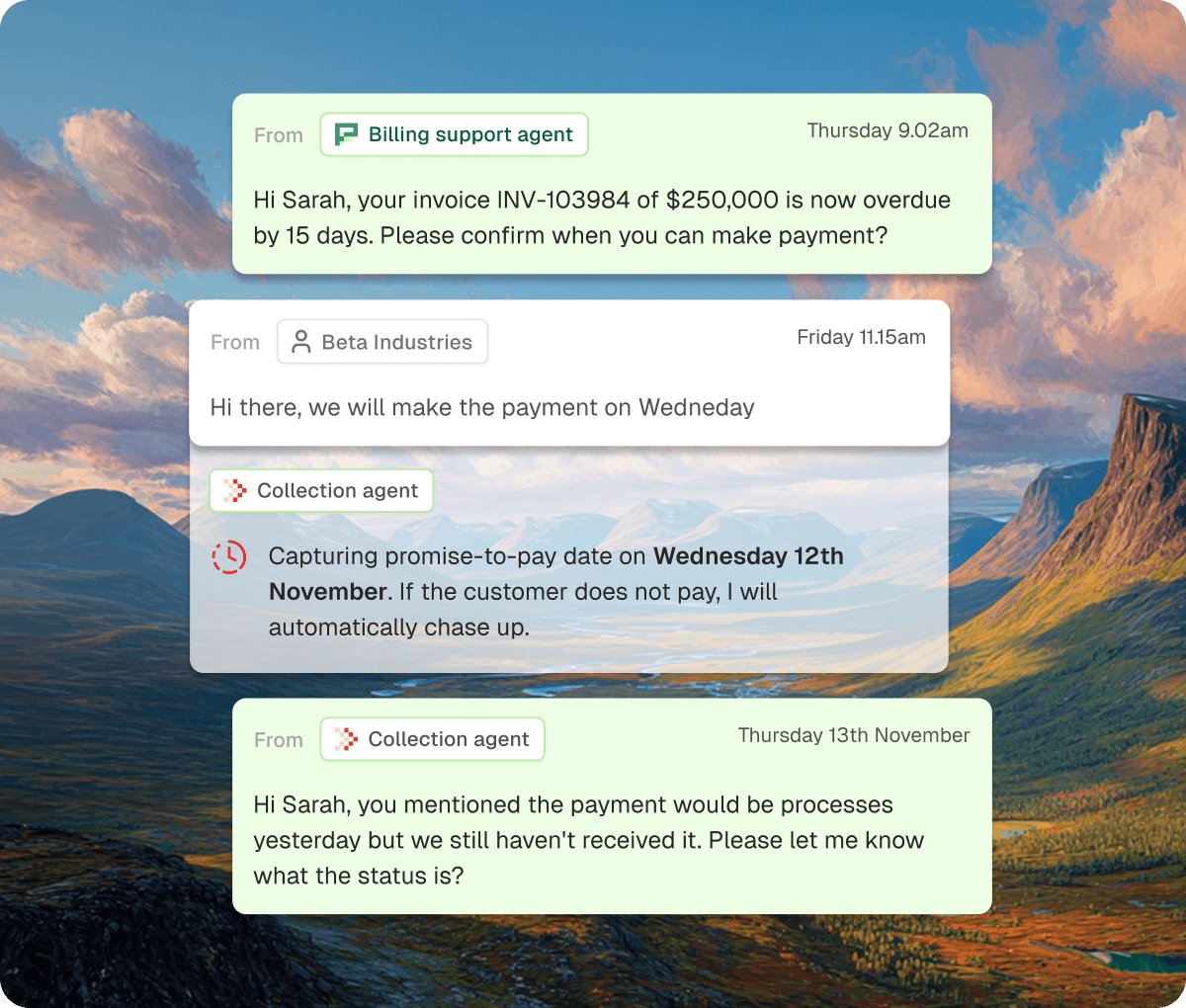
Promise-to-pay tracking and follow-up
Account-level coordination across multiple invoices
Best suited for:
Mid-market and enterprise B2B organisations with high invoice volume, frequent customer replies, or complex approval workflows.
Limitations:
May be unnecessary for very simple AR environments with low interaction.
5. Enterprise collections suites (Dunning as a module)
In large enterprises, dunning is often part of a broader accounts receivable or order-to-cash suite that includes credit management, cash application, and forecasting.
Key characteristics:
Centralised AR operations
Advanced analytics and reporting
Heavy configuration and implementation
Best suited for:
Large, global organisations prioritising standardisation and control across AR functions.
Limitations:
Dunning execution is often still workflow-driven, and adapting to conversational complexity can be slow.
While all dunning software automates follow-ups to some degree, the main difference lies in how each type handles customer replies, exceptions, and decision-making as complexity increases.
Collecting faster in 2026 with agentic dunning software
Agentic dunning software transforms accounts receivable operations by automating routine communications and follow-ups while maintaining control over exceptions. These platforms allow AR teams to work smarter, not harder, and focus on high-value accounts that truly require human attention.
Key capabilities include:
Two-way communication automation: AI agents manage ongoing conversations with customers directly in email threads, handling routine queries and follow-ups.
Promise-to-pay tracking: Commitments are logged automatically, and follow-ups are triggered at the right time.
Information retrieval: Missing purchase orders, approvals, or invoice details are collected without manual effort.
Prioritisation and personalisation: Messaging and follow-up sequences are tailored based on invoice size, customer behaviour, and account importance.
Escalation management: Exceptions are flagged and routed to human staff only when intervention is needed.
Examples of dunning emails: Traditional vs agentic
Traditional dunning email example
Subject: Past Due Invoice Reminder
This is a reminder that invoice #12345 is overdue. Please remit payment as soon as possible.
This approach provides no context, no acknowledgment of blockers, and no path to resolution.
Agentic dunning conversation example
Subject: Quick check on invoice #12345
Hi Sarah, just checking in on invoice #12345, due last week. Let us know if it’s pending approval, needs correction, or if there’s anything we can help unblock.
Replies are automatically categorized, routed, and resolved through structured workflows.
The difference between traditional and agentic dunning comes down to how each approach treats the customer. Traditional dunning assumes payment delays stem from negligence and responds with impersonal reminders. Agentic dunning recognises that most delays are operational—approvals stuck in queue, missing PO numbers, disputed line items—and opens a two-way channel to surface and resolve those issues. The result isn't just faster payment; it's a collections process that strengthens customer relationships rather than straining them, while giving finance teams the context they need to prioritise effort where it matters most.
How to Choose the Right Dunning Software for Your B2B Team
Factors to consider:
Invoice Volume: Fewer invoices → rule-based; high volume → AI-agentic.
Reply Volume: Many customer queries → two-way automation is critical.
Operational Complexity: Multi-stakeholder approvals, missing POs → AI-agentic reduces manual handling.
Team Resources: Limited headcount → automation improves efficiency and reduces errors.Key features to look for in dunning software
When finance teams evaluate dunning software, feature checklists alone are rarely helpful. Most platforms can send reminders. The real differentiators are how well a system handles volume, variation, and customer interaction as invoice counts grow.
The features below reflect what consistently matters in practice for B2B teams managing overdue invoices at scale.
Segmented, behaviour-based dunning workflows
Effective dunning software allows teams to tailor follow-up strategies by customer value, country, payment behaviour, and historical responsiveness. This includes adjusting timing, tone, and escalation logic automatically, with stricter handling for habitual late payers and more flexible approaches for strategic accounts.
Without segmentation, teams are forced into one-size-fits-all workflows that either create friction or leave cash uncollected.
Two-way communication and reply handling
One-way reminder automation breaks down as soon as customers reply. Modern dunning software must capture, classify, and route inbound responses so questions, disputes, and requests do not stall payment cycles.
Platforms that automate two-way communication reduce inbox backlog, shorten response times, and prevent invoices from ageing simply because no one replied.
Automation of the Full Follow-Up Conversation
Beyond sending emails, advanced systems automate the entire follow-up sequence, including clarification requests, document sharing, and status updates. This reduces the manual coordination typically required across email, ERP notes, and spreadsheets.
AI-assisted platforms increasingly handle routine conversations end to end, escalating only when human judgement is required.
Promise-to-pay capture and tracking
Capturing promises to pay is only useful if those commitments are tracked and enforced. Strong dunning tools log commitments, monitor whether payments arrive as agreed, and trigger follow-ups automatically when they do not.
This provides more operational insight than ageing buckets alone and improves accountability on both sides.
ERP, billing, and CRM integration
Dunning software should integrate cleanly with existing finance systems to ensure invoice status, payment updates, and customer data remain consistent. Manual syncing or duplicate data entry quickly erodes the value of automation.
Integration depth directly affects implementation speed and ongoing maintenance effort.
Escalation logic and compliance controls
Escalation should be structured, auditable, and aligned with internal policy and regulatory requirements. Teams need visibility into when and why accounts move to stricter follow-up, as well as the ability to pause or override automation when needed.
This is particularly important in multi-region or regulated environments.
Reporting on overdue drivers, not just ageing
Basic ageing reports show what is overdue, not why. The most useful platforms surface patterns in disputes, response delays, broken promises, and customer behaviour.
This insight allows teams to fix upstream issues and improve cash flow predictability over time.
Platforms like Paraglide put these capabilities into practice. Our AI agents take over the busywork of high-volume B2B collections, allowing teams to reduce Days Sales Outstanding (DSO), improve cash predictability, and focus on strategic accounts. Unlike one-way, templated reminders, Paraglide manages the full two-way conversation, dynamically adapting messages and ensuring communications reach the right stakeholders.
Final thoughts
B2B collections in 2026 is no longer about sending generic reminders. High-volume AR teams now rely on AI-agentic dunning software to automate routine communications, track promises-to-pay, and manage exceptions at scale.
By integrating with ERP, billing, and CRM systems, these platforms provide a single source of truth for every invoice, streamline follow-ups, and ensure that the right stakeholders receive the right messages at the right time. Finance teams can focus on high-value accounts, reduce Days Sales Outstanding (DSO), and lower write-offs — all while maintaining control and visibility.
Platforms like Paraglide show how AI agents can transform AR operations: handling day-to-day billing conversations, managing responses automatically, and freeing teams to focus on strategic priorities.